⚡ Voltage Drop Calculator
Calculate voltage drop, wire gauge, and conductor size for any electrical circuit — NEC compliant results
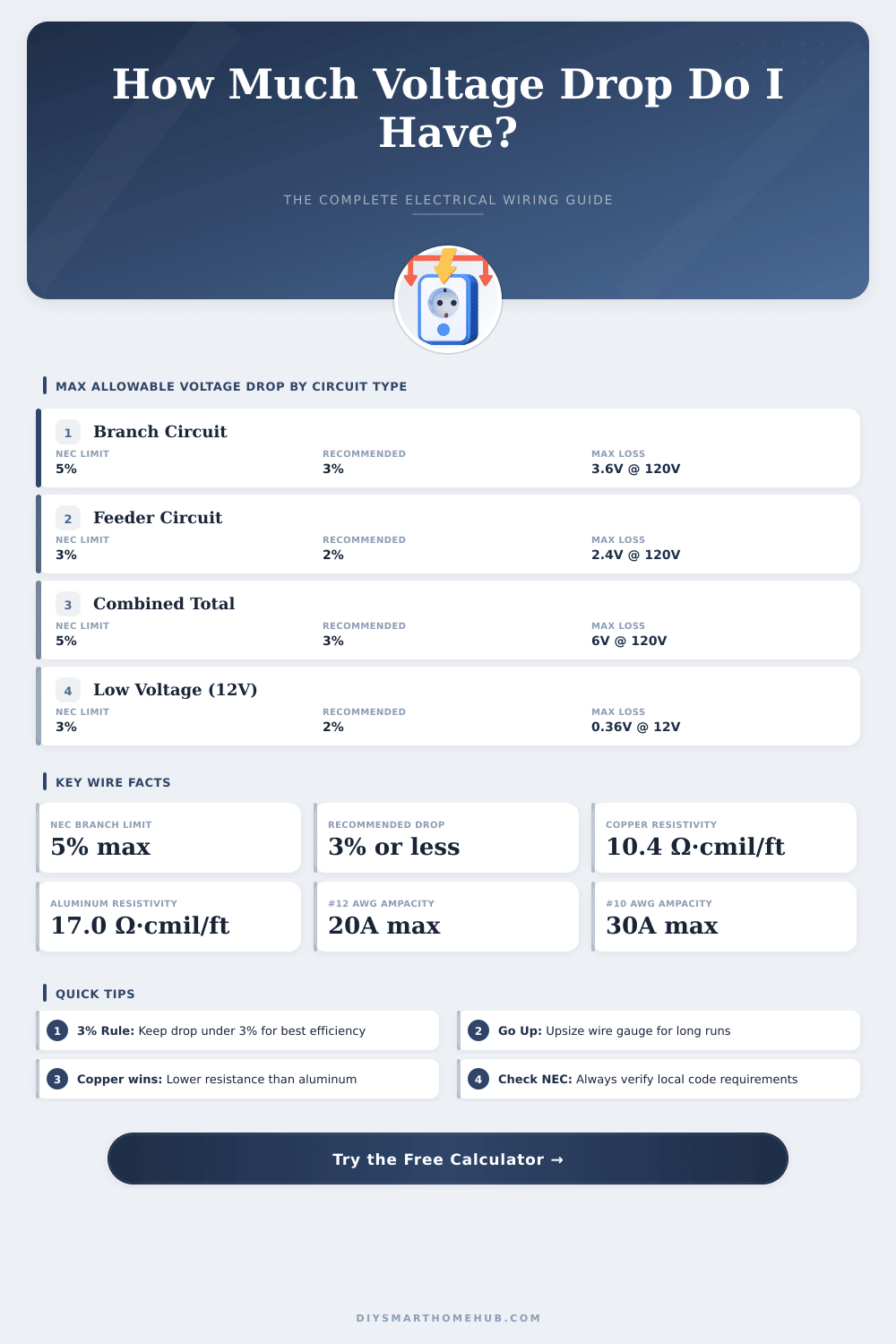
| Circuit Type | NEC Max | Recommended | @ 120V Max Loss | @ 240V Max Loss |
|---|---|---|---|---|
| Branch Circuit | 5% | 3% Best | 6.0V | 12.0V |
| Feeder Circuit | 3% | 2% | 3.6V | 7.2V |
| Branch + Feeder Combined | 5% | 3% | 6.0V | 12.0V |
| DC Low Voltage (12V) | 3% | 2% | 0.36V | 0.72V |
| DC Low Voltage (24V) | 3% | 2% | 0.72V | 1.44V |
| AWG | Copper Ω/1000ft | Alum Ω/1000ft | Copper mm² equiv. | Max Amps (Cu) | Max Amps (Al) |
|---|---|---|---|---|---|
| 18 AWG | 6.385 | 10.45 | 0.82 mm² | 7A | — |
| 16 AWG | 4.016 | 6.57 | 1.31 mm² | 13A | — |
| 14 AWG | 2.525 | 4.13 | 2.08 mm² | 15A | — |
| 12 AWG | 1.588 | 2.60 | 3.31 mm² | 20A | — |
| 10 AWG | 0.9989 | 1.64 | 5.26 mm² | 30A | — |
| 8 AWG | 0.6282 | 1.03 | 8.37 mm² | 40A | 30A |
| 6 AWG | 0.3951 | 0.648 | 13.3 mm² | 55A | 40A |
| 4 AWG | 0.2485 | 0.408 | 21.2 mm² | 70A | 55A |
| 2 AWG | 0.1563 | 0.256 | 33.6 mm² | 95A | 75A |
| 1/0 AWG | 0.09827 | 0.161 | 53.5 mm² | 125A | 100A |
| 2/0 AWG | 0.07793 | 0.128 | 67.4 mm² | 145A | 115A |
| 3/0 AWG | 0.06180 | 0.101 | 85.0 mm² | 165A | 130A |
| 4/0 AWG | 0.04901 | 0.0804 | 107 mm² | 195A | 150A |
| AWG (Cu) | 15A @ 120V | 20A @ 120V | 30A @ 240V | 50A @ 240V |
|---|---|---|---|---|
| 14 AWG | 57 ft | 43 ft | — | — |
| 12 AWG | 92 ft | 69 ft | — | — |
| 10 AWG | 146 ft | 109 ft | 145 ft | — |
| 8 AWG | 231 ft | 173 ft | 231 ft | — |
| 6 AWG | 368 ft | 276 ft | 368 ft | 221 ft |
| 4 AWG | 584 ft | 438 ft | 584 ft | 351 ft |
Voltage Drop means the loss of electrical power that appears when current flows pass through wire. Electrical energy that moves through wire receives push of voltage and must beat contrary force that the wire creates. That contrary force uses part of the energy, and the amount of that loss calls Voltage Drop.
The thing happens as current flows go through circuit. If the current stays steady through resistant parts, that causes fall across each of them. In the field of electronics Voltage Drop describes the drop of electrical power along the path of common current in circuit.
What Is Voltage Drop and How to Reduce It
Such falls show at the power source, through cables, at contacts and at connectors. That lost energy one considers small, because it dumps part of the available power.
The level of Voltage Drop depends on several things. Usually one uses copper for wires, although sometimes aluminum. Also the thickness of the wire matters.
Know, that 10-gauge wire is fatter than 14-gauge. Moreover, the length of the wire path plays big role. Wire long fifty feet will lose doubly more voltage than one of only twenty-five feet.
Wires of biggre caliber have fewer resistance each unit of length, what helps to reduce the fall.
Current has mainstream influence on it. Bigger current cause stronger Voltage Drop. Without some current there is no Voltage Drop.
There are several ways to control it. One can use thicker cables, lower the current in the end of circuit or expand the voltage at the origin.
The NEC advises to not pass 5-percent Voltage Drop from the mainstream panel too the device under full load. It splits in 2 percentages allowed for feeding circuits and 3 percentages for branch circuits. Voltage Drop is not a required coded rule, but only advice.
Too high fall can lead to warming, buildup of heat and problems with running. High resistance in connection, that causes Voltage Drop, even risk to trigger fire.
Voltage Drop itself is not really dangerous in its base. If the falls happen only while very short time, one not even considers it wrong state, that requires fixing. Even so it stays loss in the whole system and show as poor results.
Grasping it is needed during planning of electrical setup, although it is not theme for everyday chatter.
Bad connections are common problems. Bad connection has resistance and cause resistant fall across itself. Neglect bad connection, even if only moment, cancreate important troubles over the time.