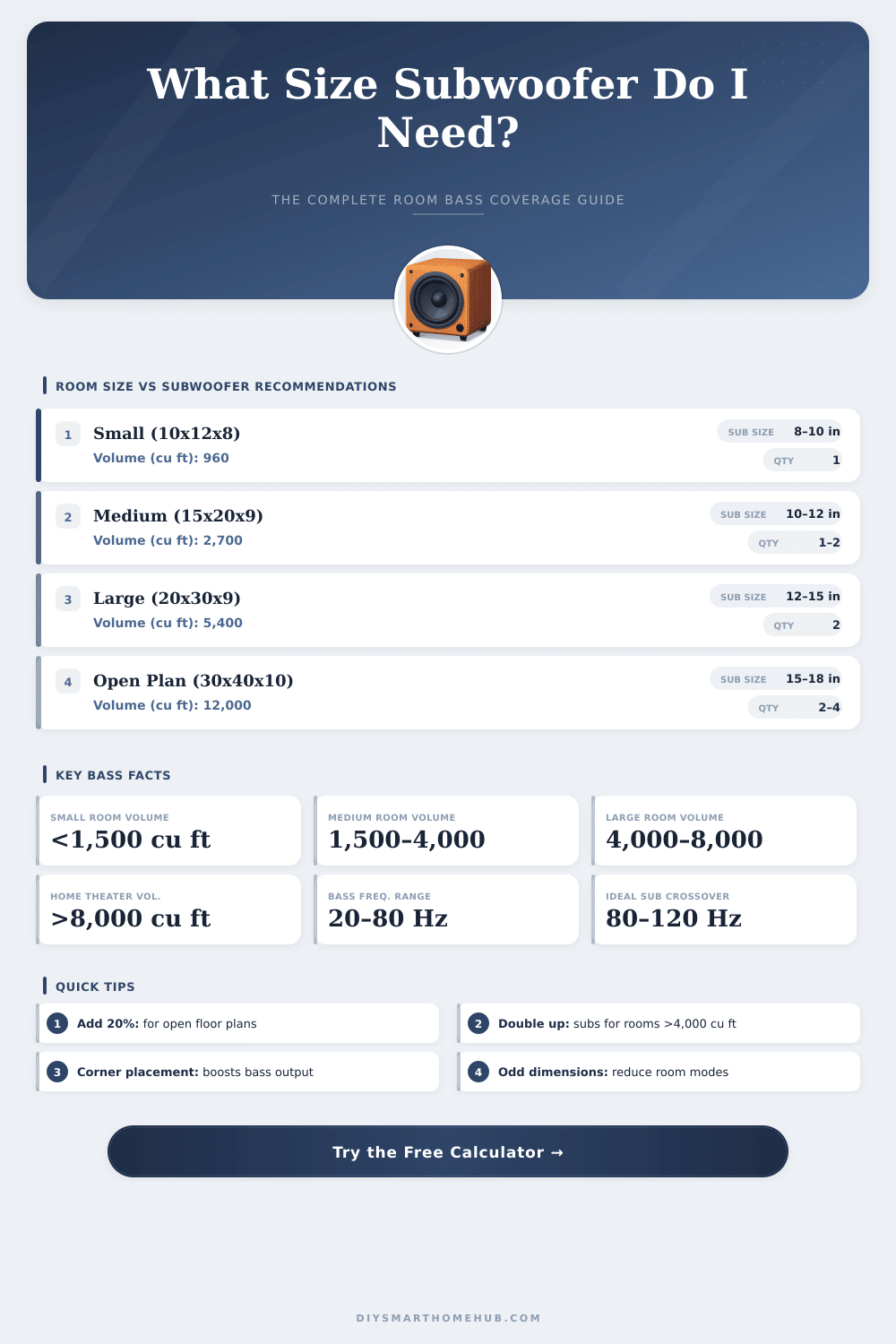
🔊 Subwoofer Room Size Calculator
Find the ideal subwoofer size and quantity for your room dimensions and listening environment.
| Sub Size | Ideal Room Volume | Freq. Range | Typical Power | Notes |
|---|---|---|---|---|
| 8 inch | < 1,000 cu ft | 35–150 Hz | 100–200W | Tight spaces, music focus |
| 10 inch | 800–2,000 cu ft | 28–120 Hz | 150–300W | Versatile, most bedrooms |
| 12 inch | 1,500–4,500 cu ft | 22–100 Hz | 200–500W | Most popular home theater |
| 15 inch | 3,500–8,000 cu ft | 18–80 Hz | 400–800W | Large rooms, cinematic bass |
| 18 inch | 6,000–15,000 cu ft | 16–60 Hz | 600–1,500W | Professional, great rooms |
| 21 inch | > 12,000 cu ft | 14–50 Hz | 1,000–3,000W | Commercial, concert venues |
| Room (LxW) | 8 ft Ceiling (cu ft) | 9 ft Ceiling (cu ft) | 10 ft Ceiling (cu ft) | Recommended |
|---|---|---|---|---|
| 10 x 10 ft | 800 | 900 | 1,000 | 8–10 inch x1 |
| 12 x 14 ft | 1,344 | 1,512 | 1,680 | 10 inch x1 |
| 15 x 18 ft | 2,160 | 2,430 | 2,700 | 10–12 inch x1 |
| 20 x 20 ft | 3,200 | 3,600 | 4,000 | 12 inch x1–2 |
| 20 x 30 ft | 4,800 | 5,400 | 6,000 | 12–15 inch x2 |
| 30 x 40 ft | 9,600 | 10,800 | 12,000 | 15–18 inch x2–4 |
| Room Type | Volume Multiplier | Effect on Bass | Adjustment |
|---|---|---|---|
| Fully Enclosed | x 1.0 | Bass reinforcement | Standard sizing |
| Semi-Open (1 wall) | x 1.4 | Some bass loss | Upsize or add 1 sub |
| Open Plan (2+ sides) | x 1.8 | Significant bass loss | Upsize 1–2 sizes |
| Outdoor / Patio | x 3.0 | Major bass loss | Multiple large subs |
| Absorption Level | Multiplier | Examples | Tip |
|---|---|---|---|
| Hard Surfaces | x 0.9 | Tile, concrete, glass | Slight oversize (room modes) |
| Mixed / Standard | x 1.0 | Drywall, wood, carpet | Use standard recommendation |
| Acoustically Treated | x 1.1 | Panels, bass traps | Slight upsize for flat response |
| Heavy Furnishings | x 1.15 | Thick drapes, sofas, rugs | Upsize slightly |
The size of the room plays an important role when you choose the right subwoofer. The bigger the room the louder subwoofer needed to play to reach target levels without distortion. In large rooms with open floor plans and high sloping ceilings, you usually need a more powerful subwoofer to give enough output.
And not only the size matters: also how loudly you are used to listen. If you want to truly feel the bass during action films, that commonly means to look at more powerful models.
How to choose the right subwoofer for your room
When you measure a room for subwoofer targets, cubic feet are much more useful than square feet. A room of 25 by 15 feet with a 10-foot ceiling indeed can be more easily filled with bass than a room of 20 by 10 feet with a 30-foot ceiling. That extra ceiling height adds a lot of extra volume.
One can roughly share room sizes like this: small rooms are under 1,500 cubic feet, medium are 1,500 to 3,000 cubic feet, big are 3,000 to 5,000 cubic feet, and huge rooms pass 5,000 cuibc feet.
Subwoofers typically range from 8 inches to 18 inches. Bigger sizes can produce deeper and stronger bass. Even so bigger does not always mean better.
The right size depends much on the room. In a tiny room, for instance 8 by 10 feet, a 15-inch sub maybe is not the best choice. Smaller subwoofers commonly feel faster and they more easily reach higher frequencies.
It is a common notion that bigger or ported subwoofers are “slower” than smaller sealed ones. That actually is a misunderstanding. DSP setup and right placing matters much more.
In a small room, the room gain helps too strengthen the bass under around 30 Hz, so sealed subs can work very well here.
Open floor plans complicate the cause. The whole space maybe is 40 feet deep, but the listening spot can be only 12 to 16 feet away from the subwoofer. Compared with 25 feet, a subwoofer delivers bigger output at 12 feet from the listening position.
A good guideline for open spaces is: if the opening to the next area is less than half of the length of the longest wall, one does not need to count the next space in the room volume. If the opening is bigger, then include it.
Using several subwoofers helps to smooth the bass, almost regardless of the room size. At least two subs help to smooth “nulls”. The size and shape of the room decides where one should place them.
Also the quality of the product very much matters. A well made 10-inch sub can beat a cheap bigger one. For instance, one 10-inch model only goes to 30 Hz, while another 10-inch model reaches 19 Hz.
Anything smaller than 10 inches usually is meant forvery tiny rooms.