🔥 Heat Load Calculator
Calculate BTU requirements for any room or building — instant, accurate results
Zone 1 Hot
Zone 3 Mixed
Zone 5 Cool
Zone 7 Very Cold
Occupant
South-Facing
Insulation
Insulation
| Room / Area | Sq Ft | Sq M | BTU / hr (avg) | Tons | kW |
|---|---|---|---|---|---|
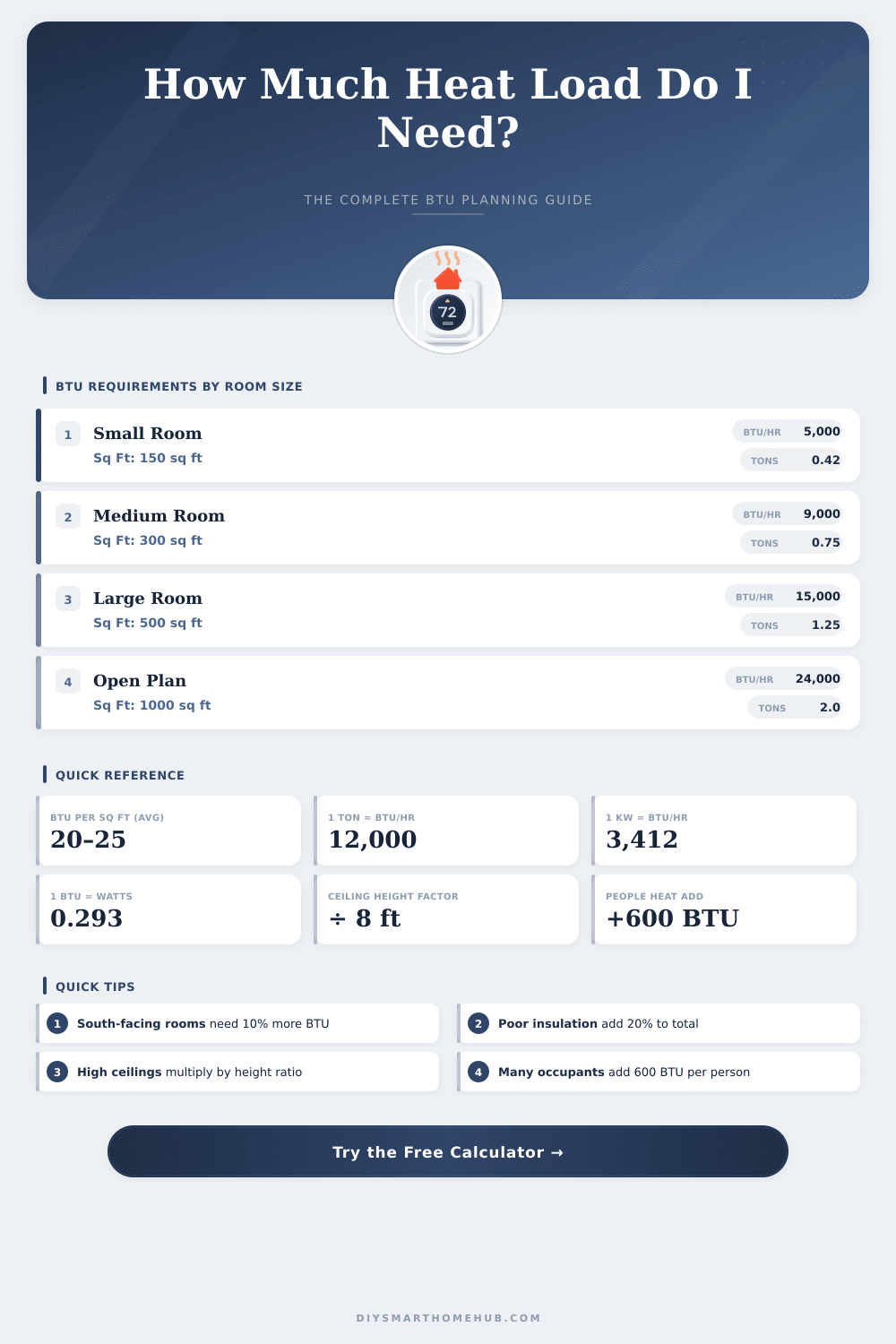
| Small Bedroom | 100–150 | 9–14 | 5,000 | 0.42 | 1.47 |
| Medium Bedroom | 150–250 | 14–23 | 6,000–8,000 | 0.5–0.67 | 1.76–2.34 |
| Large Bedroom | 250–350 | 23–33 | 8,000–10,000 | 0.67–0.83 | 2.34–2.93 |
| Living Room | 300–500 | 28–46 | 9,000–15,000 | 0.75–1.25 | 2.64–4.40 |
| Open Plan | 500–800 | 46–74 | 15,000–22,000 | 1.25–1.83 | 4.40–6.45 |
| Whole Home (small) | 800–1,200 | 74–111 | 18,000–30,000 | 1.5–2.5 | 5.28–8.79 |
| Whole Home (medium) | 1,200–2,000 | 111–186 | 30,000–48,000 | 2.5–4.0 | 8.79–14.07 |
| Whole Home (large) | 2,000–3,000 | 186–279 | 48,000–72,000 | 4.0–6.0 | 14.07–21.09 |
| BTU / hr | Tons | kW (Thermal) | Watts | Approx. Use |
|---|---|---|---|---|
| 5,000 | 0.42 | 1.47 | 1,465 | Small bedroom |
| 9,000 | 0.75 | 2.64 | 2,637 | Medium room |
| 12,000 | 1.0 | 3.52 | 3,517 | 1 ton standard |
| 18,000 | 1.5 | 5.28 | 5,275 | Large living area |
| 24,000 | 2.0 | 7.03 | 7,034 | Open plan / 1,000 sq ft |
| 36,000 | 3.0 | 10.55 | 10,551 | Small home |
| 48,000 | 4.0 | 14.07 | 14,068 | Medium home |
| 60,000 | 5.0 | 17.58 | 17,584 | Large home |
| Zone | Description | BTU / sq ft | Example Locations |
|---|---|---|---|
| Zone 1 | Hot & Humid | 20–22 | Florida, Gulf Coast, Hawaii |
| Zone 2 | Hot & Dry | 22–24 | Arizona, Nevada, S. California |
| Zone 3 | Mixed Warm | 24–26 | Mid-Atlantic, Pacific Coast |
| Zone 4 | Mixed Cool | 26–28 | Midwest, Mountain West |
| Zone 5 | Cool | 28–32 | Northeast, Great Lakes |
| Zone 6 | Cold | 32–35 | Northern States, High Altitude |
| Zone 7 | Very Cold | 35–38 | N. Minnesota, Maine, Alaska |
| Factor | Condition | BTU Adjustment | Notes |
|---|---|---|---|
| Insulation | Poor (pre-1980) | +20% | Single-layer walls, no attic insulation |
| Insulation | Average (standard) | 0% | Code-minimum R-13 walls, R-30 attic |
| Insulation | Good (above code) | –10% | R-21 walls, R-49 attic, sealed envelope |
| Insulation | Excellent (spray foam) | –15% | R-30+ walls, R-60 attic, energy star |
| Windows | Single pane | +15% | High heat gain/loss through glass |
| Windows | Double pane | 0% | Standard low-E double pane |
| Windows | Triple pane | –8% | Argon-filled, low-E triple pane |
| Sun Exposure | Sunny/South-facing | +10% | Higher solar heat gain in summer |
| Sun Exposure | Shaded | –10% | Trees, overhangs block solar gain |
| Ceiling Height | Above 8 ft | Multiply | Factor = actual height / 8 |
warm heavy calculators help you exactly find out how many heating or cooling requires your building. They do that by rating of warm prize and heat load in your home or business place, what allows you to size your HVAC-system exactly instead of simply guessing. Everything depends on how well insulated is your building and on the climate that you must work with.
Free online versions are available that helps you quickly estimate your needs for heating and cooling in rooms according to your own plan and designs. The majority of those tools are done to be easily usable. Common mode is the method based on square feet, that considers your insulation level, windows, doors and other important parts.
How Free Online Calculators Help Size Your Heater or Air Conditioner
Many of them start with default values for instance 72-degree standard temperature.
Those tools gather data about square footage, ceiling heights, doors and windows, number of people in the space and your local climate, to estimate the right size of HVAC-system. Many of them base on Manual J-calculations, that sets the needed BTU for heating and cooling of whole house as one whole. Start is eaisy, first you choose your state or province, later you specify your city.
Beyond the general, you will find more special calculators. Here one, designed specially for storage rooms, that considers sizes, insulation quality and seals in various temperatures. It even includes product pull-downs and breathing burdens, what is very practical.
Other calculator estimates the needed BTU to warm ore cool space according to that, how far you want to change the temperature from outside to inside.
Some BTU-calculators go more far and think about everything involved… Climate region, square area, ceiling height, insulation quality, sun exposure, living load and all that kitchen heat output. To ensure low-carbon heating setups, there is online tool, that leads you through doing of detailed heat load calculation, that is needed for heat pumps and biomass setups according to standards.
The basic rule to estimate heat load is simple: you multiply the flow reading by the specific heat capacity, later multiply that by your temperature change. For electric heaters it is direct, every watt of energy gives 3.412 BTU. Natural gas is a bit different; you find the input BTU on the nameplate of the device, but that, what indeed becomes usable heat, will be less than that value.
Some homeowners tested different methods one against the other, comparing professional Manual J-ratings with their own calculations based on actual fuel use and heating degree days. In one real case the fuel use method matched with Manual J almost perfectly at around 30,000 BTU each hour. Calculations of heat load and heat load do mainly the same task, when you size boilers for warm water systems.
These calculators also help toestimate capacity of boilers or air conditioners and amount of fuel savings from different insulation upgrades over time.