⚡ 12V DC Voltage Drop Calculator
Calculate wire voltage loss for 12-volt DC systems — automotive, solar, marine, RV & low-voltage lighting
Max 85A
Max 40A
Max 30A
Max 20A
Max 15A
Max 10A
Max 7A
Max 3A
| Wire Gauge | 10 ft (3m) | 25 ft (7.6m) | 50 ft (15.2m) | 100 ft (30.5m) | % Drop @50ft |
|---|---|---|---|---|---|
| 4 AWG | 0.10V | 0.25V | 0.50V | 0.99V | 4.1% |
| 6 AWG | 0.16V | 0.39V | 0.79V | 1.57V | 6.6% |
| 8 AWG | 0.20V | 0.50V | 1.00V | 1.99V | 8.3% |
| 10 AWG | 0.20V | 0.50V | 1.00V | 2.00V | 8.3% |
| 12 AWG | 0.32V | 0.79V | 1.59V | 3.18V | 13.2% |
| 14 AWG | 0.51V | 1.26V | 2.53V | 5.05V | 21.1% |
| 16 AWG | 0.80V | 2.01V | 4.02V | 8.03V | 33.5% |
| 18 AWG | 1.28V | 3.19V | 6.39V | 12.77V | 53.2% |
| Cross-Section | Ω/meter | Max Current | AWG Approx. | Common Use |
|---|---|---|---|---|
| 1.0 mm² | 0.0180 | 10A | ~18 AWG | Sensors, signals |
| 1.5 mm² | 0.0120 | 13A | ~16 AWG | Lighting circuits |
| 2.5 mm² | 0.0073 | 18A | ~14 AWG | General wiring |
| 4.0 mm² | 0.0046 | 25A | ~12 AWG | High draw loads |
| 6.0 mm² | 0.0031 | 32A | ~10 AWG | Heavy loads, winches |
| 10 mm² | 0.0018 | 50A | ~8 AWG | Solar, inverters |
| 16 mm² | 0.00115 | 63A | ~6 AWG | Battery cables |
| 25 mm² | 0.00072 | 80A | ~4 AWG | Starter cables |
| Application | Max Allowed Drop | Max Drop on 12V | Standard |
|---|---|---|---|
| Automotive (electronics) | 3% | 0.36V | SAE J1128 |
| Marine (ABYC) | 3% critical / 10% non-critical | 0.36V / 1.2V | ABYC E-11 |
| Solar / Off-grid | 3% (charge) / 1% (sensitive) | 0.36V | NEC 690 |
| Low-voltage lighting | 5–10% | 0.60–1.2V | NEC 411 |
| Motors / Pumps | 5% | 0.60V | NEC 430 |
| Sensitive electronics | 1–2% | 0.12–0.24V | Manufacturer spec |
| General DC circuits | 3% | 0.36V | General practice |
| Telecom / Data | 1% | 0.12V | TIA-568 |
| AWG | Diameter (mm) | Area (mm²) | Resistance (Ω/m) | Closest Metric |
|---|---|---|---|---|
| 4 AWG | 5.19 | 21.15 | 0.000815 | 25 mm² |
| 6 AWG | 4.11 | 13.30 | 0.001296 | 16 mm² |
| 8 AWG | 3.26 | 8.37 | 0.002060 | 10 mm² |
| 10 AWG | 2.59 | 5.26 | 0.003277 | 6 mm² |
| 12 AWG | 2.05 | 3.31 | 0.005211 | 4 mm² |
| 14 AWG | 1.63 | 2.08 | 0.008286 | 2.5 mm² |
| 16 AWG | 1.29 | 1.31 | 0.01318 | 1.5 mm² |
| 18 AWG | 1.02 | 0.823 | 0.02095 | 1.0 mm² |
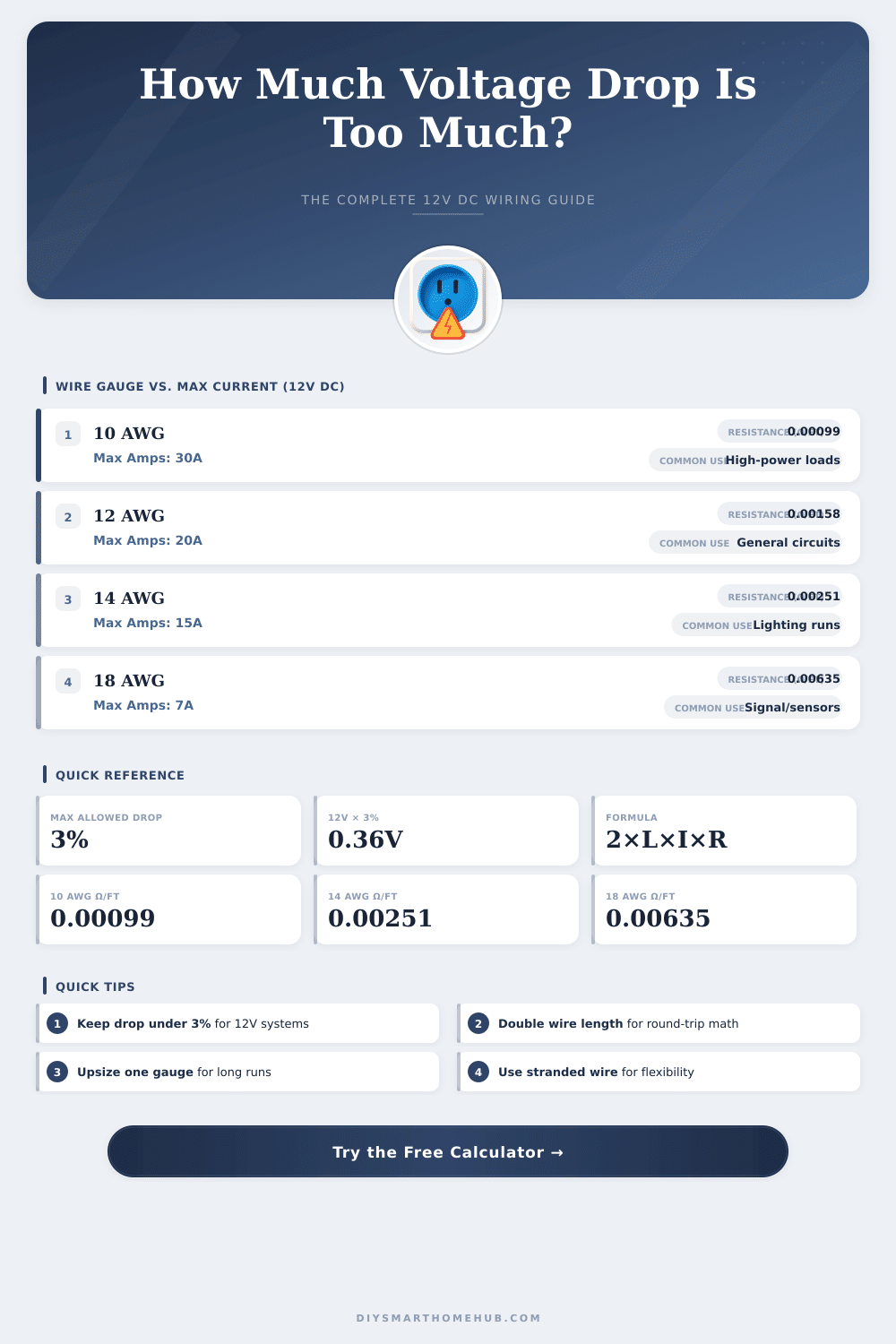
For two-wire: VD = 2 × L × I × R | For single-wire (chassis ground): VD = 1 × L × I × R
Percentage drop = (VD / Source Voltage) × 100. Voltage at load = Source Voltage – VD.
12V DC-system is very sensitive about Voltage drop. If you run 12V-wires during 10, 20, 50, 100 or even 200 feet, that can cause big Voltage drop. Compared to 120V or 220V setups, 12V ranks between the lowest levels so that the trouble gets much more severe.
During usage of 12V, one can only handle tiny Voltage drop, while some volts of loss would be normal at 120V. For same energy, the electricity at 12V is tenfold higher than at 120V, and it does not depend on that, if the setup is AC or DC.
Voltage Drop in 12V DC Systems
Voltage drop in the wires leads to energy loss in form of heat. The cables make more heat, and the Voltage at the device ends quite a lot more low than at the source. The most many electrical devices operate in range of their rated Voltage, but at 12V things become tneder because of the little margin for mistakes.
Even well installed 12V DC-circuit suffers Voltage drop problems during the time pass. Resistance grows because of corrosion in end points at any break of the line and in junction boxes along the way. Every connection, clip and fuse add their own amount of Voltage drop.
For important circuits, keeping the loss under 3 percent is good practice.
There are practical cable calculators, that show the total Voltage drop based on cable thickness, supply Voltage, current use and cable distance. That type of resource works for DC-circuits, that includes solar setups, battery-banks, automotive wiring and low-Voltage power supply. They were made for 12V, 24V, 48V and even higher DC-Voltages.
Charts about 12V DC and 24V AC Voltage drop together with maximum cable distance also are useful four plan safe camera systems and other low-Voltage works.
Here is a real sample from life. Camera of 300 mA in 100 feet on typical 18 AWG-cable at 12V DC gets Voltage drop of around 0.38 volts. The industry standards allow plus-minus 10 percent, what matches to 1.2 volts.
Beyond that: for 120 watts at 12V, the electricity reaches 10 amps. When the cables own total resistance of 0.1 ohm, that loss is 1 volt.
When dealing with inverters, Voltage drop is big cause. Running of 12V inverter at around 1000 until 1500 watts gets really hard. Handling of 275 amps from battery use for 12V, 3 kVA inverter is a challenge.
When the DC-input of the inverter loses Voltage, it needs even more electricity to keep the AC-output stable. Fully charged battery stays around 12.6 until 12.7 volts, and going under 12 volts makes issues. Good battery should not drop until 10 volts only because of turning on some lamps.
The standard Voltage of 13.8 commonly serves as base for vehicle during the alternator charge. Choose low percent of Voltage drop for important loads aselectronic controls and engines is a wise step.