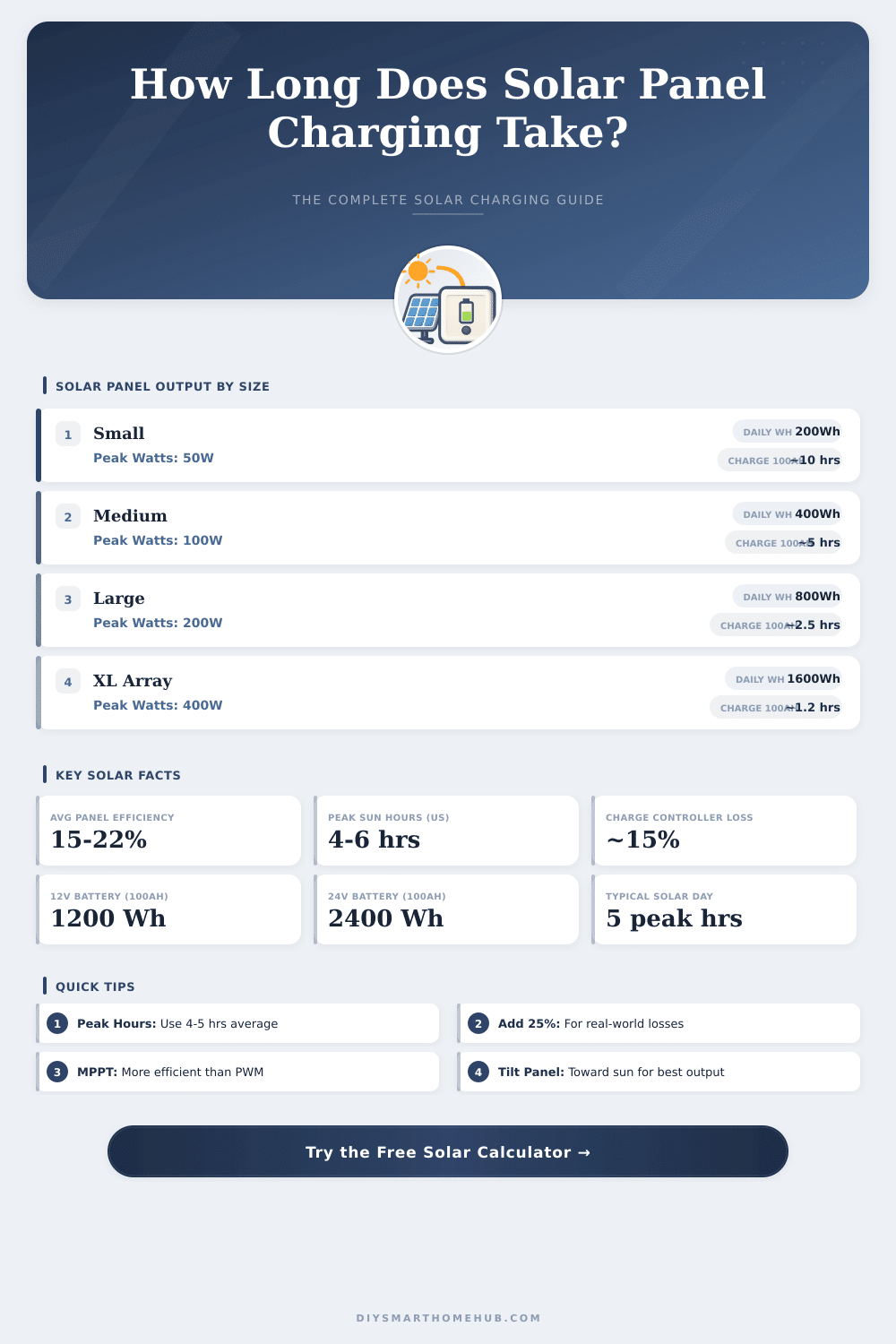
☀️ Solar Panel Charging Time Calculator
Calculate exactly how long your solar panel will take to charge any battery — enter your panel watts, battery capacity, and sun hours.
| Panel Size (W) | Daily Output (Wh) at 5 hrs | Charge 100Ah 12V (hrs) | Charge 200Ah 12V (hrs) |
|---|---|---|---|
| 20W | 100 Wh | ∼72 hrs | ∼144 hrs |
| 50W | 250 Wh | ∼29 hrs | ∼57 hrs |
| 100W | 500 Wh | ∼14.4 hrs | ∼29 hrs |
| 150W | 750 Wh | ∼9.6 hrs | ∼19 hrs |
| 200W | 1,000 Wh | ∼7.2 hrs | ∼14.4 hrs |
| 300W | 1,500 Wh | ∼4.8 hrs | ∼9.6 hrs |
| 400W | 2,000 Wh | ∼3.6 hrs | ∼7.2 hrs |
| 500W | 2,500 Wh | ∼2.9 hrs | ∼5.8 hrs |
| 600W | 3,000 Wh | ∼2.4 hrs | ∼4.8 hrs |
| Battery (Ah / V) | 100W Panel | 200W Panel | 400W Panel |
|---|---|---|---|
| 50Ah / 12V (LiFePO4) | ∼1.4 days | ∼0.7 days | ∼0.4 days |
| 100Ah / 12V (LiFePO4) | ∼2.8 days | ∼1.4 days | ∼0.7 days |
| 100Ah / 12V (AGM) | ∼3.4 days | ∼1.7 days | ∼0.9 days |
| 200Ah / 24V (LiFePO4) | ∼11 days | ∼5.5 days | ∼2.8 days |
| 200Ah / 12V (LiFePO4) | ∼5.5 days | ∼2.8 days | ∼1.4 days |
| 400Ah / 48V (LiFePO4) | ∼43 days | ∼22 days | ∼11 days |
| Region | Avg Peak Sun Hrs/Day | Season Range | Best Month Avg |
|---|---|---|---|
| Southwest (AZ, NM, NV) | 6.0 – 7.5 hrs | 5.5 – 8.0 | July: 7.5 |
| Southeast (FL, GA, TX) | 5.0 – 6.5 hrs | 4.0 – 7.0 | June: 6.5 |
| Midwest (OH, IL, MI) | 4.0 – 5.0 hrs | 2.5 – 6.0 | June: 5.5 |
| Northeast (NY, MA, PA) | 4.0 – 4.7 hrs | 2.0 – 5.5 | June: 5.0 |
| Northwest (WA, OR) | 3.0 – 4.5 hrs | 1.5 – 6.0 | July: 5.5 |
| Alaska | 2.5 – 3.5 hrs | 0.5 – 5.5 | June: 5.5 |
| Hawaii | 5.5 – 7.0 hrs | 4.5 – 7.5 | June: 7.0 |
| Temp (°F / ℃) | Output vs. Rated | Power Derate | Notes |
|---|---|---|---|
| 32°F / 0°C | +5 to +10% | None (boost) | Cold improves output |
| 77°F / 25°C | 100% (rated) | 0% | STC test condition |
| 95°F / 35°C | ∼94% | –6% | Mild reduction |
| 113°F / 45°C | ∼88% | –12% | Ventilate panels |
| 131°F / 55°C | ∼82% | –18% | Elevated risk zone |
| 149°F / 65°C | ∼76% | –24% | High heat performance hit |
Solar panel priming delivers good mode for possible devices to use sunlight. Clouds limit the energy, that panels can generate. Moreover every grade Celsius above 25°C cause loss of around 0.5 percent of production.
For best round, leave the panels stripped during the most strong sun hours around midday, from 10th in the morning until the 2nd afternoon.
Simple Tips for Using Solar Panels
Fresh panels truly generate more energy than heated. If same amount of sunshine reach them, cold panel will give bigger output than warm. Even solar panels risk damage, if they are exposed to gross heats, because many are made up of plastic materials, vinyls and silicones, that could melt under strong heat.
Between the panel and the battery does not lack charge control. Those devices commonly come in sizes of 30 amps. For estimate the needed size, share the power of the panel by the voltage of the battery and round upward.
For instance, 300-watt panel for 12-volt battery requires around 25 amps, so choose 30-amp control. Charge controls protect against overload, even so deep-cycle lead-acid batteries always require to control their water levels. MPPT-type of charge control takes high-volt panel and convert it to botom level for 12-volt battery.
Former solar panels, that come with RVs, serve mainly as little handles. They stop, that the battery drains entirely, when the vehicle stands during years. They did not intend for everyday recharging.
If you want series charge batteries in RV, start with at least 150 watts of solar power.
Direct round of phone from panel operates, but bring little power bank with it are more practical. 28-watt panel fills 10 000 mAh power bank in around 2 hours of maximum midday sunshine, or 4 to 5 hours in cloudy days. All-in-one solar banks charge around 1200 to 1800 mAh while 12 to 14 hours of light.
Truly quiet a lot slowly.
Folks commonly wonder, whether fire can charge solar panels. Modern solar cells respond only to visible light, not to infrared or ultraviolet. Fires send infrared radiation, hence they do not give enough light in the right wavelength for charge panel.
Panels, designed for 12-volt batteries, have usually charge tension of around 18 volts. Lead-acid 12-volt battery does not tolerate more than around 14.4 volts, so the charge control is needed. Solar batteries, optimised, allow to at the same time charge your device and the battery by pass-through method.
Some RVs already arewired for rooftop panels, what means to connect up to three 170-watt panels by splitter simply plugging them.