❄️ Window Air Conditioner BTU Calculator
Find the perfect AC size for any room — get accurate BTU recommendations instantly
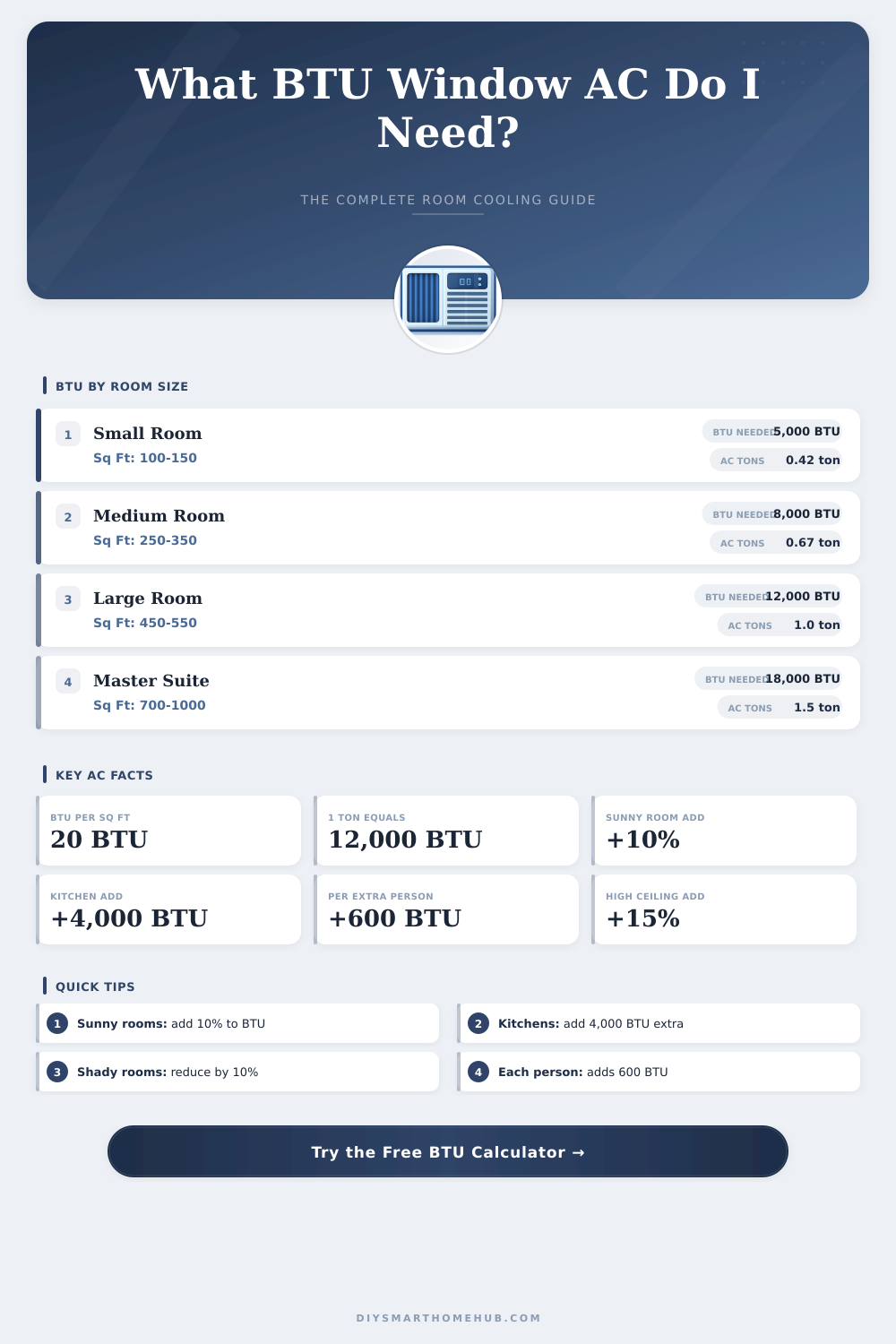
| BTU Rating | AC Tons | Sq Ft Coverage | M² Coverage | Typical Room | Watts |
|---|---|---|---|---|---|
| 5,000 BTU | 0.42 ton | 100–150 sq ft | 9–14 m² | Small bedroom | ~1,465 W |
| 6,000 BTU | 0.5 ton | 150–200 sq ft | 14–19 m² | Small bedroom | ~1,758 W |
| 8,000 BTU | 0.67 ton | 250–350 sq ft | 23–33 m² | Medium bedroom | ~2,344 W |
| 10,000 BTU | 0.83 ton | 350–450 sq ft | 33–42 m² | Large bedroom | ~2,930 W |
| 12,000 BTU | 1.0 ton | 450–550 sq ft | 42–51 m² | Living room | ~3,516 W |
| 14,000 BTU | 1.17 ton | 550–700 sq ft | 51–65 m² | Large living room | ~4,101 W |
| 18,000 BTU | 1.5 ton | 700–1,000 sq ft | 65–93 m² | Master suite / studio | ~5,274 W |
| 21,000 BTU | 1.75 ton | 1,000–1,200 sq ft | 93–111 m² | Large open plan | ~6,152 W |
| 24,000 BTU | 2.0 ton | 1,200–1,500 sq ft | 111–139 m² | Full floor / open plan | ~7,032 W |
| 28,000 BTU | 2.33 ton | 1,500–1,800 sq ft | 139–167 m² | Large floor space | ~8,204 W |
| Factor | Condition | BTU Adjustment | Notes |
|---|---|---|---|
| Sunlight | Very sunny room | +10% | South/west-facing windows |
| Sunlight | Mostly shady | −10% | North-facing or tree-shaded |
| Kitchen | Cooking appliances present | +4,000 BTU | Add flat amount for heat load |
| Occupants | More than 2 people | +600 BTU each | Each person beyond first 2 |
| Ceiling Height | Above 8 ft standard | +proportional | Volume-based multiplier |
| Floor Level | Top floor / attic | +15% | Heat gain from roof |
| Floor Level | Ground / basement | −5% | Less solar heat gain |
| Climate | Hot & humid | +10% | High ambient temps |
| Climate | Extreme heat | +20% | Desert / tropical zones |
| Insulation | Poor insulation | +15% | Older homes, single-pane |
| Insulation | Good insulation | −10% | Double-pane, well-sealed |
| Insulation | Excellent insulation | −15% | Energy Star certified building |
| Room Type | Typical Area | Base BTU | Recommended AC |
|---|---|---|---|
| Small Bedroom | 100–150 sq ft | 2,000–3,000 | 5,000–6,000 BTU |
| Average Bedroom | 150–250 sq ft | 3,000–5,000 | 6,000–8,000 BTU |
| Large Bedroom | 250–350 sq ft | 5,000–7,000 | 8,000–10,000 BTU |
| Master Suite | 350–500 sq ft | 7,000–10,000 | 10,000–12,000 BTU |
| Living Room | 300–500 sq ft | 6,000–10,000 | 10,000–14,000 BTU |
| Open Plan Kitchen/Living | 500–800 sq ft | 10,000–16,000 | 18,000–21,000 BTU |
| Studio Apartment | 300–500 sq ft | 6,000–10,000 | 10,000–14,000 BTU |
| Home Office | 100–200 sq ft | 2,000–4,000 | 5,000–8,000 BTU |
| Garage / Workshop | 400–600 sq ft | 8,000–12,000 | 12,000–18,000 BTU |
| Sunroom / Porch | 150–300 sq ft | 3,000–6,000 | 8,000–12,000 BTU (+sunny) |
Choosing the right window air conditioner depends on one main thing: BTU. The BTU value shows how much heat the device can remove from the room. A bigger number means its cooling power is stronger.
To get the best result you need to match the BTU level to the size of the space.
Choose the Right Size Window Air Conditioner
The most common window air conditioner units for home use have between 5,000 and 12,000 BTU, and they run on 120 volts. Some bigger models reach up to 30,000 BTU, but those need 240 volts and weigh about 85 pounds or even more.
For small spaces, a window air conditioner unit of 5,000 BTU works well. For instance, the LG model with 5,000 BTU cools areas up to 150 square feet and includes insulation. One finds such small devices for around 100 dollars.
Such a 5,000 BTU unit is enough for an average to big bedroom even when the temperature outside is in the 90s, although it would struggle when it goes past 110 degrees outside. Also this model lets you set the temprature from around 60.8 to 87.8 degrees Fahrenheit.
A unit of 6,000 BTU works for around 250 square feet. Even so, because ideal conditions rarely happen in real life, it is smart to choose a model of 8,000 BTU for the same area. At 8,000 BTU there are more brands.
A window air conditioner of 8,000 BTU can handle about 350 square feet and keep you comfortable during warm days. For instance, one single unit of 8,000 BTU cooled a space of around 500 square feat for a whole floor, keeping the temperature at about 68 degrees.
A unit with 10,000 BTU works to cool a whole apartment of 1,000 square feet, if one places it in a central spot. Also, putting it higher in the window than on the windowsill helps spread the cold air more well.
For bigger rooms, like rooms between 350 and 550 square feet, a unit in the range of 9,800 to 12,500 BTU is the best choice, especially with open floor plans. For instance, the GE window air conditioner with 12,000 BTU handles spaces up to 550 square feet and has Wi-Fi, so one can control it by phone or from far away.
Beyond just the BTU, energy ratings are also important. Choosing devices with a high Energy Efficiency Rating helps to lower the cost of electricity. Using a small unit for a bedroom instead of the central system can cut the costs for summer cooling.
Online there are BTU calculators that make it easy to guess the right size without needingto figure it out yourself. Also make sure the seal around the window air conditioner unit is tight, to stop air leaks.