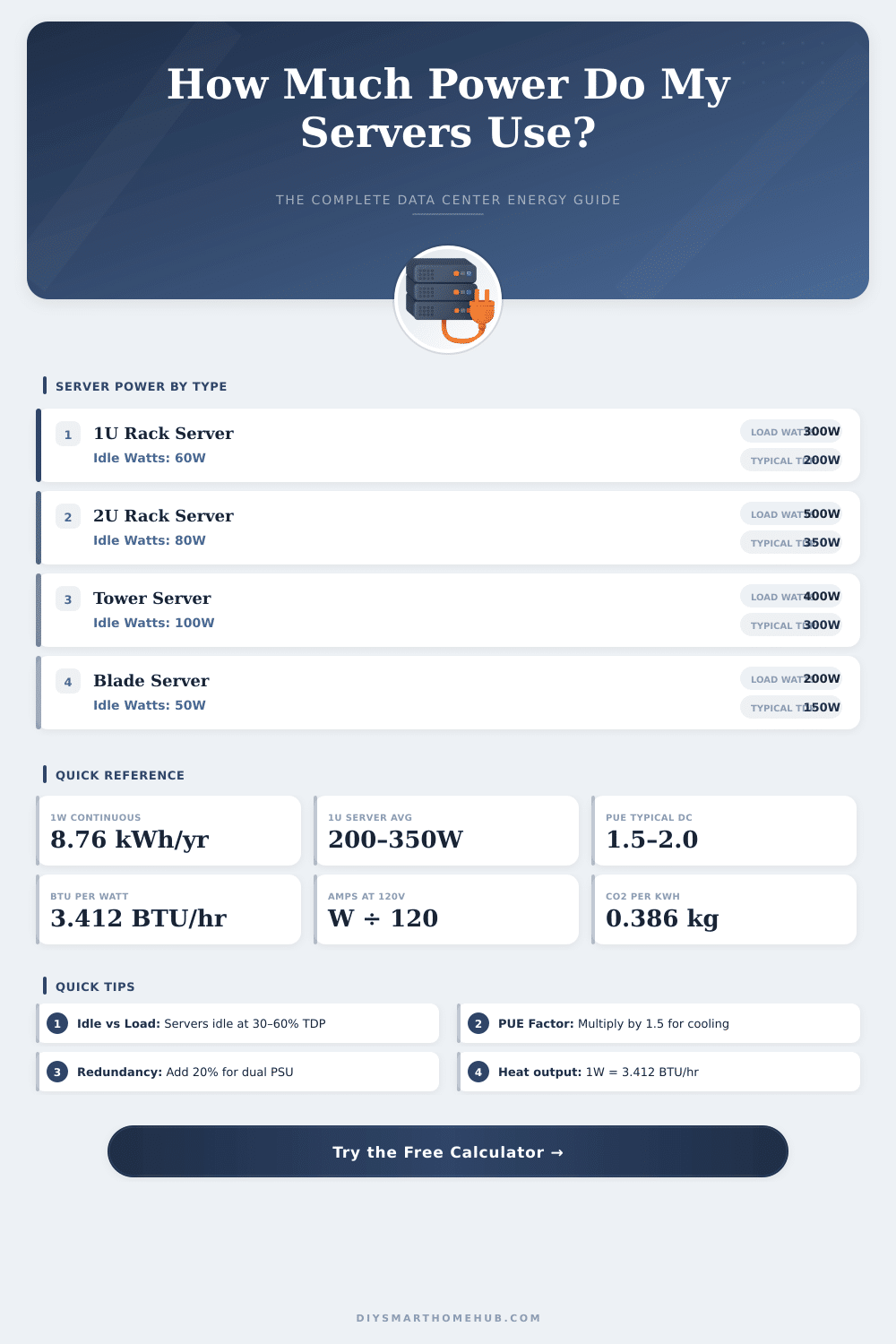
🖥️ Server Power Consumption Calculator
Estimate energy usage, heat output, and annual kWh for your server infrastructure
| Component | Idle Power | Load Power | Notes |
|---|---|---|---|
| CPU (per socket) — Low TDP | 15–30W | 35–65W | Atom, low-power Xeon |
| CPU (per socket) — Mid TDP | 30–60W | 95–150W | Standard Xeon / EPYC |
| CPU (per socket) — High TDP | 50–90W | 165–350W | High-core-count HPC |
| RAM (per 8GB DIMM) | 1.5–2W | 3–5W | DDR4 / DDR5 |
| HDD 3.5" (per drive) | 4–6W | 6–9W | Spinning disk |
| SSD SATA (per drive) | 0.5–1W | 2–5W | SATA interface |
| NVMe SSD (per drive) | 1–2W | 4–8W | PCIe interface |
| GPU (mid-range) | 20–50W | 150–250W | Workstation GPU |
| GPU (high-end / AI) | 50–100W | 300–700W | A100 / H100 class |
| Network Card (10GbE) | 5–8W | 8–15W | Per NIC card |
| Motherboard / Chipset | 20–40W | 25–50W | Platform overhead |
| Cooling Fans (server) | 5–15W | 15–60W | Scales with load |
| Server Power Draw | BTU/hr Output | kJ/hr Output | Cooling Needed |
|---|---|---|---|
| 100W | 341 BTU/hr | 360 kJ/hr | ~0.03 tons AC |
| 250W | 853 BTU/hr | 900 kJ/hr | ~0.07 tons AC |
| 500W | 1,706 BTU/hr | 1,800 kJ/hr | ~0.14 tons AC |
| 1,000W (1kW) | 3,412 BTU/hr | 3,600 kJ/hr | ~0.28 tons AC |
| 2,000W (2kW) | 6,824 BTU/hr | 7,200 kJ/hr | ~0.57 tons AC |
| 5,000W (5kW) | 17,060 BTU/hr | 18,000 kJ/hr | ~1.42 tons AC |
| 10,000W (10kW) | 34,121 BTU/hr | 36,000 kJ/hr | ~2.84 tons AC |
| PUE Factor | Classification | Overhead % | kWh/yr per 1kW IT |
|---|---|---|---|
| 1.0 | Perfect (theoretical) | 0% | 8,760 kWh |
| 1.2 | Excellent / Hyperscale | 20% | 10,512 kWh |
| 1.5 | Industry Average | 50% | 13,140 kWh |
| 1.8 | Below Average | 80% | 15,768 kWh |
| 2.0 | Inefficient / Older DC | 100% | 17,520 kWh |
| 2.5 | Very Inefficient | 150% | 21,900 kWh |
| Rack Configuration | Total Draw | Annual kWh | BTU/hr |
|---|---|---|---|
| 5x 1U servers (web tier) | ~1.0 kW | ~8,760 | ~3,412 |
| 10x 1U servers (app tier) | ~2.5 kW | ~21,900 | ~8,530 |
| 20x Blade servers | ~4.0 kW | ~35,040 | ~13,650 |
| 5x 2U database servers | ~3.0 kW | ~26,280 | ~10,236 |
| 4x GPU compute nodes | ~8.0 kW | ~70,080 | ~27,296 |
| Full 42U rack (dense) | ~15 kW | ~131,400 | ~51,180 |
Servers use more energy than most folks imagine. Before the year 2000, a typical server only needed around 50 watts of electricity. Since 2008, this amount jumped to about 250 watts.
When data centers move to setups with higher density of servers, the use of energy grows even more quickly.
How Servers Use Power and How to Save Energy
The real energy that a server uses depends on the load and the workload. Two devices of the same type can spend different amounts of power. Some servers carry several CPUs, and each of them can need 300 to 400 watts alone.
A computing service without big storage uses energy differently than one that is heavy in storage.
Home servers are usually less hungry for energy. One system that runs some virtual machines along with Plex stays at 100 watts in idle state. Another home server that stayed fully turned off during no one being there used only 0.1922 kWh during the whole day.
A small node with Proxmox in power saving mode reaches only 10 to 12 watts. On the other hand, a standard 4U-server uses at 20 watts, while a small machine like a NUC can reach 100 watts under full load. For home setups the idle use is very important, but no one lists it usually anywhere.
Big servers draw much more. An old HPE ProLiant DL580 with four CPUs uses just under 600 watts. A Supermicro disk server with two CPUs passes 300 watts.
A device with 14 drives and double chips needs around 200 watts, which costs almost 30 dollars a month for electricity. A fully loaded rack of storage servers can spend 4 to 8 kilowatts, depending on the build.
You can lower these numbers. Setting servers for dynamic CPU speeds instead of maximum output mode helps. One setup reduced its idle power use by 80 percent simply by switching too a less power hungry host.
Putting drives in standby state, using fewer RAM and choosing newer efficient CPUs like Pentium also helps. Planning times for sleep works well. One device measures 57 watts and only around 7 euros a month, thanks to sleep of the server between 1 in the morning and 8 in the morning using a script based on Wake-on-LAN.
Measuring the power draw is fairly easy. A Kill-A-Watt meter or smart plug like TUYA Zigbee can track the use over time. High end servers commonly have built-in tools like IPMI, iDRAC or software that reports the flow and total power draw.
There are also programs like Power Advisor that estimate the use across systems and racks for planning goals. Smart PDUs withmeasurement can track energy for outlets or for a whole unit, and watching trends over time is the best way.