💡 Recessed Lighting Calculator
Calculate exactly how many recessed lights you need for any room — with spacing, lumens & placement guidance
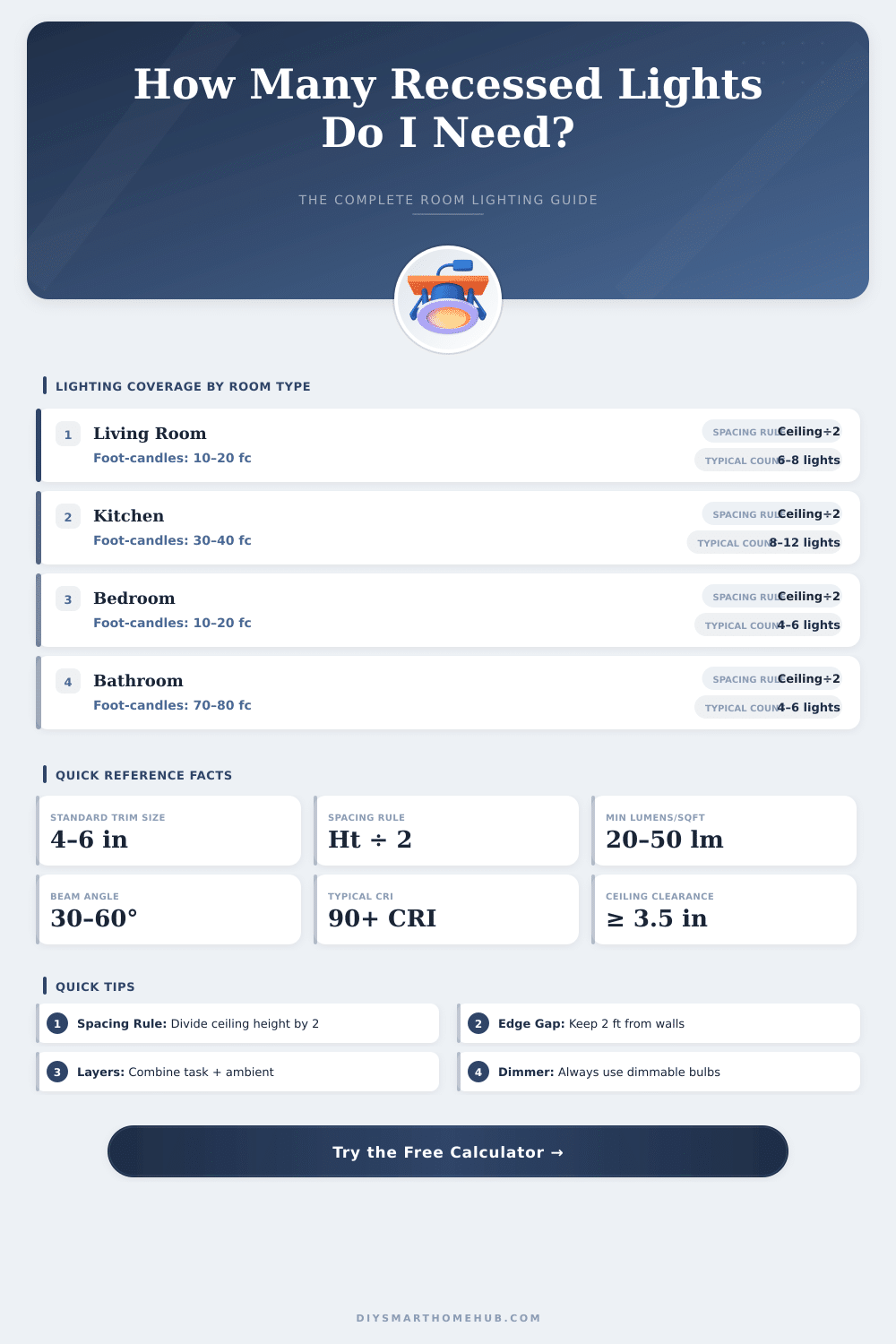
| Room Type | Foot-Candles (fc) | Lux Equivalent | Task Level | Typical Lights (10x12) |
|---|---|---|---|---|
| Hallway / Closet | 5–10 fc | 54–108 lux | Ambient only | 2–3 |
| Bedroom | 10–20 fc | 108–215 lux | Relaxed ambient | 4–6 |
| Living Room | 10–20 fc | 108–215 lux | General ambient | 6–8 |
| Dining Room | 15–25 fc | 161–269 lux | Ambient + accent | 4–6 |
| Home Office | 40–50 fc | 430–538 lux | Task lighting | 6–8 |
| Kitchen (general) | 30–40 fc | 323–430 lux | Ambient + task | 8–10 |
| Kitchen (counters) | 70–80 fc | 753–861 lux | Task only | extra under-cabinet |
| Bathroom (general) | 50–70 fc | 538–753 lux | General task | 4–6 |
| Bathroom (vanity) | 70–80 fc | 753–861 lux | Grooming task | + vanity strip |
| Garage | 20–30 fc | 215–323 lux | Work ambient | 6–8 |
| Ceiling Height | Light Spacing (ft) | Light Spacing (m) | Wall Offset (ft) | Notes |
|---|---|---|---|---|
| 7 ft | 3.5 ft | 1.07 m | 1.75 ft | Very close spacing |
| 8 ft | 4.0 ft | 1.22 m | 2.0 ft | Standard spacing |
| 9 ft | 4.5 ft | 1.37 m | 2.25 ft | Most common |
| 10 ft | 5.0 ft | 1.52 m | 2.5 ft | Open plan / higher end |
| 12 ft | 6.0 ft | 1.83 m | 3.0 ft | Use brighter bulbs |
| 14 ft | 7.0 ft | 2.13 m | 3.5 ft | Consider pendants too |
| Room | Dimensions | Area (sq ft) | Lights (9 ft ceiling) | Suggested Lumens |
|---|---|---|---|---|
| Small Bedroom | 10 x 10 | 100 sq ft | 4 | 3,200 lm total |
| Standard Bedroom | 12 x 14 | 168 sq ft | 6 | 4,800 lm total |
| Living Room | 15 x 20 | 300 sq ft | 9–12 | 8,000 lm total |
| Open Plan | 20 x 30 | 600 sq ft | 18–24 | 16,000 lm total |
| Standard Kitchen | 10 x 12 | 120 sq ft | 6–8 | 7,200 lm total |
| Bathroom | 8 x 10 | 80 sq ft | 4–6 | 6,400 lm total |
| Garage (2-car) | 20 x 22 | 440 sq ft | 8–10 | 8,800 lm total |
recessed lighting is one of those practical solutions that works well in kitchens, bathrooms, rooms or simply in any part of your house where you need reliable general light. These fixtures sit well in the ceiling with only a little edge visible, much more clean look than in the old times when one saw deep metal cases covering the tubes and cables, with decorative trims sitting against the drywall. Technology and range did big progress since that era.
Modern LED recessed lighting gives bright and equal light while they use little energy. They fit well in modern places and work surprisingly in kitchens, rooms and offices too. There are elegant options, like 4-inch models, that reach around 650 lumens and allow you to set the color temperature from 2700K in the warm finish until 5000K in the cold.
Recessed Lights: What They Are and How to Use Them
There are also updated sets, designed to match the most common existing 6-inch cutouts, complete with standard E26-base adapter, ideal, if you install them yourself.
Color temperature really affects how a space feels. At 2700K the light has warm, attractive character, that gives comfort. Set it to 3000K, and everything seems more relaxed.
When you reach 4000K, it energizes; 5000K becomes truly active; and 6500K? It feels like daylight intensity. For bedrooms warm light around 2800K until 3000K creates calm atmosphere, that helps with sleep.
Even so bedrooms have their own problems with recessed lighting. It can shine directly in your eyes, when you lie down, and it commonly creates weak shadows and gives poor light quality in that situation.
So hear are the canless options, that became very popular. These fixtures are really easy to install, because they attach directly to the drywall by means of clips and do not need the usual metal case. You simply connect to existing wiring, and they cost fairly little.
Contractors call them commonly disk-style lights and like them because of the simple and fast setup. On the other hand, traditional recessed fixtures must go in before the drywall is hung and need attention to space them from blocks.
The place of those lights matters a lot. Single recessed lights and wall washers work best, when you place them around 12 until 18 inches from the wall, such spacing helps, so that rooms feel bigger and brighter. In hallways, lay them along the center or they will not work well; you will end with dark areas.
In kitchens layered lighting is key, combine recessed lighting with under-cabinet strips and decorative ceiling pieces for the best results.
Downsides however exist: cutting those holes means you lose a bit of sealing, which reduces the energy saving of your home. Older, bigger models can make ceilings seem almost like Swiss cheese. Newer ranges shrunk to 1 until 1.5 inches in diameter, which helps a lot.
Look for LED cases with built-in drivers, that cannot be swapped (if something fails), you will have to make a big hole in the ceiling to reach it.
The benefits do not stop there. Recessed lighting looks clean and neat, making ceilings feel higher. Dimmable options allow you to move between strong task lighting and softer surrounding mood light.
Long-lasting, dimmable LED bulbs keepthe energy savings going too.