Sunrise Simulation Ramp Time Calculator
Plan a smart-light sunrise from wake time, fade duration, update interval, warm-to-cool CCT sweep, brightness ramp, and target lumen output.
Full sunrise ramp breakdown
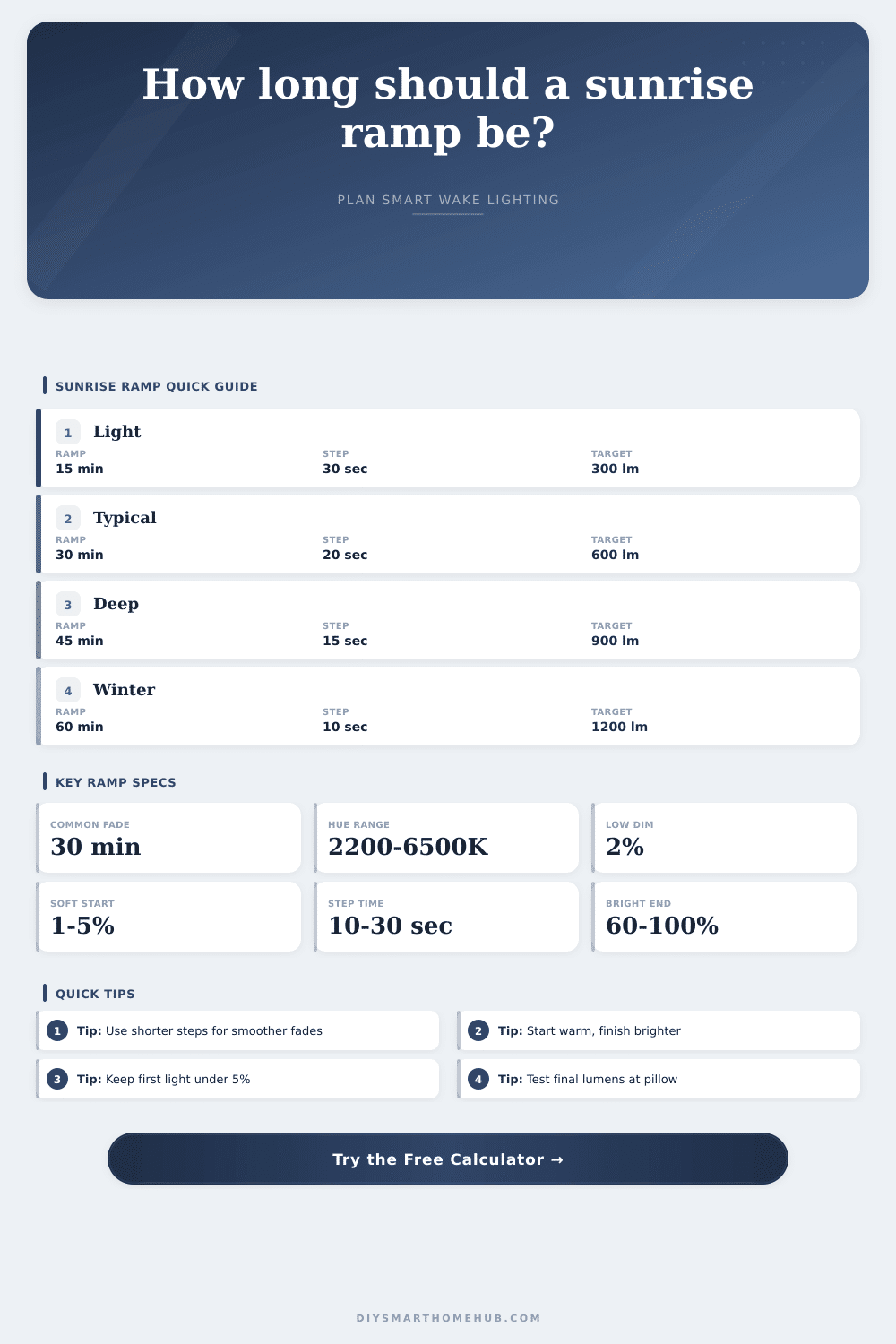
| Wake scenario | Suggested ramp | Step interval | Brightness target | Best fit |
|---|---|---|---|---|
| Light sleeper | 15 to 20 minutes | 20 to 30 seconds | 35% to 60% | Small bedside lamp or shared bedroom |
| Typical weekday wake | 25 to 35 minutes | 15 to 30 seconds | 60% to 85% | Most tunable smart bulb scenes |
| Deep sleeper | 35 to 50 minutes | 10 to 20 seconds | 80% to 100% | Multiple bulbs or brighter wake lamps |
| Very dark winter room | 45 to 60 minutes | 10 to 20 seconds | 85% to 100% | Curtains closed, north-facing room, early alarm |
| Phase | Ramp position | Brightness band | CCT band | Lighting feel |
|---|---|---|---|---|
| Pre-dawn glow | 0% to 20% | 1% to 8% | 1800K to 2400K | Dim red, amber, or warm-white start |
| Early sunrise | 20% to 45% | 8% to 25% | 2200K to 3000K | Warm orange-yellow transition |
| Morning build | 45% to 75% | 25% to 65% | 3000K to 4500K | Noticeably brighter neutral white |
| Wake finish | 75% to 100% | 65% to 100% | 4500K to 6500K | Bright white or daylight finish |
| Light source | Max lumens entered | 60% target | 80% target | 100% target |
|---|---|---|---|---|
| Small bedside bulb | 450 lm | 270 lm | 360 lm | 450 lm |
| Single A19 smart bulb | 800 lm | 480 lm | 640 lm | 800 lm |
| Two A19 smart bulbs | 1600 lm | 960 lm | 1280 lm | 1600 lm |
| Ceiling fixture scene | 2400 lm | 1440 lm | 1920 lm | 2400 lm |
| Bedroom setup | Fixture output | Recommended ramp | Target brightness | Final lumens |
|---|---|---|---|---|
| Small nightstand lamp | 450 lm | 20 minutes | 70% | 315 lm |
| Single color A19 bulb | 800 lm | 30 minutes | 80% | 640 lm |
| Two smart bulbs | 1600 lm | 35 minutes | 75% | 1200 lm |
| Large dark room scene | 2400 lm | 45 minutes | 90% | 2160 lm |
| Very gentle shared room | 800 lm | 40 minutes | 45% | 360 lm |
The alarm sound make most of us wake up, or so we think. No it doesn’t. Waking up has more to do with light hitting your retina than anything else when you gets out of bed. There’s a biological struggle happening here between being awake and having been asleep, and suddenly blindingly bright usually isn’t winning the fight for the body. Your circadian rhythm gets assaulted instead of invited, and you’re left either irritable or groggier then usual.
A sunrise simulation can prevent all that. It helps you ease into consciousness by gradually simulating how ambient light increases at dawn. Smart bulbs knows the ropes, but there’s no manual for nature. The right settings require the right brightness, color changes, and timing. This makes room feel like morning, not like a interrogation lamp.
How to Wake Up Gently with Sunrise Lights
With your desired wake time and fade parameters, the calculator (above) does all the rest of the work for you. It figures out how many automation step you really need, which means no more guesswork. For me, ramp duration is the critical factor here. I think 30 minutes is a good starting point for most homes, although it’s on the aggressive side if there are light sleeper involved or if you’re sharing a bed. You don’t want the room suddenly lighting up like a stadium when your partner is still attempting to fall asleep! So for that type of scenario, choosing shorter side with less maximum brightness will make it nice and easy on everyone.
On the other end of things, if you have a very dark bedroom or maybe you just have trouble waking up in the winter months, then you may require a bit more of intense and long ramp to help signal your body into thinking: okay, yeah, it’s morning now. How often do you update? You might think this is mostly about the step size; e.g., one lumen per second versus 10 lumens per second. But you’d be wrong: as long as the change is small enough that you don’t notice big jumps in brightness, what matters most is how frequently you make them. Update every ten to thirty seconds, and you’ll have a continuous curve. Update once every five minutes, and light will seem to stutter as it fades (pulling you out of sleep by surprise), instead of comfort. The tool uses your chosen duration and update interval to compute exactly how many updates to run. This ensures the automation engine can keep up without being overwhelmed with extra commands.
The real selling point for this illusion comes in color temperature. At roughly 2200 Kelvin you’ll have that amber-warm glow we usually experience right as the sun rise. It’s good on tired eyeballs and sustains your melatonin production just long enough so that you can naturaly wake up. As you continue to ramp up, moving towards 5000 Kelvin or above, you’re beginning to see that crisp, cool light of mid-morning. The blue-rich spectrum increase alertness while suppressing melatonin. Hold the temp constant at a neutral white? You’re looking at a lamp coming to life. Ramp from warm to cool? You’re watching dawn. That’s really the only difference between being startled awake and feeling rested and relaxed.
“Until it doesn’t work, we tend to ignore Lumen targets.” Maybe the single lamp above your bed isn’t bright enough to really wake you up? If it’s already pretty dim, it may never be. This is clearly shown by reference table on the page that shows the scale of output versus % setting for fixtures. Even with the drapes pulled, you want enough total lumens at the end of the ramp to make it feel like daytime. For most typical bedroom scenes, something in the range of 600 to 1200 lumens is usually plenty. Less than that and your body ignores it; more than that and you’re blind. There is a sweet spot somewhere between those two extremes: the room should feel bright enough to operate yet still soft enough to feel cozy.
Testing is non-negotiable. The math works out, but humans are incredibly sensitive. Try a test ramp on a weekend where there’s no alarm clock bearing down on you. Notice what it feels like at the pillow. Is it glaring? Is it too slow? Based off your experience in the real world, adjust accordingly, either by tweaking the start time or brightening/dimming the brightness ceiling.
It’s not about getting the settings perfect, it’s about feeling comfortabley when you wake. You transition from battling the morning to going with the flow as that nice warm light gradually rises. A couple minutes spent planning for that gentle rise would of been worth it.