Sump Pump Run Cycle Calculator
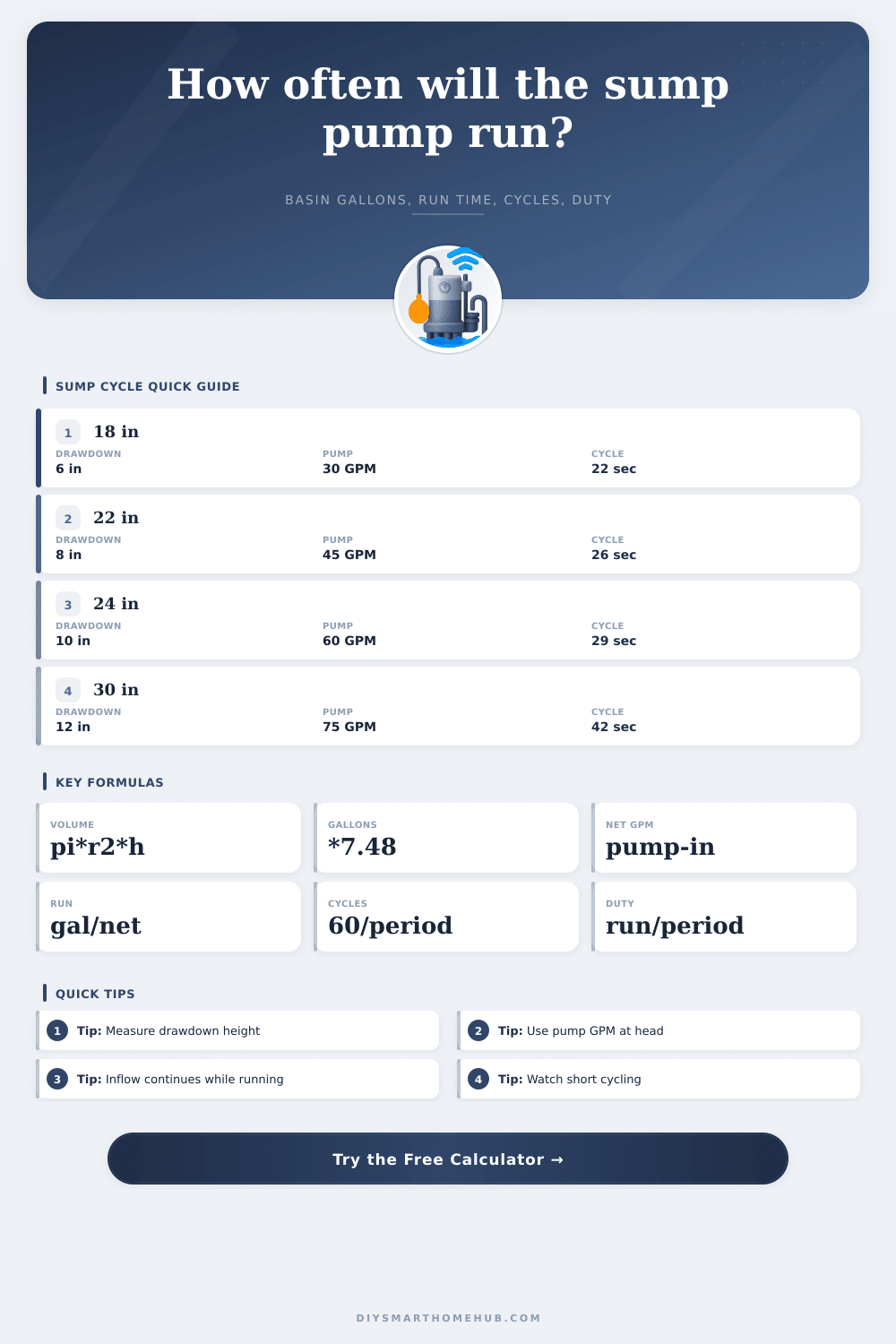
Estimate sump basin gallons, effective pump GPM, inflow GPM, run time, refill time, cycles per hour, starts per day, and pump duty cycle from the float drawdown height.
Cycle estimate
The pump removes the basin drawdown volume while new water continues to enter.
| Basin diameter | Gallons per inch | 6 in drawdown | 10 in drawdown |
|---|---|---|---|
| 18 in round pit | 1.10 gal/in | 6.6 gal | 11.0 gal |
| 22 in round pit | 1.64 gal/in | 9.8 gal | 16.4 gal |
| 24 in round pit | 1.96 gal/in | 11.7 gal | 19.6 gal |
| 30 in round pit | 3.06 gal/in | 18.4 gal | 30.6 gal |
| Metric | Comfortable range | Watch range | Why it matters |
|---|---|---|---|
| Run time | 20 to 90 sec | Under 10 sec | Very short runs can mean a tight float range or small usable volume. |
| Cycles/hour | Under 10 | Over 15 | Frequent starts add mechanical and electrical wear. |
| Duty cycle | Under 50% | Over 70% | High duty means inflow is close to pump capacity. |
| Inflow share | Under 50% | Over 80% | When inflow nears pump GPM, water level recovery becomes slow. |
| Scenario | Usable volume | Net pump rate | Estimated cycle |
|---|---|---|---|
| 18 in pit, 6 in drawdown, 2 GPM inflow | 6.6 gal | 28 GPM | 14 sec run, 18/hr |
| 22 in pit, 8 in drawdown, 4 GPM inflow | 13.1 gal | 36.5 GPM | 22 sec run, 15/hr |
| 24 in pit, 10 in drawdown, 10 GPM inflow | 19.6 gal | 44 GPM | 27 sec run, 23/hr |
| 30 in pit, 12 in drawdown, 6 GPM inflow | 36.7 gal | 61.5 GPM | 36 sec run, 9/hr |
Something’s not right when you hear a certain sound from your basement system. Not the rushing water. Not even the hum of the motor. It’s the quick clicking noise of the switch rapidly turning on and then off again. That’s what we call short cycling. And short cycling will ruin sump pumps fast.
Homeowners typically buy and install their system and expect that “pumping something” has to be good enough. Guess what? Typicaly that’s not the case. How often your pump runs are just as important as type of pump you have.
Why Your Sump Pump Is Breaking
Balance This all comes down to balance. You have a set amount of water entering your pit per minute. You also have a set amount of water exiting your pit per minute (pump). When those two numbers is too near to one another, your pump will never get a break. Your pump will be churning out water as more water rushes in. It’s an endless cycle that overwork motor windings and breaks through motor seals.
In this situation, knowing your basin volume is key. How big is your pit? What’s its drawdown height? A smaller pit mean a smaller drawdown height. This causes your pump to turn on more often for very brief periods of time. During these brief periods, your pump produce heat but does not allow the motor to cool.
So be sure to note the distinction between rated flow vs actual flow in the tool above. When manufacturers quote gallons per minute, they do so at zero head. That means that they’re assuming that you’re lifting water directly out of a bucket on level ground. In reality, you probably have vertical lift. You want to discharge it outside or into a drain line). You also have friction losses due to elbows and check valves. To account for this, the calculator above lets you dial back effective flow rate depending on how high your vertical lift is. Why? Because if you overestimate the pump capacity, you’ll underestimate its runtime.
Another confusing variable is inflow. Many people assume that when the pump is running, there’s no more inflow. In most cases, inflow continues even with the motor not spinning because groundwater pressure push water into the pit. That’s where the net drawdown rate comes in. It takes the inflow and subtracts it from the outflow. So you get an accurate view of the actual run cycle length. The higher your inflow is compared to your pump size, the longer the duty cycle. A duty cycle above 50% are typically a red flag for conventional submersible pumps. Conventional submersibles depend on off time to cool down.
Running your pump too little (short cycling) can be just as bad if not worse. When the float switch has too small a stroke or you have too small a pit, that pump could of running for only ten seconds at a clip. That’s not long enough to displace any significant amount of water. But it’s all day long enough to stress the heck out of the start capacitor and hammer on electrical contacts.
The reason basin diameter makes such a big difference is illustrated in the reference tables on the page. Increasing the pit size from eighteen inches to twenty-two inches can make a huge difference in how much volume moves with each cycle. That evens out the short runs of the pump. The solution to this isn’t rocket science (you don’t need to be an engineer). The solution require having the correct numbers. Estimate how long it takes your pond to fill up on a wet day and then measure the diameter of your basin inside. With those few data points, you have everything you need to model your system.
The results will show if your drawdown range is enough. They will also show if you need to extend your float arm to lower the water level more each time the pump cycles. Alternately, if space allows, you could add a larger pit. Better to have a pump run a little longer but less frequently then to chatter constantly.
So the bottom line? Your sump pump should be a sump pump, regular and predictable. The longer you let it work in measured cycles with proper rest, the longer it will last. And the drier your basement during heavy rains. So don’t get caught up in buying the big motor first. Get the math correct. Otherwise, you’re likely to spend money on frantic repair jobs after the floor’s been wet.
If it’s quiet, it is working. It’s the right size, and it isn’t fighting itself.