Smart Blinds Slat Tilt Angle Calculator
Estimate a motorized venetian blind tilt angle from sun altitude, window orientation, slat geometry, privacy sightline, glare limit, and remaining open area.
Recommended smart blind tilt
The current scene is calculated from direct sun geometry, privacy sightline, and slat open area.
| Formula | Expression | Meaning |
|---|---|---|
| Azimuth offset | delta = sun az - window az | 0 deg is sun normal to glass |
| Plane altitude | atan(tan(alt) / cos(delta)) | Sun angle in slat cross-section |
| Ray pass | max(0, p - w |sin(t) - m cos(t)|) / p | Clear fraction for ray slope m |
| Open area | max(0, p - w |sin(t)|) / p | Straight-on opening through slats |
| Privacy slope | (target ht - eye ht) / distance | Outside eye to indoor point |
| Slat profile | Width | Pitch | Closure tilt |
|---|---|---|---|
| Mini blind | 1.0 in | 0.82 in | 55 deg |
| 2 in wood | 2.0 in | 1.58 in | 52 deg |
| 2.5 in wide | 2.5 in | 1.90 in | 50 deg |
| Tight ladder | 2.0 in | 1.35 in | 43 deg |
| Custom | User | User | asin(p / w) |
| Scenario | Sun altitude | Window offset | Typical tilt | Open area |
|---|---|---|---|---|
| High south sun | 55 deg | 0 deg | 0 to 20 deg | 75 to 100% |
| Morning side sun | 25 deg | 35 deg | 35 to 50 deg | 25 to 55% |
| Low west glare | 15 deg | 20 deg | 55 to 70 deg | 0 to 30% |
| Street privacy | 0 deg | Back side | 45 to 65 deg | 0 to 45% |
| View priority | 40 deg | 70 deg | 0 to 25 deg | 65 to 100% |
The ray-pass formula treats each slat as an opaque line segment in cross-section. Real fabric tapes, curved slats, manufacturing tolerances, and wall reflections can change perceived glare and privacy.
Before thinking about window treatments, you probably experienced painful glare on your computer monitor. Many times this occurs with west facing windows as the setting sun drops lower in the sky, causing a great brightness. Without knowing about middle-ground, most people fully close their smart blinds, blocking out any available daylight.
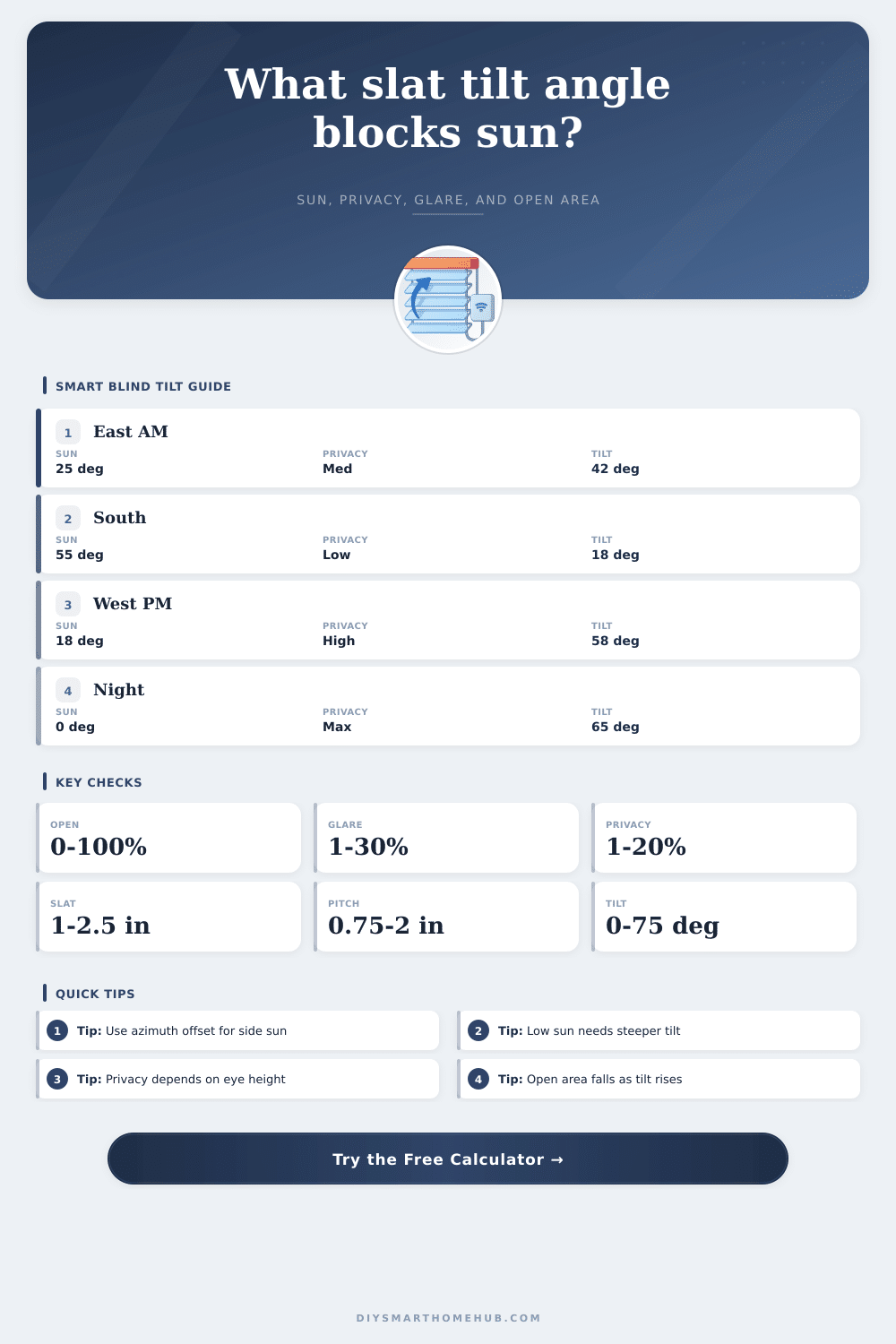
Sliding into the middle ground is the variable called slat tilt angle: a seeming technical term that realy just applies geometric principles to comfort. If you think of your slats as horizontal shutters and not a curtain, understanding the physics behind them is simple: light rays go straight, and your slats stops some when tilted slightly (as shown here for a 55-degree high-sun situation). But at sunrise and sunset, the sun is low. You need a steeper angle to prevent those grazing rays.
How Blind Angles Stop Bright Light
So there is no one perfect position for your blinds; the moving sun require that your blinds move too. To run this math, just use the calculator. But knowing what it’s running will keep you from getting wrong answer.
First, the slat profile (vertical pitch) matters. A narrow one-inch mini blind won’t behave like a standard two-inch wood blind. Wide blinds will provide coverage over a wider area (that seems like a good thing), but they’ll obscure more of your view when opened. You must choose between visibility and light control. No free lunch here, in window treatment design land.
Another factor is the direction of your windows, which affects how the light hits the glass. Windows facing south get the bright mid-afternoon sun, which is easy-peasy with a slight angle. West-facing windows are trickier because they deliver soft glare, which is best handled with near-vertical slats. The tool will ask about sun position and window azimuth (the direction from north); that lets it calculate not simply the angle of incidence from the sky, but in relation to the glass surface itself. That makes a difference; a steep tilt works better on side glare then the top down.
There’s also a layer of privacy, which this tool factors in by modeling an outside observer’s eye height, but which does matter if your window looks onto a neighbor’s patio or a busy sidewalk. Then you don’t just care about how bright it is, but also what people on the other side might be able to see, your sightlines. For these scenarios, the calculator takes into account distance from the window and height of an outside observer’s eye. It also considers whether they are able to look through the window and into your protected indoors. If so, it tweak the tilt to block their view while keeping the window as open as possible.
The output isn’t just brightness. It is also an estimate of how much it’ll improve privacy. This estimate shows whether the proposed angle will be enough to keep prying eyes at bay, or if something else need adjusting.
Don’t worry about exact measurements: Real windows have walls, there’s a frame around them, and the slats aren’t all exactly parallel. After the initial installation you’ll probably adjust that final angle a couple of degrees anyway. Maybe you want a little more daylight than the model calls for. Maybe your neighbor sits right in front of the window. This means he’s closer then the assumed distance in the default scenario. At this point it’s not an exercise in precise engineering as much as it is personal preference.
Don’t take any of these scenarios (which are really just preset scenes on the tool) to be an absolute truth; they’re all tradeoffs! For instance, “East Morning” minimizes glare from the kitchen but keeps some view out into the street. “Winter Low Sun” adjusts for lower angle sunlight and shorter days. You can’t optimize all three at once, light, comfort, and visibility. Choose your two priorities and accept that you may have to sacrifice perfect visibility for perfect privacy (or vice versa).
Blinds offer the promise of smartness… but smart without useful settings is not realy smart, if I shut my blind all the way, then why did I buy windows in the first place? If the blind tilts aimlessly, it look broken and feels intrusive. The point of having a smart blind is for it to react intelligently to the sun’s location (and leave you feeling comfortable). Tilt angle is what lets you do this, making it more than a motorized gadget, but a real part of your home environment.
First, observe where early-morning light enters your main seating spot. Follow the same trajectory for late afternoon. You’ll see the required angle shift greatly throughout the day. Calculating this allows you to establish programmed tilting according to specific times. This produces an ever-changing interior that responds to the heavens rather than contests them. Daily tweaks, however slight, can transform into the difference between glare and glow.