Soffit Vent Air Flow Calculator
Estimate attic intake net free area, soffit vent linear feet, slot free-area ratio, pressure-driven airflow, and intake-to-exhaust balance from one focused worksheet.
1.Start with a real soffit scenario
Presets set attic area, vent type, pressure differential, blockage, and exhaust NFA. You can adjust every value afterward.
2.Enter attic and vent details
3.What the calculator checks
Balanced intake plan
ReadyCalculation breakdown
4.Soffit vent airflow/spec grid
Lower flow per foot, useful when vented panels span long eave runs.
Common continuous strip vents balance moderate attic exhaust systems.
Higher rated vents help when eave length is limited by returns or dormers.
Screened slot airflow is usually below ideal open-area flow.
5.Reference tables
| Vent type | Typical NFA | Free-area ratio clue | Best use |
|---|---|---|---|
| Perforated soffit panel | 4 to 7 sq in/ft | 25 to 40 percent | Long eaves where the whole soffit run can breathe. |
| Vinyl continuous strip | 8 to 10 sq in/ft | 40 to 55 percent | Balanced 1/300 attics with typical ridge vent exhaust. |
| Aluminum strip with screen | 9 to 12 sq in/ft | 45 to 60 percent | Retrofits that need durable, even intake along both eaves. |
| High-flow continuous intake | 16 to 20 sq in/ft | 65 to 80 percent | Short eaves, large attics, or high exhaust NFA systems. |
| Attic floor area | Total NFA at 1/300 | Target intake at 50% | Strip length at 9 sq in/ft with 15% derate |
|---|---|---|---|
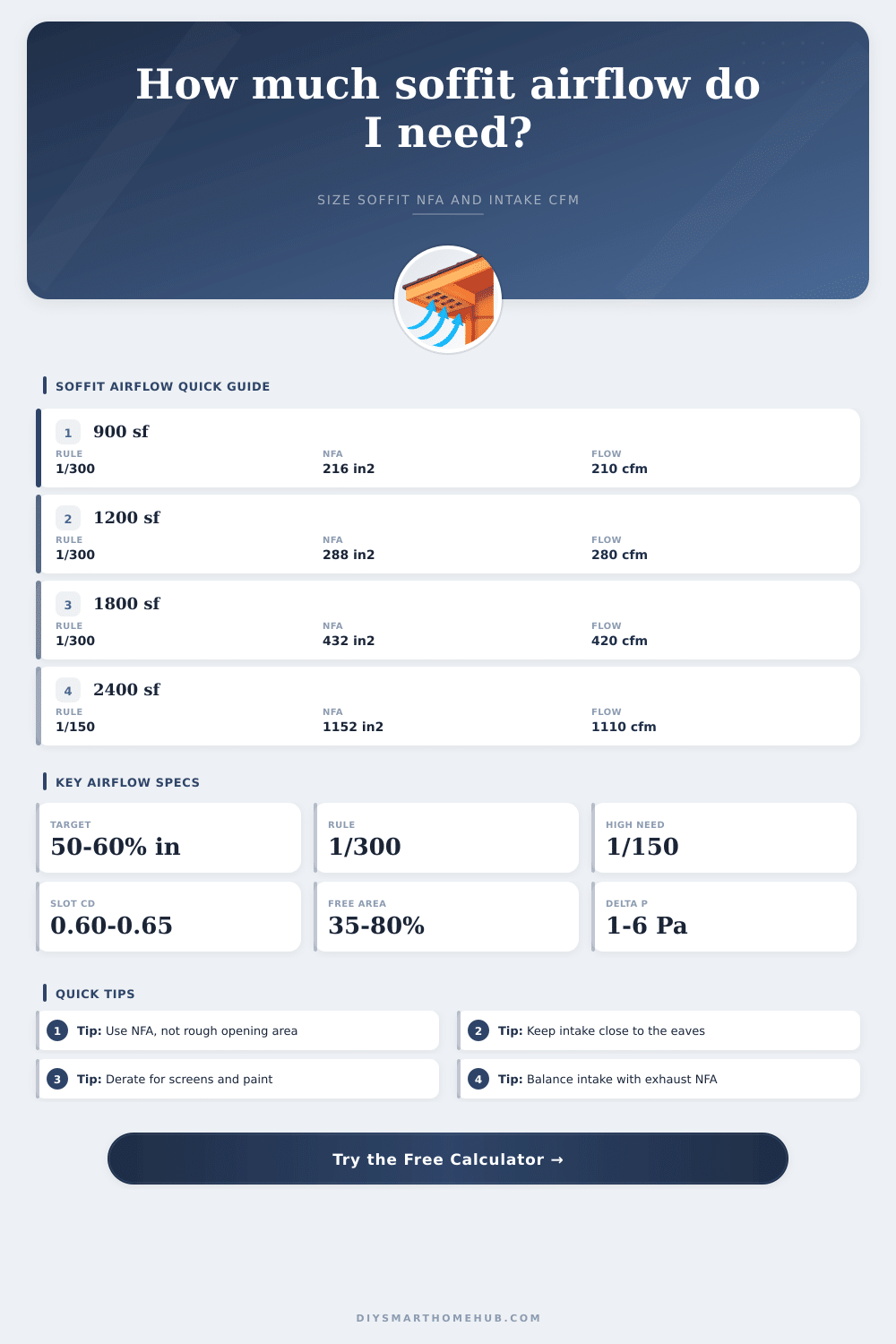
| 800 sq ft | 384 sq in | 192 sq in | 25.1 linear ft |
| 1200 sq ft | 576 sq in | 288 sq in | 37.6 linear ft |
| 1800 sq ft | 864 sq in | 432 sq in | 56.5 linear ft |
| 2400 sq ft | 1152 sq in | 576 sq in | 75.3 linear ft |
| Pressure differential | What it represents | Flow effect | Calculator use |
|---|---|---|---|
| 1 Pa | Light stack effect | Low natural flow | Use for mild weather or low-slope roofs. |
| 3 Pa | Moderate attic draft | Baseline estimate | Good default for balanced natural ventilation checks. |
| 6 Pa | Strong wind or thermal lift | About 1.4x the 3 Pa flow | Use for sensitivity, not guaranteed continuous airflow. |
| 10 Pa | Very strong driving force | High but intermittent | Useful for stress checks on restrictive vent layouts. |
| Balance ratio | Condition | Likely issue | Planning target |
|---|---|---|---|
| Below 80% | Intake starved | Exhaust can pull from leaks or conditioned space. | Add effective soffit NFA or reduce exhaust area. |
| 80 to 120% | Balanced | Good intake/exhaust pairing for most attic layouts. | Keep intake open with baffles and clean vent paths. |
| 120 to 150% | Intake generous | Usually acceptable when exhaust is continuous and clear. | Confirm exhaust is not blocked at the ridge. |
| Above 150% | Exhaust limited | Extra intake may not raise real attic airflow. | Check exhaust NFA before adding more soffit vent. |
6.Practical sizing notes
Soffit vent are component that allow for outdoor air to enter the attic. Soffit vents are necessary because warm air create a rising movement that requires an escape route out of the attic through upper vent. If the soffit vents dont allow enough air to enter the attic, heat will build up in the attic.
This heat will make the house warmer. Furthermore, the attic will pull air from the conditioned room within the house. This will lead to increased cooling cost for the house.
How to Size and Check Soffit Vents
Therefore, you must ensure the soffit vents provide enough air to the attic to balance the exhaust vent that are within the attic. To calculate the needed size of the soffit vents, you must measure the attic roof to determine the square footage of the attic floor. The 1/300 rule is used in most instance to determine the needed size of the soffit vents.
The 1/300 rule states that one square inch of net free area is required for every 300 square feet of attic floor. Some attic may require more net free area if the pitch of the roof is steep or if the attic feature heavy insulation that may block the air from reaching the soffit vents. Furthermore, the intake air from the soffit vents must be balanced with the exhaust air from the ridge vents in the attic.
The net free area of the soffit vents is not always the same than the effective net free area of the soffit vents once installed into the attic. There may be a blockage factor due to the paint, screens, and insulation within the attic that might reduce the air movement through the soffit vents. For instance, the net free area of the soffit vents may be rated at nine square inches, but the effective net free area may be only seven square inches.
In this case, a calculator that takes into consideration the blockage factor of the soffit vents may be use to ensure that the soffit vents provide enough air to the attic. Airflow is created by the difference in air pressure in two area. These difference in air pressure can be created by the stack effect or by the movement of the wind.
The stack effect creates a movement of air within the attic due to the tendency of warm air to rise within the attic; warm air within the attic move out through the exhaust vents. A calculator can be used to calculate the cubic feet of air that moves through the attic each minute (CFM). This number can be used to determine whether or not the soffit vents will provide enough air to the attic.
However, the number calculated by the calculator is only an estimation of the airflow due to the changing speed of the wind. The actual amount of air that moves through the attic will change based off the movement of the wind. One of the common solution for increasing airflow through the attic vents is to increase the length of the vents.
However, this isnt always the best solution. If the exhaust vents have a larger diameter than the intake capacity of the soffit vents, the exhaust vents will create a pull on the attic air that will restrict the intake of air through the soffit vents. This will prevent the attic from effective venting its warm air.
Therefore, the intake area of the soffit vents should be balance with the exhaust area of the ridge or gable vents to ensure that the intake and exhaust vents are both effective. Finally, there may be physical obstruction to the movement of air within the attic. These physical obstruction might include recessed lights, return duct for the air conditioning system, or the insulation within the attic.
All of these can block the movement of air through the attic. A flashlight can be used to inspect the area where the soffit vents are located to ensure that there are no physical obstruction of the soffit vents. Even if the soffit vents have a large net free area, they will not function effective if the insulation within the attic blocks air movement to these vents.
By ensuring that the soffit vents have enough air movement, as well as ensuring that the exhaust vents effectively release the warm air from the attic, the attic will remain dry and cool. Furthermore, if the intake and exhaust vents are sized correctly, the attic will function proper and will not pull air from the conditioned room of the house. You should of checked the vents for any moddern obstruction that could stop the airflow.