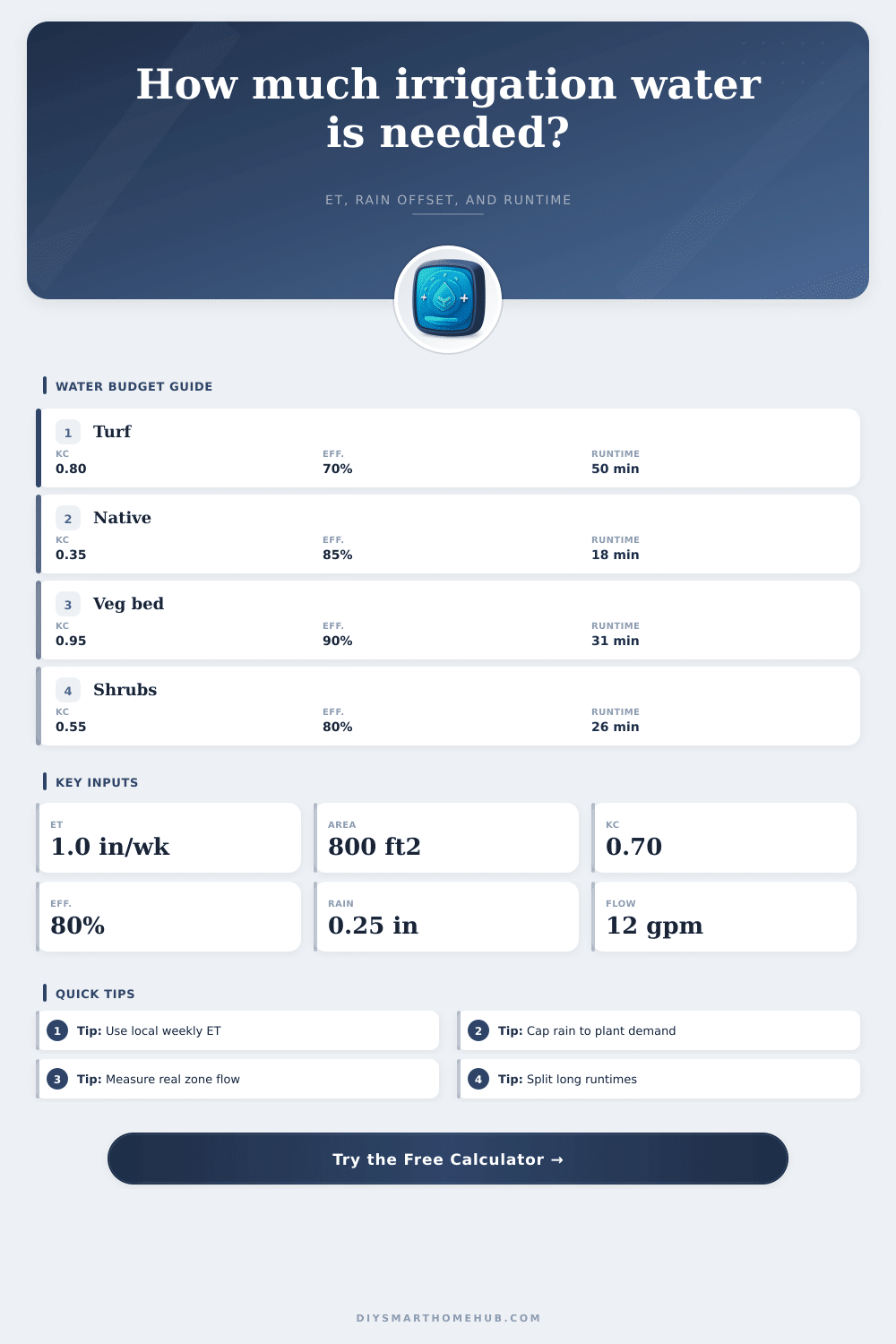
Smart Irrigation Water Budget Calculator
Estimate a weekly zone water budget from ET, landscape area, crop coefficient, irrigation efficiency, usable rainfall, flow rate, and controller runtime.
Water budget results
Use the result as a planning number, then tune with soil moisture feedback, catch-cup measurements, and plant response.
| Irrigation type | Typical efficiency | Flow note | Best use |
|---|---|---|---|
| Fixed spray heads | 55% to 70% | High gpm | Small, regular turf shapes |
| Rotor heads | 65% to 80% | Medium gpm | Larger turf zones |
| Rotary nozzles | 70% to 85% | Lower gpm | Mixed turf with longer cycles |
| Dripline or emitters | 85% to 95% | Low gpm | Beds, shrubs, trees, and planters |
| Example area | Demand depth | Net gallons | Runtime at 12 gpm |
|---|---|---|---|
| 400 sq ft bed | 0.40 in | 100 gal | 8 min |
| 800 sq ft turf | 0.70 in | 349 gal | 29 min |
| 1,200 sq ft lawn | 0.85 in | 636 gal | 53 min |
| 2,000 sq ft yard | 0.60 in | 748 gal | 62 min |
| Step | Formula | What it controls | Output |
|---|---|---|---|
| Crop ET depth | ET x Kc | Plant-adjusted weekly demand | Inches or mm |
| Water budget gallons | ET inches x area sq ft x 0.623 x Kc / efficiency | Gross irrigation before rain | Gallons |
| Rainfall offset | Min(rain x effective %, crop ET) | Usable water credited from rain | Inches and gallons |
| Runtime | Adjusted gallons per zone / zone flow | Controller minutes for each zone | Minutes |
On faith (aka “on a schedule I set back in March”), you water your lawn. That plan has to hope it will last through a dry spell in August, a heat wave in July or an unexpected downpour in September. Most controller schedules don’t adjust fast enough for the ever-changing weather. Yet every day, evapotranspiration (ET) respond to solar radiation, wind speed and humidity. Why do you treat sprinklers like a static appliance rather than a responsive system? Because it’s hard to keep track of all that data, and the disconnect leads to suffering plant and spiraling water bills.
The smart irrigation water budget calculator plug in your zone specifics and local ET data and does the math for you. It eliminates guesswork on conversions and coefficients that typically trip people up. So: Why the big deal with the crop coefficient? Your garden never behaves like that typical grassy surface.
Why Use a Smart Water Calculator for Your Garden?
This creates a need for ET (reference evapotranspiration), which is the amount of water such a hypothetical surface would lose to the air on any given day, based off prevailing weather. Now your plants vary greatly from that baseline demand, and that’s where the crop coefficient come in; a simple ratio that tweaks it up or down depending on what they realy are. For instance, a mature bed of natives may be okay at 35 percent of this loss, while a well-established lawn might need close to 80. The calculator plugs those percentages into the raw weather stats to dial them back to something more suited to your growing environment. And that tiny tweak keep you from drowning things by watering them as though they were lawns. Which most drought-resistant shrubs aren’t, even if they seem similar.
There’s another variable we tend to forget about, which is irrigation efficiency. No system are precise enough to deliver 100 percent of its water to the root zone. Wind drift and evaporation during spray will steal some, and sloping ground lead to runoff, wasting more before it ever does anyone any good. That loss factor has a direct effect on valve-open time, so the tool ask for an efficiency percentage; if you’re operating old fixed spray heads that leak, or that spit out lots of mist, efficiency may be as low as fifty-five percent. Newer drip lines, or rotor nozzles, can push up into the nineties. Having this one right makes the runtime calculation reflect real life, not an ideal world in which every drop lands on target.
There is an additional wrinkle: rainfall credit means you don’t just knock out all rain from your calculations. Why? Because not all rain penetrate well into the ground, a deluge on hard surfaces or compacted soils will run off, rather than contributing to the rootzone. You’ll also see that you are asked to assign an effective rainfall percentage when entering data in the calculator, which limits the amount of credit you give so it’s never more than what might realy be absorbed by the plants. In other words: no more skipping an irrigation because you got rained on briefly but the rain only soaked the top inch. No, it makes you do real math about real rain versus light rain. Prettier rain.
Cycling and runtimes is the physical limits imposed by the hardware (and also the soil). For example, say the recommended weekly allotment is 90 minutes of runtime. That might be too much for your ground to handle without causing runoff on even gentle slopes… But what if you broke up that total time into several smaller cycles, each with a soak period between? That way you’re getting the appropriate amount of water without exceeding the grounds own soaking rate. A gallons-per-week figure becomes something you can program as a set of instructions for your controller, practical.
Bottom line: these calculators are good to use along with eyeballing it (and observing what happens). The numbers give you a good baseline, but how well does the math check out in your microclimate? You should of used them more often. If the plants show signs of stress even after enough running time, adjust the coefficients to match; if they still get runoff, lower the frequency to match. It’s not a hard-and-fast exercise, but an intelligent one, where knowledge makes you more flexible then dogmatic.
This is the difference between doing landscaping by the seat of your pants versus by the numbers. It is the difference between guessing intuitively and making adjustments according to data to keep the waste down and the yard happy.