Aquarium Heater Wattage Calculator
Size heater watts from tank volume, target water temperature, lowest room temperature, tank material, lid coverage, circulation, warm-up time, and the number of heaters you want to split across.
Heater wattage estimate
| Profile | Base W/gal/°F | Best match | Calculator role |
|---|---|---|---|
| Low loss room | 0.26 | Stable heated room, covered tank | Lower steady maintenance wattage. |
| Normal indoor room | 0.34 | Typical living space with normal air movement | Default profile for most aquariums. |
| Drafty location | 0.42 | Exterior wall, window draft, cool floor | Raises watts for extra conductive and evaporative loss. |
| Cold basement or garage | 0.55 | Cool room with larger target-to-room rise | Approaches the upper heater sizing range. |
| Custom factor | User input | Known measured or conservative factor | Lets experienced keepers override the default table. |
| Adjustment | Multiplier | Why it changes wattage | Typical use |
|---|---|---|---|
| Acrylic tank | 0.86x | Acrylic insulates better than glass. | Large acrylic displays and sumps. |
| Standard glass | 1.00x | Baseline conductive side-wall loss. | Most framed aquariums. |
| Rimless thin glass | 1.08x | More exposed glass edge and open styling. | Open aquascapes and rimless cubes. |
| Tight lid | 0.78x | Reduces evaporation, the largest top loss. | Glass tops, canopies, and covered tanks. |
| Open top | 1.18x | More evaporation and air exchange. | Reef tanks, rimless tanks, grow-out tubs. |
| Open sump | 1.12x | Extra water surface and plumbing exposure. | Reef systems and basement filtration. |
| Tank size | Small temp rise | Moderate temp rise | Large temp rise |
|---|---|---|---|
| 5 to 10 gal / 19 to 38 L | 25 W | 50 W | 75 W |
| 20 to 29 gal / 76 to 110 L | 75 W | 100 to 150 W | 150 to 200 W |
| 40 to 55 gal / 151 to 208 L | 150 W | 200 W | 250 to 300 W |
| 75 to 90 gal / 284 to 341 L | 200 to 250 W | 300 to 400 W | 400 to 600 W split |
| 125 gal+ / 473 L+ | 300 W split | 400 to 600 W split | 600 W+ split |
| Step | Formula used | Output | Why it matters |
|---|---|---|---|
| Temperature rise | Target water temp - lowest room temp | °F or °C difference | Heater load rises directly with this difference. |
| Steady heat loss | Gallons x rise °F x adjusted W/gal/°F | Maintenance watts | Estimates watts needed to hold temperature. |
| Warm-up energy | Gallons x 8.345 x rise °F x 0.293 / hours | Warm-up watts | Checks whether the heater can raise water in the selected time. |
| Reserve buffer | Max(steady, warm-up) x buffer | Design watts | Gives margin for colder nights and thermostat cycling. |
| Multiple heaters | Rounded total watts / heater count | Watts per heater | Splits load for better distribution and redundancy. |
Whether it’s an aquarium or a basement, there are parts of winterization that just makes you sweat… Keeping water warm for your fish yet avoiding overheating the water or freezing everything else in the tank by simply following some rules. Thermodynamics isn’t luck, It’s the difference between heating failure and a healthy betta fish.
And unless you get a few inches of snow in the middle of summer (you’re welcome if you do), thermodynamics sounds boring until your room temperature drops to fifty degrees while the heater struggle to keep up. Once you know what each input means, you’ll never shop the same way again. Enter your volume and target rise, and the calculator will do the rest.
How to Choose the Right Heater Size
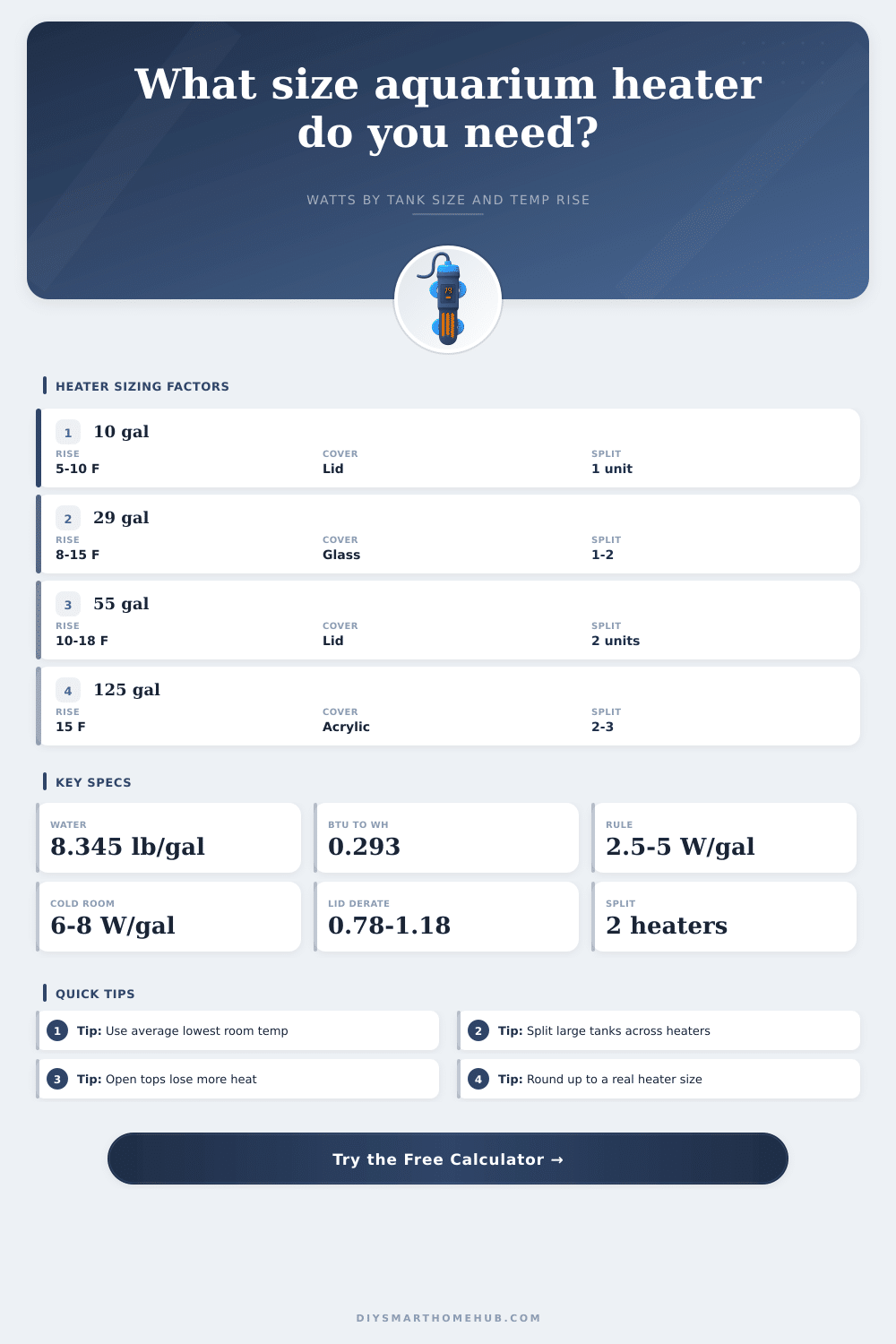
Most hobbyists use the gallons per watt rule as a starting metric. Two and a half watts per gallon is common wisdom for tropical tanks, which isn’t bad as a beginning guideline for a warm, living room environment with ambient air temperatures over seventy degrees. But if you have a tank in an unfinished basement or garage, that’s as far from true as it gets. That’s where the real math comes into play.
The temperature difference between the air and water matter greatly. It requires much more power to maintain the same settings across a twenty degree gap compared to a five degree one. It’s a common misstep many people make, they get caught up in how much they need/want for capacity but forget about the location of the tank.
So that’s where the heat loss factor comes from, the tool on this page asks what your minimum expected room temperature is. The tool on this page asks for your lowest expected room temperature; it doesn’t use the average because averages don’t keep fish alive during a cold snap. So it doesn’t assume “average” since averages don’t keep your fish alive when it’s cold outside. Instead, it looks at the factors involved in your set up and applies a heat loss factor.
This factor accounts for how much heat will be lost due to the evaporative surface and wall losses of the glass or acrylic. For example, an open top loses heat very aggressively. As water turns to vapor and leaves the tank it carries thermal energy with it. If you’re running a reef tank without a lid and high flow, that loss multiplies rapidy. To adjust for that, the calculator use multipliers for circulation level, tank material, and lid.
Thick plastic (like acrylic) is an insulator while thin glass conducts heat from inside the tank to the surrounding cold air. Rimless tanks do expose more of their surface area compared to their volume; thus, they could result in a bit more heat loss. But that’s splitting hairs and important only if you’re trying to get your sizing right down to the last decimal point.
The calculator use those coefficients to provide you with a steady state wattage value, the amount of power required to simply keep your water at temperature after it’s already warmed up. That’s one layer. There’s another: how long will it take?
When you replace half the water in your tank in the middle of winter you’re adding cold fresh water to a warm tank, which means the heater has to work overtime. Not only does it have to heat up all that new water (raise its bulk temperature), but it also has to make up for the heat lost to the room. For example, a heater sized only for maintenance may require as long as forty eight hours to get back to the target temp, which stresses sensitive fish. Setting a warm-up target in terms of hours assures the heater is given enough brute force energy to recover fast, and the calculator will choose whichever value is higher: this energy need or the steady state loss.
For bigger tanks, it’s wise practice to split your heater load across two heaters, which not only avoids having a bunch of hot spots (water right near an overly strong heater being way too warm for the rest of the tank), but also gives you some redundancy in case one heater goes belly up catastrophically. So look at what you want and then round up to the next most popular size you can find in the store. You calculate you need one hundred twenty watts? Go buy the one hundred fifty watt version rather than cutting it close by getting the one hundred watt version (precision is good for plans), but margin is better for creatures who live things.
It’s not about purchasing hardware, it’s about establishing an environment that disregards what Mother Nature is doing outside. Once you know the relationship between evaporation, temperature change and volume, you’re no longer guessing at things and are instead designing a system that will hold them during the coldest night of the year. You feel confident with the math, and you manage the details that make them succeed.