Wire Gauge by Amperage Calculator
Find the first copper or aluminum AWG size that clears load current, insulation temperature, terminal limits, current-carrying conductor derating, ambient correction, and voltage drop.
🎯Smart home circuit presets
🧮Load and conductor inputs
📊Recommended size
Wire size result
⚙Current calculation specs
Copper Table 310.16-style ampacity
| AWG | 60°C | 75°C | 90°C |
|---|---|---|---|
| 14 | 20 A | 20 A | 25 A |
| 12 | 25 A | 25 A | 30 A |
| 10 | 30 A | 35 A | 40 A |
| 8 | 40 A | 50 A | 55 A |
| 6 | 55 A | 65 A | 75 A |
| 4 | 70 A | 85 A | 95 A |
| 2 | 95 A | 115 A | 130 A |
| 1/0 | 125 A | 150 A | 170 A |
Aluminum Table 310.16-style ampacity
| AWG | 60°C | 75°C | 90°C |
|---|---|---|---|
| 12 | 20 A | 20 A | 25 A |
| 10 | 25 A | 30 A | 35 A |
| 8 | 35 A | 40 A | 45 A |
| 6 | 40 A | 50 A | 55 A |
| 4 | 55 A | 65 A | 75 A |
| 2 | 75 A | 90 A | 100 A |
| 1/0 | 100 A | 120 A | 135 A |
| 4/0 | 150 A | 180 A | 205 A |
Derating and correction checks
| Condition | Factor | Used by calculator | Result effect |
|---|---|---|---|
| 1 to 3 conductors | 100% | Current-carrying count | No conductor-count reduction |
| 4 to 6 conductors | 80% | Current-carrying count | Adjusted ampacity falls |
| 7 to 9 conductors | 70% | Current-carrying count | Often upsizes one gauge |
| Ambient above 30°C | By temp column | Insulation rating | Hot spaces reduce ampacity |
| Terminal temperature | 60/75/90°C cap | Selected terminal limit | May cap final usable amps |
| Small conductors | OCP cap | 14/12/10 Cu, 12/10/8 Al | Breaker guide can be lower |
Typical smart-home wiring loads
| Scenario | Common volts | Load range | Common check |
|---|---|---|---|
| Smart lighting branch | 120 V | 3 to 12 A | Ampacity and 3% voltage drop |
| Network closet branch | 120 V | 8 to 16 A | Continuous UPS or rack draw |
| Security/control panel | 12 to 24 V | 1 to 8 A | Voltage drop dominates |
| Garage smart controller | 120 V | 12 to 20 A | Long run plus warm conduit |
| Aluminum feeder planning | 120/240 V | 30 to 80 A | Terminal and derating caps |
| Camera power supply | 24 V | 4 to 10 A | Low-voltage drop margin |
📝Formula notes used by this calculator
“But the breaker doesn’t trip” you say, “so I know the size of that circuit is right.” Thinking is dangerous. Even if your circuit doesn’t trip out, it can overheat the insulation or burn off terminal screws. It can also cause voltage drop issues that makes things act wonky.
That’s why we have a wire gauge by amperage calculator. It takes the guess work out of guessing. When do you know that fifteen amps on a copper circuit needs to be fourteen gauge? You might know that from a chart (and that’s fine, that’s how most DIYers begin). But the world outside textbooks isnt always textbook.
Why You Need a Wire Calculator
Second: Is it a continuous load? Does the device run for at least three hours straight? Usually yes if it’s electrical code compliant. In that case, we need to size the wire at one-hundred twenty-five percent of its actual current. The calculator take care of this multiplier for you. A network rack or a smart home hub may not seem like heavy machinery, but it’s on all the time. Wires overheat when ignored in an attic or crawlspace because people look at the amp draw from the nameplate and assume it will just be carrying the EXACT same number forever. That’s why they often don’t account for this “continuous” factor.
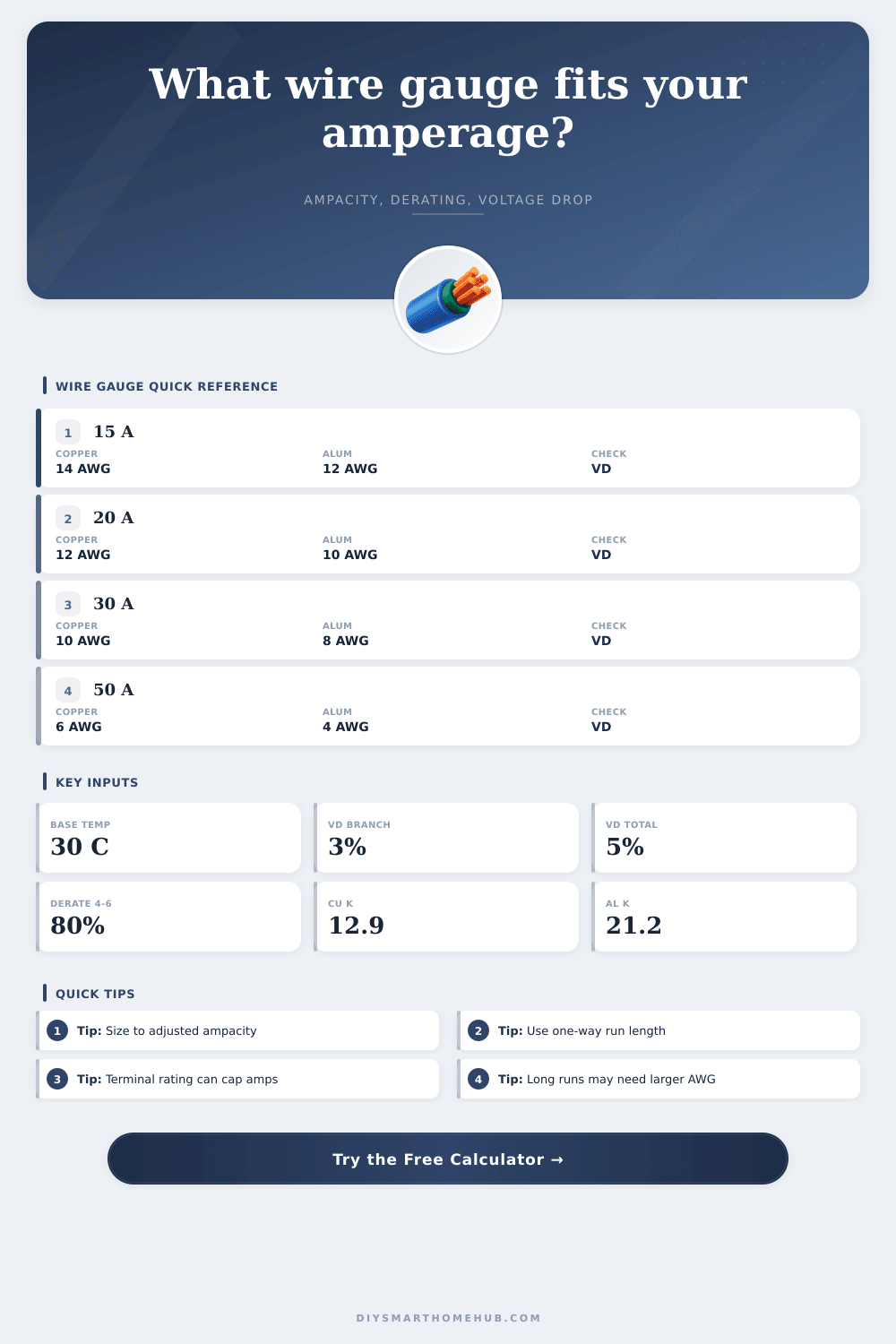
Heat stacking is another consideration. When you have more than one wire carrying current in the same conduit, they heat each other up. They may be OK at three, but when you have four to six, their capacity drop by twenty percent. Then seven to nine creates an even bigger derate. So if you put those numbers into the tool it will apply the deratings for you based on how many conductor you selected. Why does this matter? Insulation doesn’t just break down due to peak current, it’s because of sustained heat as well. You can have a perfectly rated wire that goes bad because there are other wires drawing current and all sitting in close proximity.
The same goes for ambient temperature. Standard ampacity tables assumes an environment of eighty-six degrees Fahrenheit. Ambient temperature is the air around the conduit. It could be on a sunny roof or adjacent to a boiler, which makes the air warmer. Warmer air reduces the ability of the wire to cool itself. When you plug in a higher ambient temperature into the calculator, it will lower the ampacity. You do not need to memorize all the temperature corrections above thirty Celsius. It calculates those numbers for you and lets you concentrate on selecting the right size before pulling the wire.
It’s important to understand the concept of voltage drop on long runs. You may be using a heavy-gauge wire capable of handling the amperage without issue. However, when you add in an extended length (fifty feet or longer), the resistance builds up. By the time the electricity hits your load, there isnt as much pressure. Lights dim, motors stall and sensitive electronics randomly reboot. To check this against your desired percentage, typically three percent for branch circuits, the calculator takes into account the length of the run, specific K constants based on the metal used (aluminum vs. Copper), and it estimates that loss. Increasing a gauge just one size wont necessarily change the safety profile significantly, but will eliminate a nuisance voltage drop issue entirely.
Another overlooked limitation is terminal ratings. Your wire may be rated for 90 degrees but your outlet screws or breaker terminals might only handle 60 degrees. Terminal ratings are the weak link in the chain. The calculator limits the total amps to what you choose as the lowest rated terminal. So you can’t use a larger ampere wire if the screw limits the capacity, even if the wire itself could handle more. That is an annoying thing to discover once wired. Checking that ahead of time should of saved money and time.
When it comes to picking the wire material, typically you would pick copper if available and affordably priced over aluminum. But the physics are a bit different than expected. For the same amount of current, aluminum needs to be a bigger (higher) gauge because it has greater resistance. The comparison chart on the page illustrates the step-up needed with aluminum versus copper. You can’t simply switch from one to the other based solely on gauge number. That’s why the calculator takes this material variation into account when calculating both voltage drop and ampacity.
All in all, it’s a matter of cost vs performance vs safety when it comes to sizing wire. Not only do you need something that won’t trip your breaker, but you want something that will last decades and not degrade over time. Tweak those numbers based on your set up and use the presets as examples of how your lighting branches or garage relays can be wired. Size it correctly the first time and you’ll never have to think about what’s going down that conduit ever again.