Smart Dishwasher Cycle Cost Calculator
Estimate dishwasher cycle cost from your own electricity rate, water and sewer rate, detergent amount, cycle count, heated dry setting, and per-cycle energy and water use.
| Component | Formula | Per cycle | Annual |
|---|---|---|---|
| Electricity | kWh x rate | $0.00 | $0 |
| Water/sewer | gal / 1000 x rate | $0.00 | $0 |
| Detergent | amount x value | $0.00 | $0 |
| Use level | Cycles/wk | Annual cycles | Annual total |
|---|---|---|---|
| Current | 0 | 0 | $0 |
| Cycle | Base kWh | Gallons | Typical use |
|---|---|---|---|
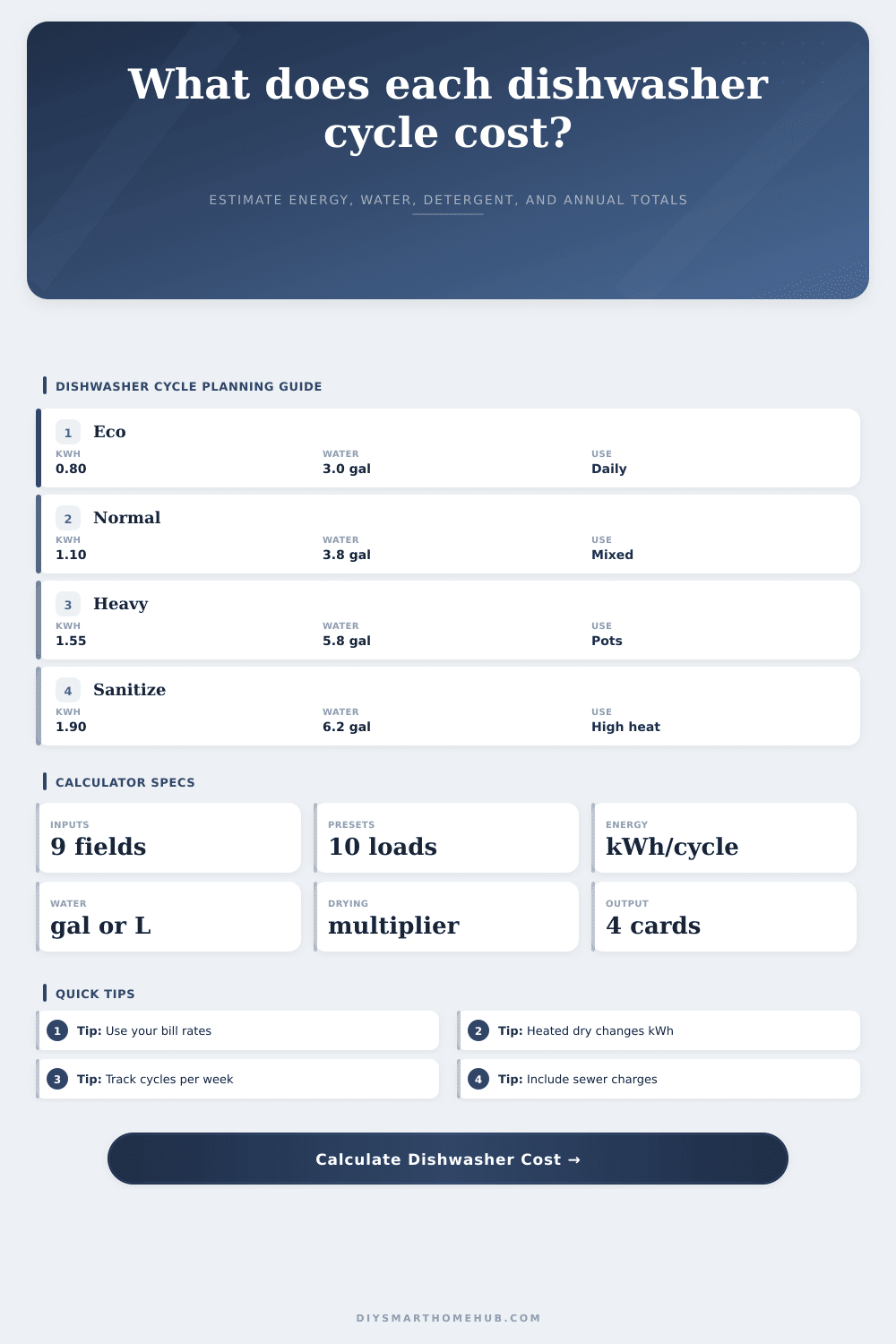
| Eco or energy saver | 0.70-1.00 | 2.6-3.5 | Daily full loads |
| Normal wash | 0.95-1.30 | 3.2-4.5 | Mixed dishes |
| Auto soil sensing | 0.90-1.45 | 3.0-5.5 | Variable soil |
| Quick or express | 0.65-1.15 | 2.8-4.8 | Light soil |
| Heavy pots and pans | 1.30-1.90 | 4.8-7.0 | Cookware |
| Sanitize or high heat | 1.50-2.20 | 4.5-7.5 | High temp needs |
| Glass or delicate | 0.75-1.10 | 3.0-4.2 | Fragile items |
| Rinse hold only | 0.10-0.25 | 1.0-2.2 | Pre-rinse |
| Item | Conversion | Use in formula | Notes |
|---|---|---|---|
| Liters to gallons | L / 3.78541 | Water cost | Internal unit |
| Gallons to liters | gal x 3.78541 | Annual report | Display only |
| Water rate | per 1,000 gal | gal / 1000 x rate | Add sewer |
| Annual cycles | wk cycles x 52 | Annual total | Planning year |
| Dry setting | Multiplier | Main effect | Use when |
|---|---|---|---|
| Air dry | 1.00x | No extra kWh | Time is flexible |
| Efficient heated dry | 1.15x | Small kWh rise | Balanced drying |
| Standard heated dry | 1.35x | Medium kWh rise | Daily convenience |
| Extra dry | 1.55x | High kWh rise | Plastic-heavy loads |
| Sanitize plus dry | 1.75x | Highest kWh rise | High heat routine |
| Routine | Cycles/wk | Dry factor | Watch item |
|---|---|---|---|
| Single person | 2-4 | 1.00-1.15x | Detergent unit |
| Family meals | 6-9 | 1.15-1.35x | Annual cycles |
| Cookware heavy | 3-6 | 1.35-1.55x | kWh and water |
| Sanitize routine | 2-5 | 1.55-1.75x | Heating energy |
Everyone knows that a dishwasher eats electricity and water, but nobody realy knows what a given cycle of their own dishwasher costs them. And they assume it’s just some line item on the bill. So they runs it five nights a week.
It is usually in vain, since the true cost depends completely on the cycle you select, not to mention how you handle the drying phase. Enter your local detergent price and utility rate into the calculator above, and it’ll do the math for you. Vague guilt becomes precise dollars and cents.
How to Save Money on Your Dishwasher
Heated dry is also known as big hidden cost. These days, dishwashers is shockingly good at cleaning your dishes, with as little as three to four gallon of water per load. During the wash cycle, they also aren’t a huge power hog either; most models draws under a kilowatt hour of energy on eco settings. Here’s where it gets dicey. On the finish, the heated dry feature will keep the heating element running so any leftover moisture gets evaporated off the dishware. Depending on which setting you choose, this extra step can add between 15 and 75 percent more energy used per load. A small toggle button makes a big change in the physics of the load.
Open the door a smidge at the end of the cycle and let the rest of the work be done by evaporation instead. It costs nothing in electricity, and you save money.
The tricky part is the cost of water, which varies greatly different than place to place. Some places has metered water and sewage systems. They bill you for every gallon of water you draw from the main, so pulling all that water will essentially double your costs. Since that’s electricity + water, if your local rates are high enough, water will become a bigger factor in the cost stack than the electricity itself. That’s why the tool asked for both water AND sewage together. Go to your water bill and figure out how much you pay to USE water (not just how much it COSTS per unit). That’s the total number you plug into this thing, and then it’ll give you a real-world view of how many dollars you’re flushing down the drain with each of those three gallons of water.
But what no-one thinks of as being ‘cheap’ is detergent. You don’t think, “hey that’s twenty eight cents a load”, that’s just a pod. But then times five-hundred loads a year… that’s more than a hundred bucks a year! So the calc asks how much you spend on detergent (liquid vs. Powder vs. Pods) and breaks down the annual cost. Again, it’s not who makes it, but the math of the dose. Using two pods instead of one just doubles the expense without increasing the clean. If you’re wasteful with detergent, the chart on the page explains, then it can easily outweigh utility bills even on an efficient cycle.
The other multiplier (frequency) is where even slight inefficiencies adds up in big ways on your yearly bill. Someone doing a heavy cycle with heat dry every night will see their annual bill skyrocket more different than someone running an eco cycle three times per week. Most kitchen loads don’t require a heavy wash. Rinse holds or quick cycles can handle lightly soiled load to save both energy and water.
You need to know what you are measuring. Then, adjust your habits to use the most efficient cycle for each pile of dishes. We don’t want you to avoid the dishwasher, we just want you to use it smarter. Get a sense of what cycles you run and what your real electricity rate is, so that you know exactly where your money’s flowing. Often it has little to do with the appliance itself and much more to do with which buttons you’ve gotten into the habit of pressing.
Once you know how much it will cost you per year to keep doing what you’re doing, you could of decided if you want to adjust your cycle usage or switch to air drying. You’ll begin to view each press of a button differently, knowing the costs involved. The cost awareness shifts your view of the device from a black-box-of-consumption to a tool with a set of clear tradeoffs. That’s the difference between paying for convenience versus paying for waste.