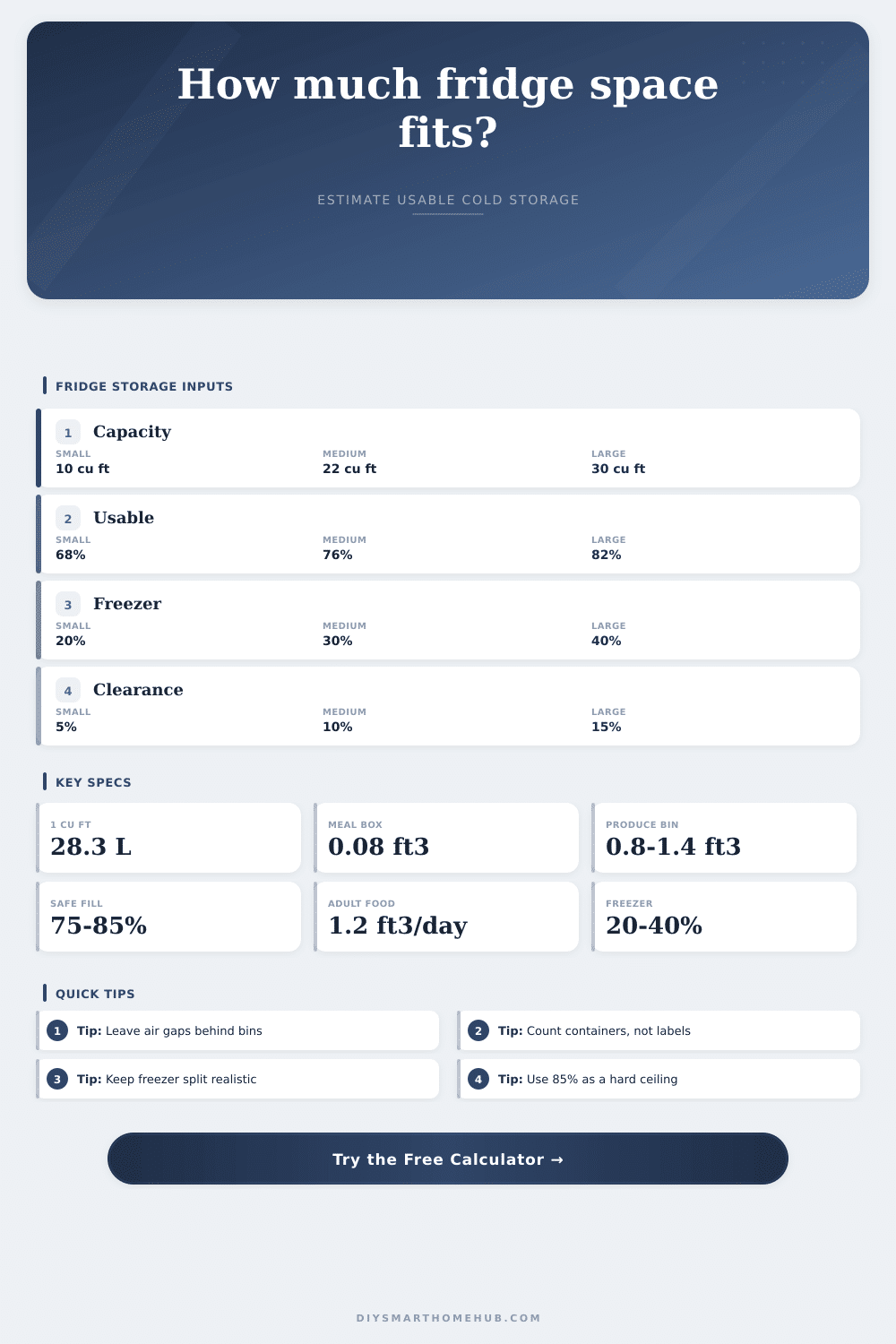
Smart Fridge Storage Volume Calculator
Estimate usable refrigerator volume, freezer split, meal-prep container load, produce space, shelf clearance loss, occupancy percent, and realistic days of food capacity.
Storage Volume Results
Calculation Breakdown
| Advertised size | Usable at 70% | Usable at 78% | Liter equivalent |
|---|---|---|---|
| 10 cu ft compact | 7.0 cu ft | 7.8 cu ft | 283 liters gross |
| 18 cu ft apartment | 12.6 cu ft | 14.0 cu ft | 510 liters gross |
| 22 cu ft family | 15.4 cu ft | 17.2 cu ft | 623 liters gross |
| 30 cu ft large | 21.0 cu ft | 23.4 cu ft | 850 liters gross |
| Food group | Typical volume | Smart fridge note | Planning use |
|---|---|---|---|
| Meal-prep box | 0.025-0.055 cu ft | Count every stacked box | Direct displacement |
| Produce drawer | 0.8-1.4 cu ft each | Humidity bins reduce stacking | Reserved fresh space |
| Drink shelf | 0.6-1.2 cu ft | Tall bottles need clearance | Airflow reserve |
| Leftovers tray | 0.3-0.8 cu ft | Flat zone improves scanning | Occupancy pressure |
| Layout | Typical freezer share | Fresh-space effect | Best fit |
|---|---|---|---|
| Compact | 10-22% | Mostly fresh storage | Drinks, snacks, dorms |
| Top freezer | 25-32% | Balanced fresh volume | Small households |
| French door | 28-36% | Wide fresh shelves | Family meal prep |
| Side-by-side | 35-45% | Narrow fresh shelves | Frozen inventory |
| Scenario | Total capacity | Target fill | Planning range |
|---|---|---|---|
| Single compact | 7-11 cu ft | 70-78% | 2-4 food days |
| Two adults | 14-19 cu ft | 75-82% | 4-6 food days |
| Family kitchen | 22-28 cu ft | 78-85% | 4-7 food days |
| Bulk prep home | 28-34 cu ft | 80-88% | 6-10 food days |
You probably bought your smart fridge for the camera or its screen, but what you realy bought was a complicated box governed by the laws of physics. Whether it contain fresh spinach or frozen meat, it takes up space and has a volume. In most cases, when we look at what is advertised as cubic footage available inside the fridge, we envision empty shelves. In reality this rarely happen. That’s where the usable factor comes in.
You see, manufacturers use advertised capacity as a way to market their product. They’re measuring entire interior, including all ventilation channels, ice maker housing, door bins and walls. There’s no room in there for your leftover lasagna. To account for this physical fact, the calculator runs the math for you, but it also helps to know why advertised capacity is a marketing trick.
The Truth About Fridge Space
For example, a compact fridge may gives you just sixty-eight percent of what they say it can hold. This is due to amount of space taken up by the mechanics and insulation. Their larger French door models is more efficient. They can reaches seventy-eight percent or even higher. This is important if you want to fit a week’s worth of meal prep.
Most errands at the grocery store fail here. You look around and think there’s empty space available, but there isn’t. Each can or box you put in there takes up a cubic volume of air. When you pack the Tupperware and cook for yourself (or four), remember that the Tupperware itself has a physical presence as well.
Enter an estimate for how many containers you’ll keep and their average size, and the tool will shows you how much space they take up in the airflow. It’s not just food, it’s also plastic.
The other key for fridge efficiency is airflow. By default, fridges has one temperature sensor that typically sits at the back of the unit and reports just that one temperature. But if you block door swing or stack items tight against the vented back, the sensor thinks it’s perfect even though your milk is warming inside a bubble of still air. The calculator should of had a buffer for this, so it doesn’t fill the unit to the brim. It’s just thermodynamics, not aesthetic.
A freezer split makes all the difference. A top-freezer fridge is great for fresh stuff because the cold air stay down there, but it is too bad if you can’t fit all your frozen item in. With side by side, you get a huge freezer, but tight shelves for the fresh stuff.
Do you freeze half your groceries? You want it dedicated cold space. Do you eat primarily fresh food? Choose width different than depth. How layout determines use: see the reference table on the page.
Daily food consumption is the amount an average person eats, measured in cubic feet per day. The packaging also counts: One and a half cubic feet of food per day for each adult. Your household size determines how much throughput you require: High throughput if you have a large household Compactability if you live alone The calculator figures out your food days based off that ratio. Are you living on a ten-day buffer or just a two-day supply?
Every fridge has its advantages and disadvantages. No fridge is perfect, but some are perfectly suited to what we do (and by we I mean ME). Do you meal prep? Then count your containers and make sure there’s plenty of room for fresh stuff. Do you stock up on bulk items? Then make sure you have enough freezer space and don’t mind narrow shelves.
The point isn’t to pack it all into the box, it’s to control the flow. Leave yourself room for air. And leave yourself room for errors. Your food will thank you for letting it breathe.