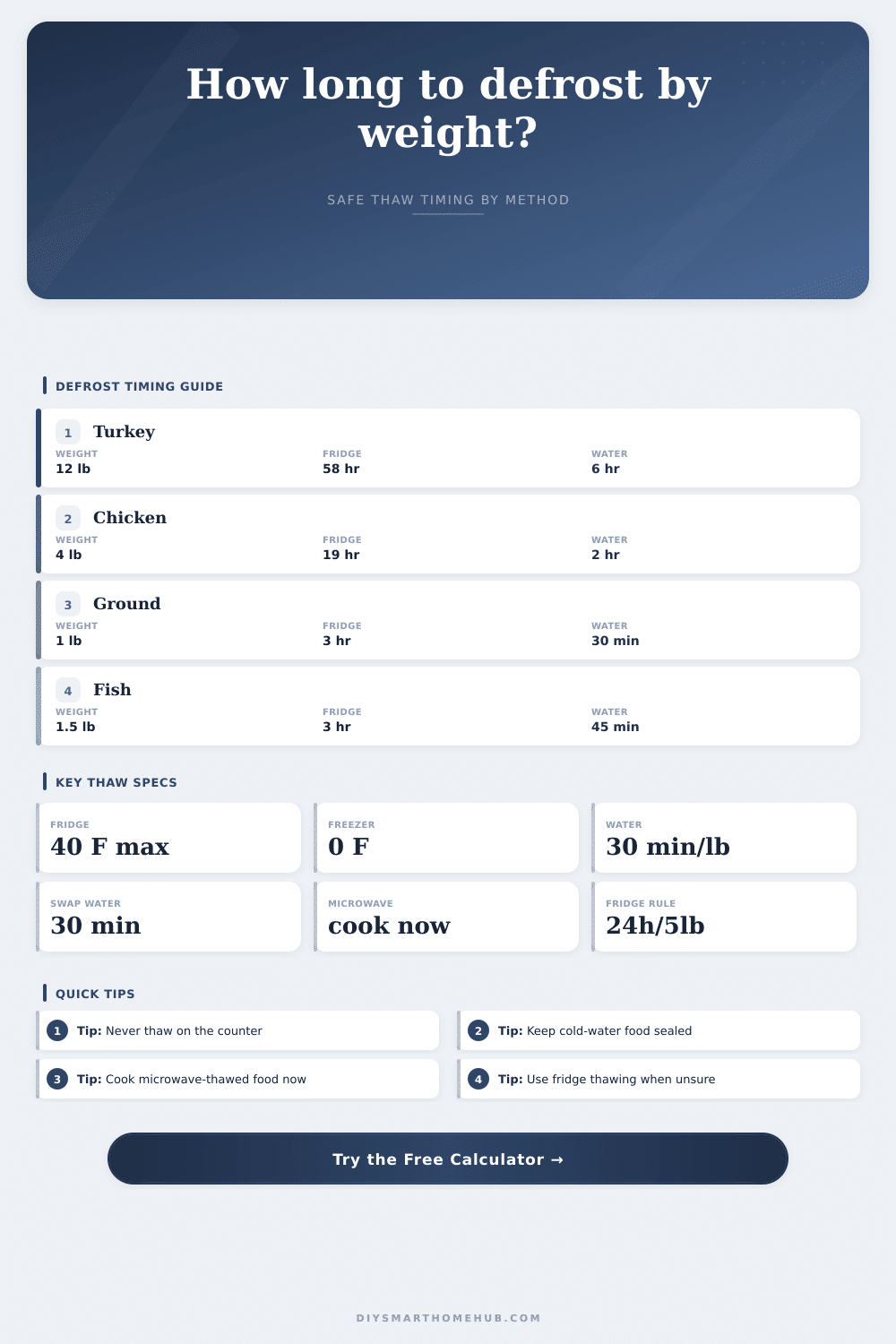
Defrost Time by Weight Calculator
Estimate refrigerator, cold-water, or microwave thaw time from food weight, food type, thickness, starting temperature, package shape, and safety checkpoints.
| Method | Calculator Basis | Safety Rule | Best Use |
|---|---|---|---|
| Refrigerator | Hours per pound with fridge-temp factor | Keep food at 40°F or below | Safest planning method |
| Cold water | Minutes per pound with water-change factor | Seal package and change water every 30 minutes | Faster same-day thawing |
| Microwave | Minutes per pound adjusted for wattage | Cook immediately after thawing | Small portions cooked right away |
| Cook from frozen | Not a defrost estimate | Allowed for many foods with longer cooking time | When thawing is skipped |
| Food Type | Fridge Base | Cold Water Base | Microwave Base |
|---|---|---|---|
| Whole turkey or large whole bird | 4.8 hr/lb | 30 min/lb | Not ideal |
| Whole chicken or small whole bird | 4.5 hr/lb | 28 min/lb | 5.5 min/lb |
| Ground meat block | 2.6 hr/lb | 22 min/lb | 4.0 min/lb |
| Fish fillets or seafood portions | 2.1 hr/lb | 18 min/lb | 3.0 min/lb |
| Roast or dense meat block | 5.2 hr/lb | 32 min/lb | 6.0 min/lb |
| Package Shape | Factor | Why It Matters | Example |
|---|---|---|---|
| Flat single layer | 0.75x | More surface area touches cold air or water | Flat fish fillets |
| Tray wrapped pieces | 0.95x | Moderate air gaps and contact area | Chicken breasts |
| Dense block | 1.20x | Center stays frozen longer | Ground beef brick |
| Whole bird | 1.30x | Cavity and uneven mass slow thawing | Turkey |
| Stacked bag | 1.40x | Clumps reduce exposed surface | Frozen shrimp bag |
| Scenario | Weight | Suggested Method | Planning Result |
|---|---|---|---|
| Weeknight ground beef | 1 lb | Cold water | About 30-45 min |
| Whole chicken | 4 lb | Refrigerator | About 1 day |
| Holiday turkey | 12 lb | Refrigerator | About 3 days |
| Fish fillets | 1.5 lb | Cold water | About 30-60 min |
| Dense roast | 3 lb | Refrigerator | About 18-30 hr |
| Reference | Used Here | Calculator Note | Safety Action |
|---|---|---|---|
| USDA FSIS Big Thaw | Three safe thawing methods | Fridge, cold water, microwave only | Plan ahead for refrigerator thawing |
| USDA FSIS Big Thaw | Cold-water timing | About 30 minutes per pound for whole turkey | Change water every 30 minutes |
| FDA Safe Food Handling | Immediate cooking rule | Cold-water and microwave thawing require cooking soon | Do not refreeze before cooking |
| FoodSafety.gov charts | Cold storage context | Frozen storage at 0°F preserves safety | Use quality timelines separately |
When planning on making tacos at six o’clock and realizing ground beef is still frozen, or remembering that you threw the turkey in the freezer back during Thanksgiving, you’re faced with a certain panic. In real life, defrosting isn’t exactly a science experiment; it’s more of a race against biology and clock. But most people approach thawing as a passive process. They don’t have to be wrong about that: it’s a mistake.
Thawing is all about managing temperature gradients. Dense matter doesn’t heat quick, and it warms up faster then it cools down. If the outer surface warm before the inner core cools, you get in danger zone. Once you plug-in weight and method, the calculator figures out the rest. It turns physical properties into a time frame you can trust.
How to Thaw Meat Safely
The fridge is still safe. It is the slowest but safest method; all food stay below forty degrees, and the tool compensates with a base rate per pound. The thing about volume versus mass: a flat fillet thaws faster than a whole bird, which have much greater surface area. The heavier an object, the slower its heat exchange (a dense slab of meat lets heat through less easily). The tool accounts for shape; a single layer in freezer thaws more quickly than a stack of the same amount of food.
Big difference. Why? Because if you don’t account for thickness, then whatever number you enter won’t work, and what’s inside will thaw before the outside defrosts, leaving you with frozen centers and spoiling edges. Know the deepest part, not longest dimension. That’s a big change from edge-to-edge length and will add a lot to your buffer time.
An emergency option is thawing in cold water. This is quicker (water moves heat more efficiently than does air), but it requires active involvement. You need to change the water frequently. The calculator takes into account how often you replace it on half-hourly schedule. In other words: Don’t leave the food sitting, or it will start to warm up. This is why the tool applies a warming time factor to account for this delay. It also tells you that you should cook within hours of defrosting; otherwise, it’s not safe. And it cautions that you can’t refreeze something once you’ve defrosted in water.
Once safety chain is broken, it stays broken. The microwave is even stricter. As the food thaws, it cooks. So when it comes out of the microwave, you have to cook it right away. The calculator knows this, so it recommends cooking immediately as the only possible safe action next. Why? Because warmth and moisture are the perfect environment for bacteria to grow quicky.
Big roasts are a great example of where people underestimate how long they take. You can’t just pop a 3lb piece of beef into fridge and expect it to be done within an hour. The answer? Plan ahead. That’s really the only way around it. This is why there is a reference table on page to make those timelines clear.
Why does it take days, rather than hours for a turkey? Because if you try to do that, your bird will cook unevenly, with the outside dried out while the center is still raw. Choosing the right package shape prevents that; a turkey is a good example because its cavity slows down the heat flow. The tool handles geometry, so it applies a multiplier for things other than regular shapes. No more false confidence from a quick estimate… Just a realistic window instead of a hope-filled guess.
Do not let anything defrost on countertop. That seems easy. The room temperature is all over the place though and it’s dangerous. Before the inside of the package has time to thaw completely, the exterior will reach an unsafe temperature. So the calculator excludes counter thawing entirely. And that’s good! Because it requires you to take the safe route.
That’s what a constraint does: makes sure you make smart choices. Smart choices keep you healthy; they don’t have to be perfect, they just need to become habits. If in doubt, use a thermometer. Follow the timer, but check the outcome.
Cooking can be fun, eating safely shouldn’t get in your way. Thawing properly saves money, taste, texture, and most importantly keeps things from getting ill. You turn a clump of ice into something useful. In the end, defrosting is physics: it is about respecting how heat acts like heat.
When cold food warms up, it doesn’t just become warm food. Somewhere along the way, there is a critical phase where all kinds of life form. You must also learn how to control that phase. With patience or precision.
The calculator delivers the precision. Patience is what you get from your plan. Bring them together. Make a plan so you don’t have a dinner crisis. Instead, you have a manageable task. You have turned a frozen disaster into something else. Knowing how much that meal weighs is step one.