SHGC Heat Gain Calculator
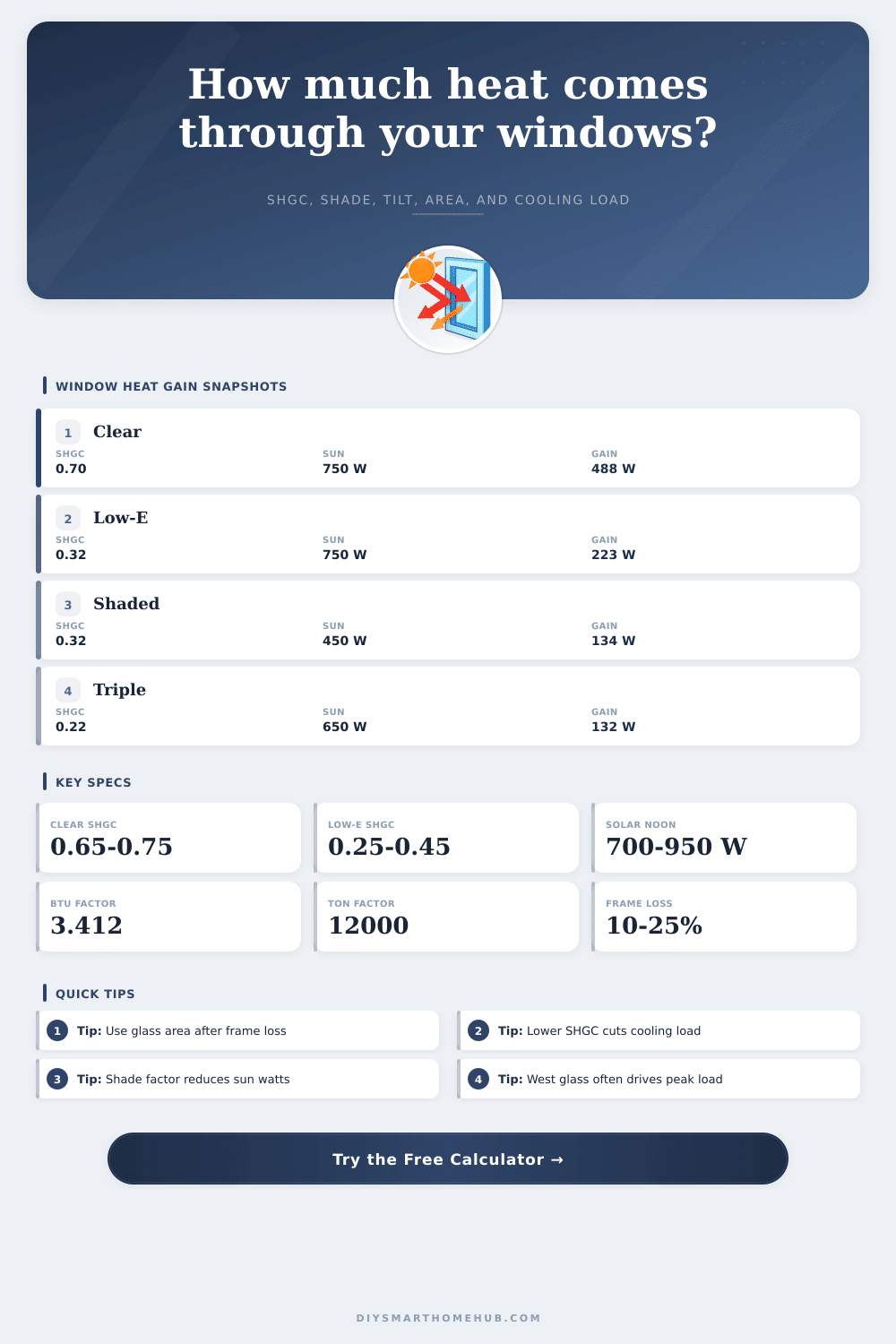
Estimate solar heat gain through windows using window area, SHGC, irradiance, orientation, shade, tilt, frame fraction, temperature difference, and exposure duration.
📌 Window heat gain presets
📐 Window and sun inputs
The solar path uses SHGC. The temperature delta path uses U-factor, so the total load can include both sun-driven and conduction-driven heat gain.
📊 Heat gain results
🔎 Glazing spec grid
🧮 Heat gain formulas
📋 SHGC and U-factor reference
| Glazing type | Typical SHGC | Typical U-factor | Best use |
|---|---|---|---|
| Clear single pane | 0.70 to 0.80 | 0.95 to 1.10 | Existing older windows |
| Clear double pane | 0.55 to 0.70 | 0.45 to 0.55 | Moderate climates |
| Low-E solar control | 0.25 to 0.40 | 0.24 to 0.34 | Cooling-dominant rooms |
| Low-E passive gain | 0.45 to 0.60 | 0.25 to 0.35 | Winter solar gain |
| Triple pane low-E | 0.18 to 0.35 | 0.14 to 0.24 | Very low conduction |
| Orientation | Factor | Peak behavior | Design note |
|---|---|---|---|
| North | 0.35 | Mostly diffuse light | Usually the lowest solar load |
| East | 0.78 | Morning sun | Can warm bedrooms early |
| South | 0.88 | Midday sun | Overhangs can work well |
| West | 1.00 | Afternoon peak | Often drives cooling load |
| Horizontal skylight | 1.12 | High sky exposure | Tilt and shade matter most |
| Shade condition | Factor range | Typical source | Calculator input |
|---|---|---|---|
| Unshaded glass | 0.95 to 1.00 | Direct sun on pane | Use 1.00 |
| Light interior blinds | 0.70 to 0.85 | Partial light control | Use 0.75 |
| Exterior screen | 0.40 to 0.65 | Solar screen or mesh | Use 0.55 |
| Deep overhang | 0.25 to 0.55 | Roof, balcony, awning | Use 0.45 |
| Tree shade | 0.35 to 0.70 | Seasonal filtered shade | Use 0.60 |
| Window scenario | Area | SHGC | Quick reading |
|---|---|---|---|
| Bedroom pair | 28 ft² | 0.32 | Small but noticeable peak |
| Patio slider | 72 ft² | 0.30 | Large west glass matters |
| Skylight group | 24 ft² | 0.40 | Tilt raises exposure |
| Sunroom wall | 180 ft² | 0.42 | Can dominate room load |
| Triple-pane upgrade | 72 ft² | 0.23 | Lower sun and conduction |
💡 Practical calculation tips
Even if your air conditioning isn’t broken, you probably know that windows is also a major source of heat entering a home. Sunlight enter through the window glass and becomes trapped within your livivng space. This metric, called the Solar Heat Gain Coefficient (SHGC), represents the percentage of that solar energy that penetrates into your home. A higher SHGC value indicate greater heat penetration; a lower one indicates less. Knowing this will help you control comfort level in your living area.
If you know size of your window(s) and what type of glass it’s made from, the calculator will do the math for you. You’ll need to take into account direction: West-facing gets super-hot afternoon sun while north is diffuse. It will also adjust based off direction so that you can view the specific openings that contributes the most to your cooling load. In a lot of cases, one big west-facing patio door have a bigger impact different than multiple small bedroom window facing east.
How Windows Let Heat Into Your Home
A biggie: How much shade does the window have? Heat will enter through any window, but exterior shades is more effective at blocking that heat since they block rays before they reach the pane. Interior blinds don’t block energy, all that’s doing is trapping heat inside, between glass and the blind itself. The shade factor in the calculator accounts for this variation. So don’t assume typical reduction; adjust accordingly based on what you actualy have installed. If you get shading right, your AC unit would of be the right size.
Even if a window doesn’t get direct sunlight, it will still transmit heat by conduction: hot air outside conducts its heat into cool air inside, in contact with glass. That’s measured as U-factor. Amount of conductive gain. Triple-paned windows is very good at keeping heat out of your home (although they’re more expensive up front). Low-E coatings also reflect that heat outward, where it belongs. The tool breaks down conductive vs. Solar gain for you, so you know which one is dominating your scenario. Both pieces of data matters for knowing how much of a load your HVAC system are carrying overall.
But that’s not necessarily right either; the least efficient is not always best. For example, if you live in a cold climate and are designing a passive house, you may want more solar gain in the winter months to help with heating bill. This leads to higher efficiency. But if you’re running the air conditioner much of the year, you’ll be better off seeking lower coefficient glass.
To understand what range to expect for various glass types, here’s a reference table that shows typical ranges for different glass type. You can use it as a baseline comparison between old and new windows. You can use it as a baseline comparison between old and new windows.
In addition, the accuracy of result depends on frame fraction. Sashes and frames obstruct part of the window, which lowers its effective surface area and blocks out some of sunlight. If you input a reasonable estimate for frame fraction, the calculator will automatically subtract that part of the rough opening. Failing to account for it make your calculated heat gains too high. A little tweaking in this direction can be crucial to get accurate energy results.
Windows control how much energy flow in and out. Newer Low-E units close these valves tighter then older single-pane glass. The system doesn’t waste time battling continuous solar infiltration, saving on cooling bill. Typically, west exposures is the biggest culprits; check them first in peak hours. Before you replace any windows, adjust your shading strategy, since an easy-to-install exterior awning might work better than new glass.