Attic Insulation Depth Calculator
Estimate how much attic insulation depth to add from target R-value, existing R-value and depth, material type, settled density, joist depth, compression factor, coverage area, and climate zone.
📌Attic presets
📏Enter R-value and attic data
Attic insulation depth result
Enter target R-value, existing insulation, material, density, joist depth, area, compression, and climate zone to size the added depth.
🧱Insulation material grid
📊Reference tables
| Climate Zone | Attic Target | Planning Note | Typical Depth Check |
|---|---|---|---|
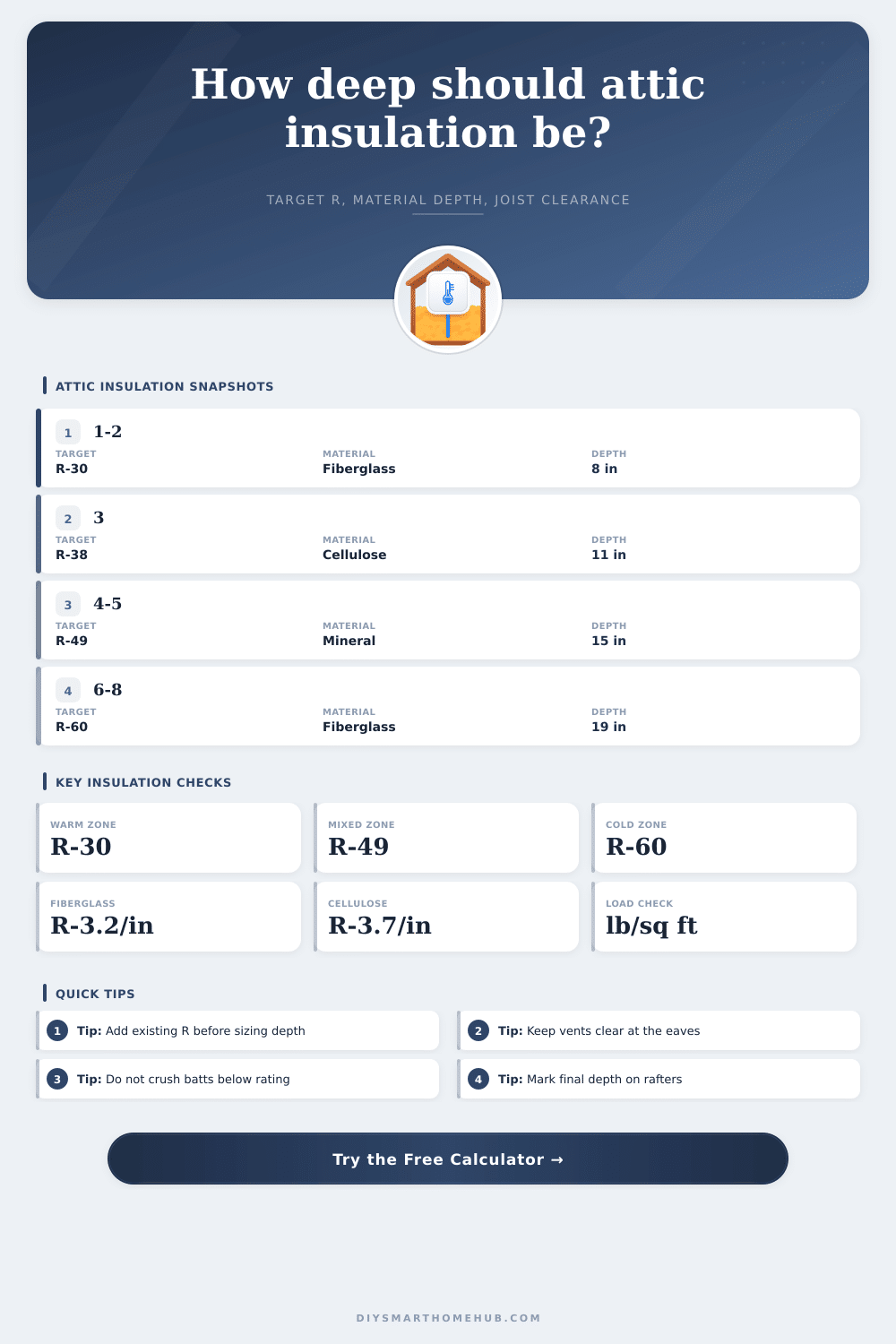
| Zone 1 | R-30 | Hot humid attic target | About 8-10 in at R-3.2 to R-3.7/in |
| Zone 2 | R-30 | Warm climate attic target | Existing R can reduce added depth |
| Zone 3 | R-38 | Warm mixed climate target | About 10-12 in at common loose fill |
| Zone 4 | R-49 | Mixed climate target | About 13-16 in at common loose fill |
| Zone 5-6 | R-49 | Cool to cold target | Check eave baffles and hatch height |
| Zone 7-8 | R-60 | Very cold target | May need raised walkways or dams |
| Material | Typical R/in | Density Range | Depth Note |
|---|---|---|---|
| Loose-fill fiberglass | R-2.7 to R-3.4 | 0.45-0.75 lb/ft3 | Light load, depth markers useful |
| Loose-fill cellulose | R-3.2 to R-3.8 | 1.4-2.0 lb/ft3 | Higher load, good air resistance |
| Loose mineral wool | R-3.0 to R-3.7 | 1.2-1.8 lb/ft3 | Heavier loose-fill option |
| Fiberglass batt | R-3.0 to R-3.7 | 0.5-1.0 lb/ft3 | Compression lowers effective R |
| Mineral wool batt | R-3.7 to R-4.3 | 2.0-3.0 lb/ft3 | Dense batts resist slumping |
| Closed-cell foam | R-5.8 to R-6.8 | 1.7-2.2 lb/ft3 | High R per inch, air seals well |
| Formula | Calculator Use | Imperial | Metric Equivalent |
|---|---|---|---|
| Missing R | Target R minus existing R | Rtarget - Rexist | Same R value |
| Settled depth | Depth needed after settling | Missing R / adjusted R/in | Inches x 2.54 = cm |
| Installed depth | Depth before settling allowance | Settled depth / (1 - settle) | cm shown from inches |
| Added volume | Insulation volume with buffer | Area x depth / 12 | ft3 x 0.0283168 = m3 |
| Load | Added attic floor load | Density x depth / 12 | lb/ft2 x 4.882 = kg/m2 |
| Compression | R loss from squeezed material | R/in x compression factor | Same factor |
| Attic Example | Area | Target | Common Result |
|---|---|---|---|
| Small ranch attic | 700 sq ft | R-38 | 6-9 in added over R-11 |
| One-story mixed zone | 1200 sq ft | R-49 | 8-12 in added over R-19 |
| Two-story cold zone | 900 sq ft | R-49 | 10-14 in added over R-13 |
| Deep energy attic | 1600 sq ft | R-60 | 13-18 in added over R-11 |
| Low joist retrofit | 500 sq ft | R-38 | Final depth often above joists |
| Foam roof deck | 850 sq ft | R-38 | Lower depth from higher R/in |
💡Attic insulation sizing tips
It’s July. You head to the attic to survey for pests, and discover compressed fiberglass, which sends heat downward into a hot, dusty atmosphere. Why? Because home-owners installed it without considering its depth compared to the R-value needed for your climate zone. It sits there as if it were barely nothing at all; instead of providing insulation, it just traps more heat.
Insulating isn’t complicated math. You have to be patient with it though. A lot of folks just push the batts around in the joist cavities until they are out of sight. This crush them, though. That is bad because it eliminates their loft, which means they has less ability to trap air.
Why Insulation Depth Matters for Your Home
The calc will tell you how much additional insulation volume you need to get up to correct resistance level. It even figures in the compression/settled density and lets you know if some extra inches would actualy insulate. The first thing you’ll do is enter your climate zone. This sets target R-value. Homeowners in colder climates want an R-value of 60 or higher to help seal out heat, while Floridians want as high as R-30 to avoid those sky-high cooling bills in summer. This tool take into account the regional weather pattern and will adjust accordingly so there’s no need to remember which building code applies to each and every county.
You can pour new stuff on top of old, but you have to measure what’s already there first. That’s why you enter your initial depth and R-value into the calculator. If you’ve got a couple layers of old compressed fiberglass but didn’t measure how thick they are, pouring in layer of cellulose will form a thermal bridge. You’ll need to figure out what’s missing.
The physical depth depends off material choice. Materials with more insulation value per inch, like closed-cell spray foam, require less volume than materials with less insulation value per inch, like loose-fill fiberglass. Attic insulation also affects air sealing (cellulose does better then loose-fill fiberglass). Will your attic floor support the added weight of cellulose? How much heavier will your attic floor become? Use these calculations in the results section to check structural safety before hiring a contractor.
To test how much can be stored on top, check your joist depth. Is the amount of recommended insulation too deep for your joists? Walking or stacking boxes above will crush the higher levels, creating gaps that cut down effectiveness and show up on infrared camera as cold spots. Maintaining depth in the middle part of the roof plane (above) keep the air flowing, but leaves room at the eaves for ventilation.
By calculating volume you’ll be able to order just enough material. Add a little extra as a percentage buffer to account for odd shapes around attic hatches, plumbing stacks, and duct work. Better to have some left over loose fill versus having holes next to electrical junction boxes. Those holes will undermine your whole thermal envelope.
Insulating can become a science that leads to fewer drafts and lower utility bills. You don’t have to deal with dust in your eyes just to be precise when working in the attic. Turn it from chaos to comfortabley with proper depth. It could of been easier if you used this tool.