Rack Weight Capacity Calculator
Estimate loaded equipment weight, rack rating utilization, floor load, per-U density, caster derating, safety-factor headroom, and top-heavy risk for a home lab or smart home rack.
Full Breakdown
| Rating check | Formula used | Good range | Watch range | Action range |
|---|---|---|---|---|
| Loaded equipment weight | servers + UPS + switches + rails + cable allowance | Below derated capacity | Near protected capacity | Above protected capacity |
| Rack utilization | loaded weight / derated rack rating | Under 60% | 60% to 80% | Over 80% |
| Safety utilization | loaded weight / (derated rating / safety factor) | Under 85% | 85% to 100% | Over 100% |
| Minimum rack rating | loaded weight x safety factor / derate | At or below actual rating | Within 10% of rating | Above actual rating |
| Rack service | Derate factor | Why it changes | Best practice |
|---|---|---|---|
| Static rack on leveling feet | 1.00x | Load is mostly vertical and stationary. | Keep feet level and all rails fastened. |
| Static rack anchored | 1.00x | Anchoring improves stability, not the rack frame rating. | Use anchors for tall or narrow racks. |
| Rolling rack on casters | 0.75x | Casters add point loading and dynamic side loads. | Lock casters and avoid rolling while fully loaded. |
| Mobile while loaded | 0.60x | Door thresholds and turns can shock-load the frame. | Unload heavy UPS units before long moves. |
| Wall-mounted rack | 0.50x | Mounting surface and bracket pull-out become limiting. | Verify wall structure separately before loading. |
| Metric | Light load | Moderate load | Dense load | Planning note |
|---|---|---|---|---|
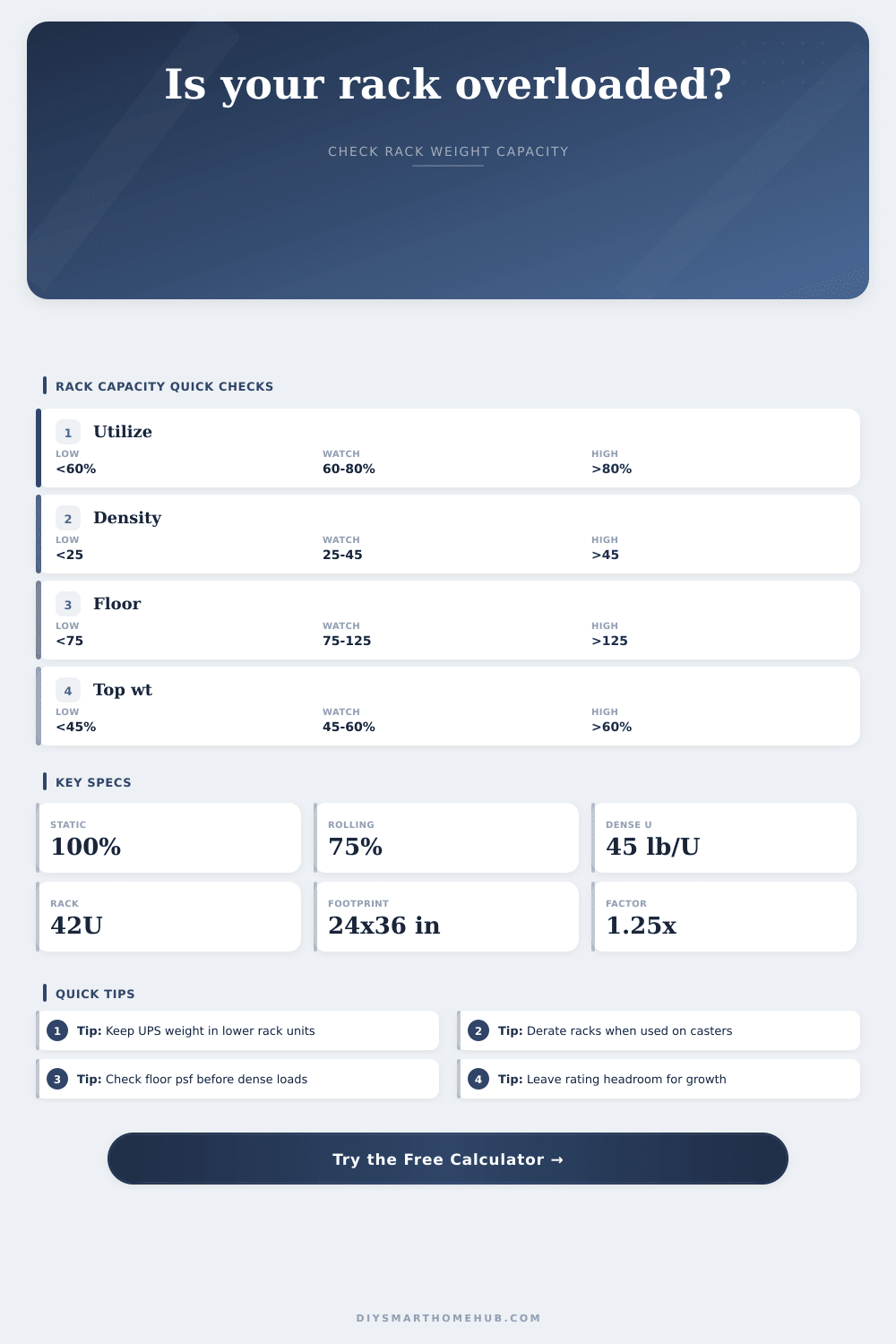
| Per-U density | Under 15 lb/U | 15 to 35 lb/U | Over 35 lb/U | UPS and short-depth servers raise density quickly. |
| Floor load | Under 75 psf | 75 to 125 psf | Over 125 psf | Small rack footprints can create high local loads. |
| Top-half weight | Under 45% | 45% to 60% | Over 60% | Place battery trays and heavy servers low when possible. |
| Safety factor | 1.10x | 1.25x | 1.50x+ | Use more headroom for rolling racks and future expansion. |
| Build name | Rack | Loaded weight | Used U | Per-U density | Notes |
|---|---|---|---|---|---|
| 6U wall network | Wall rack | 55 to 90 lb | 4U to 6U | 10 to 16 lb/U | Often limited by wall structure, not rails. |
| 12U AV closet | Static shelf rack | 120 to 220 lb | 8U to 10U | 14 to 24 lb/U | Receivers and UPS units should sit low. |
| 24U network rack | Open frame | 220 to 450 lb | 12U to 18U | 15 to 25 lb/U | Check cable and shelf allowances. |
| 42U home lab | Enclosed rack | 500 to 1100 lb | 18U to 32U | 25 to 40 lb/U | Floor psf can matter more than rack rating. |
Floor load is a planning calculation using rack footprint area. Building structure, subfloor span, caster contact area, wall anchors, and local codes can impose stricter limits.
You are facing a black server rack in your home office. It’s the machine that houses your network switch, server and UPS. It is something to be proud of, an industrial looking piece of equipment. But what about the structural limitations of the floor? While most people think about storage and processing power, they doesn’t realize steel has a limit to how much it can hold. A tipped over rack can injure someone, damage the floor and wreck the equipment. This calculator prevents that.
Dynamic load versus static load. To start with, you need to know that there are two types of load: static and dynamic. If it’s bolted to the floor, it will support more weight than if it’s on wheels. When you opt for a rolling base, the tool use a reduction factor of approximately seventy-five percent. Why? Your rack moves around and creates shock loads as it rolls across uneven surfaces or over thresholds. So although you may believe a twelve-hundred-pound rating is adequate, in reality a rolling rack carries a safety margin of only nine hundred pounds.
Keep Your Server Rack Safe and Stable
Many people overlook the fact that weight isn’t stationary. They just look at the max number on the box and think they’re good to go.
Another consideration is center of gravity. Even if you’re within the overall weight limit, you could still have a problem. Because the rack is basically a lever, placing any heavy equipment, such as a battery backup or disk array… In the upper part will affect it balance. This is where the calculator assess the risk of being top-heavy by measuring how much of the weight are located above the half-way mark. The higher this number, the greater the torque on the bottom, making it more susceptible to tipping over. It’s a matter of strict physics, and even a light amount of gear positioned too high up could be more hazardous than a heavier but evenly distributed load. To prevent this, keep your heaviest items down.
Another factor is the floor load. People and furnitures live in residential floors; they don’t live in floors made for concentrated industrial loads. How much does your rack weigh? Depending on its size, that translates into a number of pounds per square foot, exactly what the floor was never meant to hold. When you put all that weight on a little two-foot by two-foot patch of floor, it’s way more than those floor joists were ever meant to support, particularly if it’s in an upstairs floor. To see whether it’s overloading the floor joists, you don’t have to become a structural engineer. Just look at the numbers.
Is it overloaded? Either shift the location of the rack to a load bearing wall or use a plywood sheet to distribute weight.
It’s not just about safety factors, it’s also about safety padding. Your total weight should of never exceed the max capacity by more than 20% (that’s the default factor), so there’s room to account for any unknowns. This could be due to material degradation, future server additions or even making changes to cables. Better safe than stuffed to the brim. To make it easy to visualiz this range, we included reference tables within the tool. That helps you see how your setup falls on the spectrum from low risk to critical danger.
When building your home lab, you need control over power, networking, and data, but most importantly, the physical hardware itself. Stability, weight distribution and floor strength are real things to consider. They’re the foundation for your setup. Get the physics right first and it’s easier to get the technical stuff right after that. Run the numbers to see what you’re capable of with the tool. Now you can pack those racks in with confidence, knowing they’ll hold everything you put on them.