Pool Turnover Rate Calculator
Estimate pool gallons, effective pump GPM, filter and plumbing derates, turnover hours, turnovers per day, and the pump runtime needed for your daily circulation target.
🏊 Turnover presetsCommon pool and circulation setups
📝 Pool and pump inputs8 inputs calculate volume, derated flow, and daily runtime
Turnover result
Enter pool dimensions and pump flow, then calculate.
⚙️ Active calculation specsLive factors used by the calculator engine
Waterline area from the selected pool shape.
Flow multiplier for clean, loaded, or dirty filter pressure.
Plumbing head loss multiplier for the selected pipe path.
Maximum daily turnovers if the pump ran continuously.
🔍 Flow comparison gridHow the same pool behaves under different flow conditions
A clean filter and short plumbing keep most of the rated pump GPM available for circulation.
Pressure rise across the filter lowers return flow and stretches the hours needed for one turnover.
Heaters, check valves, cleaners, and long pipe runs reduce effective flow even with a healthy pump.
Small plumbing or partially closed valves can make a high-rated pump behave like a much smaller one.
📘 Reference tablesPlanning ranges and formulas used by this calculator
Volume formulas
| Shape | Surface area | Gallons formula | Measurement note |
|---|---|---|---|
| Rectangle | L × W | Area × depth × 7.48052 | Use inside waterline dimensions. |
| Round | pi × r² | Area × depth × 7.48052 | Enter diameter in the width field. |
| Oval | 0.785 × L × W | Area × depth × 7.48052 | Use longest length and widest width. |
| Freeform | 0.45 × L × W | Area × depth × 7.48052 | Approximate the bounding rectangle. |
Filter derate factors
| Filter condition | Flow factor | Example 60 GPM | Planning note |
|---|---|---|---|
| Clean filter | 1.00 | 60.0 GPM | Baseline after normal priming. |
| Slightly loaded | 0.92 | 55.2 GPM | Minor pressure rise or fine debris. |
| Dirty filter | 0.78 | 46.8 GPM | Noticeable pressure rise. |
| Very dirty | 0.62 | 37.2 GPM | Overdue cleaning or restricted media. |
Plumbing head loss factors
| Plumbing path | Head factor | Typical causes | Runtime effect |
|---|---|---|---|
| Short simple | 0.98 | Nearby pad, few fittings | Shortest calculated runtime. |
| Standard run | 0.94 | Typical residential piping | Small flow reduction. |
| Long run | 0.88 | Heater, cleaner, long pipes | Moderate runtime increase. |
| Restrictive | 0.74 | Small pipe or tight valves | Large runtime increase. |
Common pool turnover examples
| Pool size | Effective flow | One turnover | Runtime for 2 turns |
|---|---|---|---|
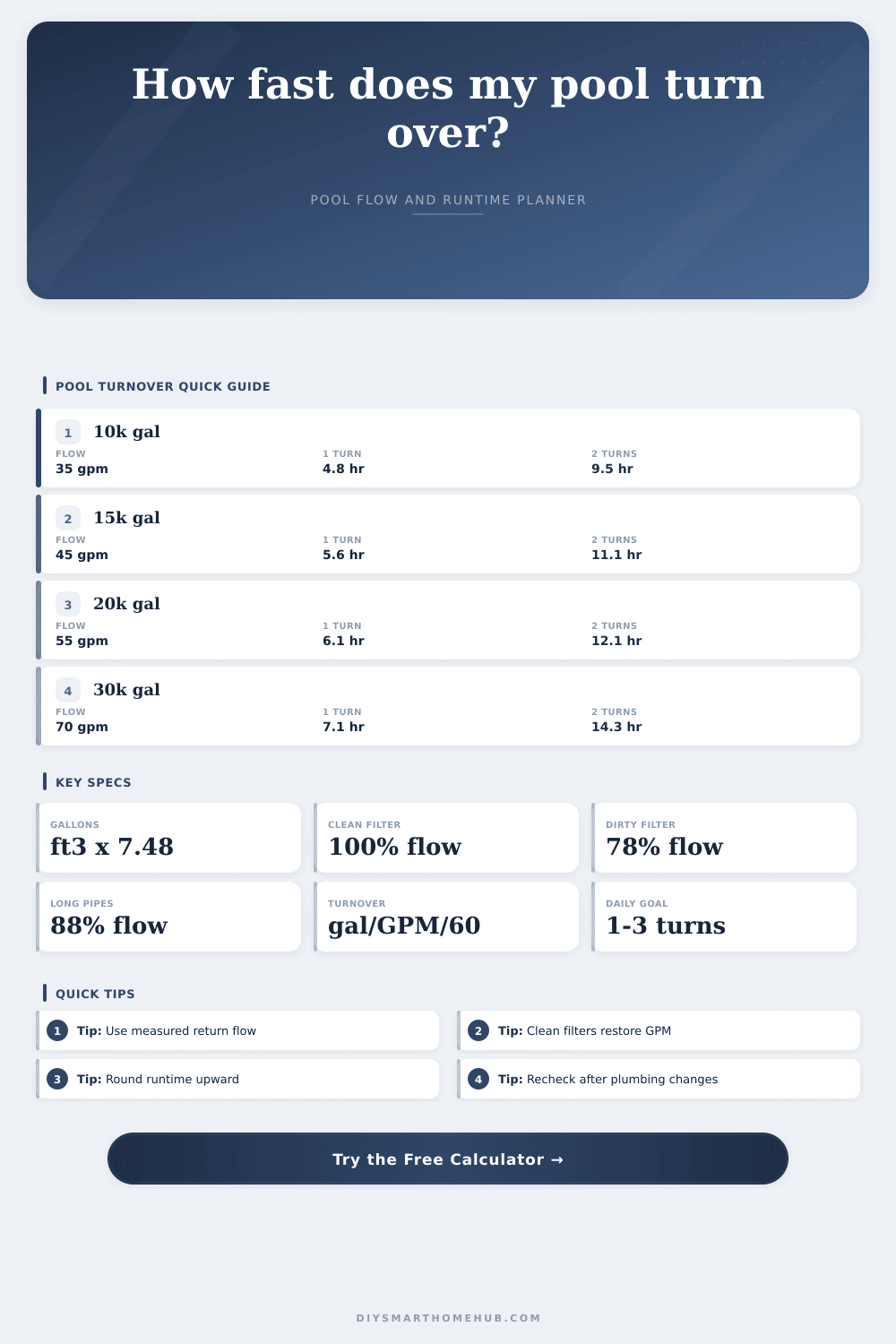
| 10,000 gal | 35 GPM | 4.8 hr | 9.5 hr/day |
| 15,000 gal | 45 GPM | 5.6 hr | 11.1 hr/day |
| 20,000 gal | 55 GPM | 6.1 hr | 12.1 hr/day |
| 30,000 gal | 70 GPM | 7.1 hr | 14.3 hr/day |
💡 Turnover tipsTwo practical checks before trusting the runtime
The water in a swimming pool is still, yet it’s filled with chemical activity. Bodies adds sugars and bacteria; sunlight depletes chlorine; you dump more chlorine in. You control all that by circulating it. You’re not merely treating the water, you’re moving it around, running it through some sort of filter, and repeating it until each cubic inch of the entire volume have passed through filter.
How quickly? That’s your turnover rate. Get it right and you have clear water. Get it wrong and you get algae and you pay big bucks for shock treatments.
How to Keep Your Pool Water Clean
After entering your pool’s dimensions into the calculator above, it will do the math for you. No need to guess what the volume of your odd-shaped pool is. Pool volume isn’t always a simple result of shape. Kidney shaped pools has places water doesn’t go. The deep end holds more water then you think based off how much surface area there is.
Underestimating volume/over estimating flow rate can result in running the pump longer (i.e., 6 hrs) and believing you’ve filtered all the water. You haven’t. You’ve only filtered half and now your pool water look cloudy. That missing piece of runtime makes all the difference between clear vs. Cloudy.
How much does it realy flow? How do you know? You have an equipment pad, you have a pump. Your pump is rated at X number of horsepower. So what? Horsepower doesn’t tell you anything about water movement. It’s electrical consumption. Gallons per minute is what matters.
And even the rated flow rate are optimistic. That assumes straight piping and a clean filter. Reality is different. Filters gets full of gunk. Pressure builds. Your system slows down. Dirty filters can decreases effective flow by almost a quarter. Using a heat pump or a pool cleaner add more resistance to the system. Then there is the plumbing itself creating friction. Small valves and long pipe all restrict the system. The chart on this page demonstrates that a typical system drop roughly six percent of potential flow. That sounds like little. It’s not. All those lost gallons put hours back on your daily run time.
Know who you’re targeting. For residential pools, your turnover rate should of been between one and three times daily. A single time is the bare minimum for maintaining basic sanitation. Three times is what you’ll want to do when having a big party or during a heatwave. So once you know your target, you know exactly how long you have to run the pump for.
Whether you run it non-stop for however many hours or break up that time with multiple runs doesn’t make any difference. What matters is that entire volume is pushed through filter. Know that you set your goal on the calculator for sixteen hours of runtime? And you only ran it for eight? You swam in the same dirty water twice. You weren’t cleaning, you were stirring.
Many people makes the same mistake: they set their pumps to the maximum flow allowed and assume “faster is better.” Nope. Too much flow will damage filter media or cause leaks at weaker joints in the plumbing. Too little flow waste electricity by having your pump on but not doing any work. Finding the right balance between enough time to keep your pool clean and not too long (don’t stress your equipment or waste electricity) mean finding the sweet spot.
You don’t want your pump to turn off after fewer hours than the calculator says. That’s not a problem with the schedule. If the pump stays on so long that it seems wasteful, the problem isn’t the schedule; the problem is your system. Perhaps you have too-small a pump, maybe you have a dirty filter, perhaps your pipes is too narrow.
So let’s get to the math. First thing: What’s the size of your pool? Go measure it (from within). Water line, not deck. Consider its shape. Is it rectangular? Is it freeform? That will shrink or expand your volume. The next step is to pull out the filter pressure gauge. Does it read high? Clean it. A clean filter equals flow. That’s the most cost-effective upgrade you’ll ever do.
Once you have your dimensions and target turnover, everything else are math. But why the math matter is where being a pool manager sets itself apart from a pool owner. Running a pool isn’t about turning on a switch; it’s managing a hydraulic cycle. Understanding that the filter is really the cleaner, and the pump is simply a mover, removes the guesswork from the runtimes. The numbers aren’t random; they’re a map. Stick to the map, and the water remains clear. Get off the map and you’re just winging it.