DIYSmartHomeHub spa water planning tool
Hot Tub Fill Volume Calculator
Estimate usable water volume from tub shape, dimensions, fill height, seat displacement, hose flow rate, and heater startup water mass.
The calculator converts shape volume from cubic feet to gallons with this factor.
Useful for heater startup load and water weight checks around filled spas.
Metric results use liters for volume and kilograms for water mass.
Startup heat load is shown in kWh with the BTU equivalent.
Round spa
Best estimated with diameter and fill height. It avoids rectangular overestimates for smaller plug-and-play tubs.
pi x r2 x hSquare or rectangle
Works well for straight-wall acrylic shells, swim spas, and boxy wooden tubs measured at the waterline.
L x W x hOval lounger
Uses ellipse area, then subtracts a larger seat displacement for loungers, steps, and contoured benches.
pi x a x b x hCorner triangle
Models a triangular plan area for corner shells where a rectangle would roughly double the water estimate.
0.5 x B x H x h| Tub Shape | Dimension Formula | Water Volume Formula | Best Use |
|---|---|---|---|
| Rectangle or square | Length x width | cubic ft = L x W x fill height | Square acrylic spas, cedar tubs, swim spas, and straight-wall shells. |
| Round | pi x radius squared | cubic ft = pi x (diameter / 2) squared x fill height | Round portable tubs and circular soaking tubs measured at the waterline. |
| Oval | pi x half length x half width | cubic ft = pi x (L / 2) x (W / 2) x fill height | Lounger tubs and rounded rectangles when the water surface is close to oval. |
| Corner triangle | 0.5 x base x width | cubic ft = 0.5 x base x width x fill height | Corner shells where the plan area is closer to a triangle than a square. |
| Custom area | Known surface area | cubic ft = custom area x fill height | Manufacturer waterline area, measured grid area, or irregular in-ground spas. |
| Common Hot Tub | Typical Inside Size | Normal Fill Height | Typical Filled Volume |
|---|---|---|---|
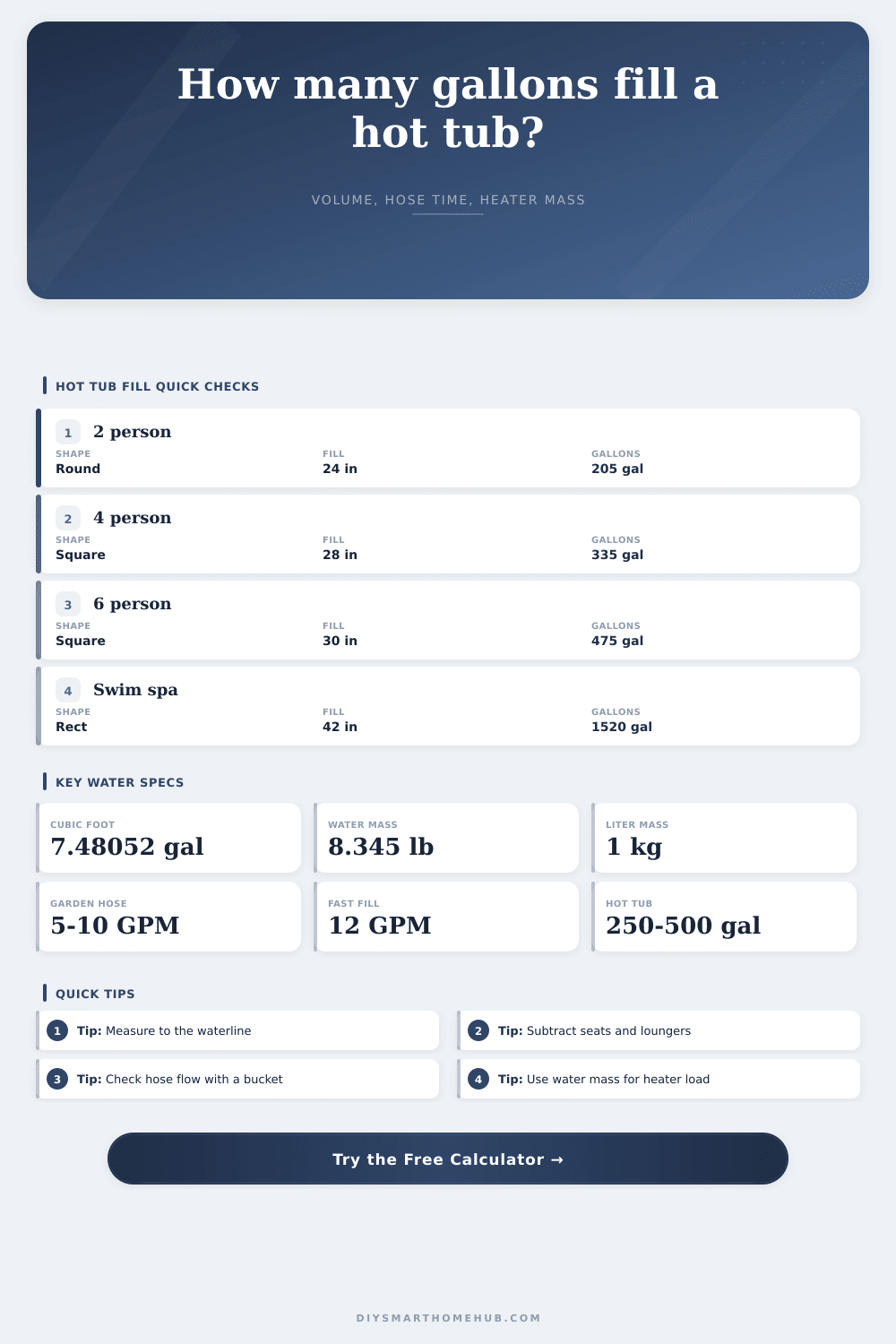
| Compact 2 person round | 5.5 to 6.0 ft diameter | 22 to 25 inches | 180 to 240 gallons before bather displacement. |
| Small square 4 person | 6.0 x 6.0 ft | 26 to 29 inches | 280 to 380 gallons after seat displacement. |
| Standard 6 person square | 7.0 x 7.0 ft | 28 to 32 inches | 400 to 520 gallons depending on bench volume. |
| Large party spa | 8.0 x 8.0 ft | 30 to 34 inches | 550 to 750 gallons for deeper shells. |
| Small swim spa | 12.0 x 7.0 ft | 38 to 46 inches | 1200 to 1700 gallons with molded wells subtracted. |
| Hose Flow Rate | 300 Gallons | 450 Gallons | 650 Gallons |
|---|---|---|---|
| 4 GPM slow spigot | 75 minutes | 113 minutes | 163 minutes |
| 6 GPM typical hose | 50 minutes | 75 minutes | 108 minutes |
| 8 GPM strong hose | 38 minutes | 56 minutes | 81 minutes |
| 10 GPM high flow | 30 minutes | 45 minutes | 65 minutes |
| 12 GPM fast fill | 25 minutes | 38 minutes | 54 minutes |
| Net Fill Volume | Water Mass | 40 F Startup Load | 60 F Startup Load |
|---|---|---|---|
| 250 gallons | 2086 lb / 946 kg | 29.3 kWh / 99900 BTU | 43.9 kWh / 149900 BTU |
| 350 gallons | 2921 lb / 1325 kg | 41.0 kWh / 139900 BTU | 61.5 kWh / 209800 BTU |
| 450 gallons | 3755 lb / 1703 kg | 52.7 kWh / 179800 BTU | 79.1 kWh / 269700 BTU |
| 650 gallons | 5425 lb / 2461 kg | 76.2 kWh / 259800 BTU | 114.3 kWh / 389700 BTU |
| 1500 gallons | 12518 lb / 5678 kg | 175.9 kWh / 600200 BTU | 263.8 kWh / 900300 BTU |
When you get your new hot tub, you’re excited, and concerned. It’s an empty shell that will hold the weight of a sedan full of water. How much is that? How long will it take to fill? How much will that cost in electricity? How much structure can it support? This calculator calculates those values. It also provides gallons, liters, fill time, water mass, heater load, and displacement volume.
These are based off realistic spa measurements rather than exterior dimensions. Don’t be confused about measuring the outside of cabinet. It’s insulated and has a thick shell to it. Those inches is added from the frame and they won’t hold any water. Measure the interior length or diameter at the water line. That’s where most folks mess up. If you measure full depth, you’re accounting for a tub that overflows which is seldom what you want.
How to Use the Hot Tub Calculator
With this tool you can adjust for shape. Oval, round and square spas has different formulas. Here’s the rule with them all, Gross Volume equals Internal Plan Area times Fill Height Subtract displacement because equipment wells, steps, and seat take up space where water would go. A molded seat can knock out 10-15 gallons. Remember to account for that when calculating fill volume, or you’ll mess up your hose time estimates. You will think the heater isn’t as efficient as it actually is. Once you input the displacement into the calc it does the math for you. To get that right takes a bit of intuition. If your tub has a raised footrest or deep loungers, add more to the displacement field. It is a small detail but it matters for accuracy.
Here are the practical considerations, such as how much time I have to wait. To figure that out, you must know what’s going into it. A garden hose isn’t all equal; some might struggle to push four gallons of water per minute if they has a clogged nozzle, while others can moves as many as 12. If you want hot water for your party, those extra eight gallons per minute make an hour-long wait versus half an hour, and it’s an hour or half an hour. The only way to be certain about your hose delivery is to time it yourself with a stop watch and a bucket.
How long will the fill take? The answer depends on the volume and more than the hose flow rate. The chart on the linked page show the scaled fill times, so you can get a sense beforehand.
It takes a lot of energy to warm the water. Water is dense. It doesn’t move well, and it don’t change temperatures easily. A gallon of water weighs about eight and a third pounds. Multiply that weight by the increase in temperature needed to get from the cold tap water to a full 100 degrees Fahrenheit, and soon it all adds up. That’s the startup heat load in BTU’s and kilowatt-hours that the calculator display. And that’s what causes your electric bill to spike at the initial fill. It is not because of a leak, but because of thermodynamics.
Now knowing your load allows you to choose when best to fill the tub. Maybe you will do it on a sunny day so the sun can pre-heat the water. Or maybe you’re willing to pay for quicker turnaround time.
Filling a hot tub takes physics and patience. It’s not unlike moving several thousand pounds of water into a small area. Consider the power requirements. Plan for seating. Double check measurements. A hot tub installation could of been a messy afternoon or a well thought-out mission with the help of this tool. Know your dimensions. Test your hose. Take your time. Account for the weight of all that water.