Pool Heating Time Calculator
Estimate pool heat-up time from gallons, target temperature rise, heater output, efficiency, heat pump COP, cover loss factor, and ambient air derate.
Calculation breakdown
| Pool volume | BTU per 1°F | BTU for 10°F | BTU for 20°F |
|---|---|---|---|
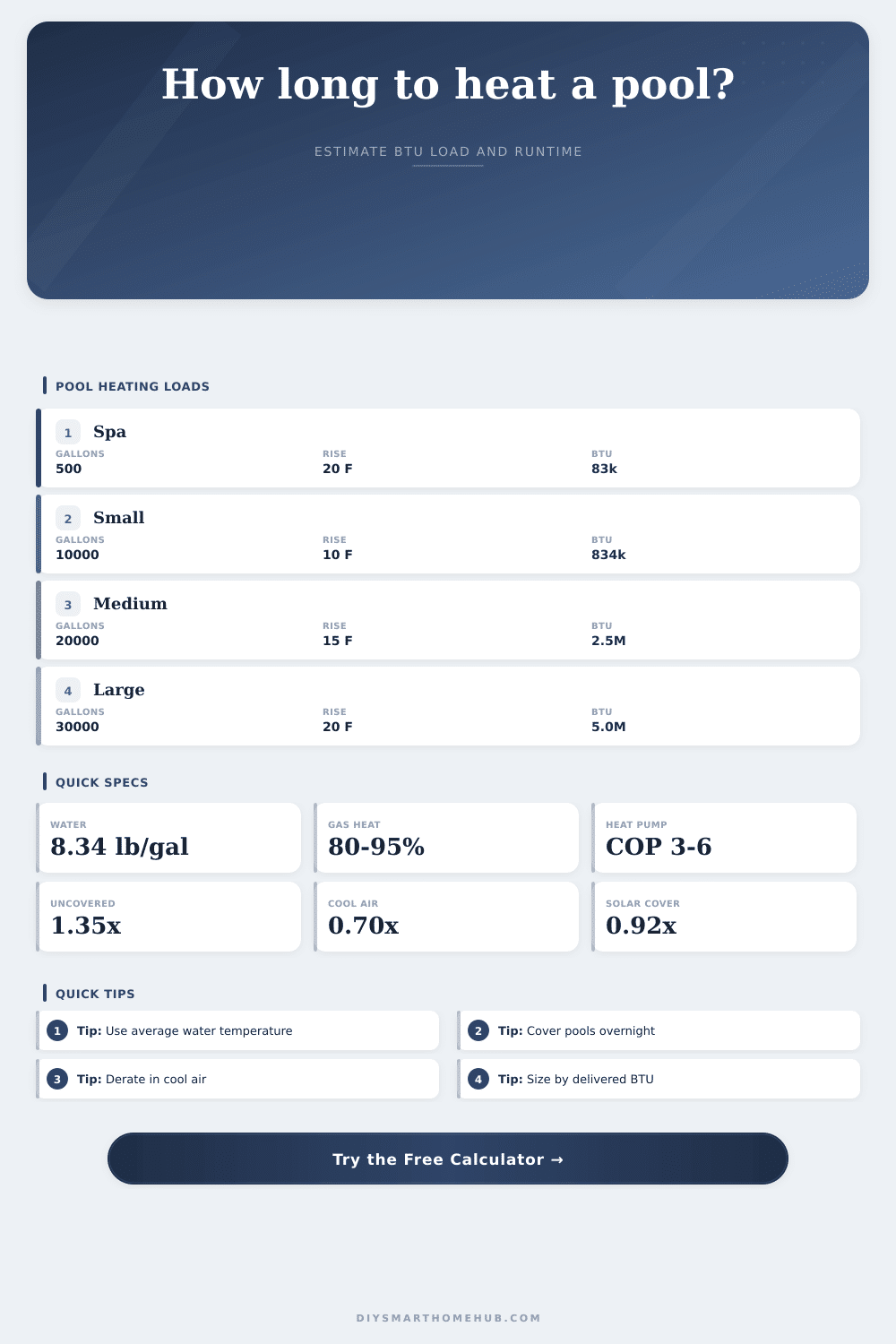
| 5,000 gallons | 41,700 BTU | 417,000 BTU | 834,000 BTU |
| 10,000 gallons | 83,400 BTU | 834,000 BTU | 1,668,000 BTU |
| 20,000 gallons | 166,800 BTU | 1,668,000 BTU | 3,336,000 BTU |
| 30,000 gallons | 250,200 BTU | 2,502,000 BTU | 5,004,000 BTU |
| Heater delivered output | 834k BTU load | 2.5M BTU load | 5.0M BTU load |
|---|---|---|---|
| 60,000 BTU/hr | 13.9 hours | 41.7 hours | 83.4 hours |
| 100,000 BTU/hr | 8.3 hours | 25.0 hours | 50.0 hours |
| 200,000 BTU/hr | 4.2 hours | 12.5 hours | 25.0 hours |
| 320,000 BTU/hr | 2.6 hours | 7.8 hours | 15.6 hours |
| Cover condition | Factor | Best use in calculator | Planning note |
|---|---|---|---|
| Solar cover while heating | 0.92x | Covered daytime or overnight heat-up | Useful when evaporation is controlled during the run. |
| Covered or low wind | 1.00x | Default for stable conditions | Matches the base BTU formula with small surface losses. |
| Partial cover or breezy | 1.12x | Some evaporation or wind wash | Raises the load before the heater time calculation. |
| Uncovered overnight | 1.38x | Cool air and open water surface | Often the slowest practical heating case. |
| Ambient condition | Derate input | Applies most to | Heating effect |
|---|---|---|---|
| Warm air, calm day | 100% | Gas or heat pump | Use rated output if equipment data matches conditions. |
| Mild air or light wind | 90% | Most pools | Good default when equipment output is optimistic. |
| Cool air below rating | 75% | Heat pumps | Lower air temperature reduces usable heating capacity. |
| Cold air and wind | 60% | Heat pumps, exposed pools | Expect longer runtime and reduced recovery speed. |
Gas Heater
80-95%Fast recovery when the BTU rating is large, with runtime driven mainly by delivered output and pool gallons.
Heat Pump
COP 3-6Efficient in mild air, but output can fall sharply below the temperature used for the equipment rating.
Electric Element
Near 100%Simple delivery math, though smaller residential outputs can make large pool temperature rises slow.
Solar Assist
VariableBest treated as an output credit only when measured collection data is available for the same weather.
So you’re frustrated because you’d like to go swimming in your pool, but it’s still too cold? An hour after cranking up the heater, you open the thermostat and see no change. Why? Because you think the heater will raise the water temp at a constant rate. Nope. That’s physics. You’re battling efficiency losses, evaporation, AND physics itself.
By entering the target temperature, pool size/volume, and your heater specs into this calculator above, we can estimate how long it should of take so you don’t have to guess. Not magic, but much better than guessing.
Why Pool Heaters Take So Long
It all boils down to the fact that it takes X amount of BTUs to increase Y amount of water Z degrees. Water is heavy stuff and clings to its heat like glue. Each gallon contain about 8 and a third pounds of water. So if you’re dealing with an eighteen thousand gallon pool, you’re attempting to heat more than one hundred fifty thousand pound of water. That’s a boatload of thermal mass to shift around. Once you enter your temperature differential and volume, the tool do the rest for you, sparing you having to do big-number multiplication in your head. All you have to know is how much water you actualy have in your pool. Estimating by deck dimensions alone will probably put you way off.
Volume is a direct link to BTU load. A small volume variation equate to a big variation in the total BTU load. Heat loss is the silent killer of all pool heating projects. No matter what BTU’s your heater are putting out, you’re also losing heat via conduction and evaporation into air. That’s where the cover factor input is so important.
At night, an uncovered pool lose heat three times as fast than a covered one in the middle of the day. Are you heating up atmosphere instead of the pool? That’s a waste of electricity. And when the water is exposed, you’re heating the atmosphere. The multipliers for this are outlined in reference table on the page which shows how a solar cover can bring effective load down almost ten percent. It seems small but over a 40-degree rise, that saves hundreds or even thousands on your energy bill or hours of run time.
Another issue is equipment efficiency. Generally speaking, gas heaters runs from eighty to ninety five percent efficient. In other words, a good chunk of every gallon of gasoline go up in smoke; almost a fifth doesn’t make it into the water. Heat pumps operate under different principle. Since they don’t create heat but move existing heat around instead, they’re significantly more efficient during mild weather. Unfortunately, their output plummets rapidy as temperatures drop. The calculator takes that into consideration by offering an ambient derate setting.
What does all this mean? If you’re heating early in the spring and air is still cool, don’t expect your heater to perform at its “peak” rating, whatever number was printed on sticker by manufacturer. Adjust for reality. The runtime per degree number is one that most folks completely overlook. This will help you plan how long to let the water heat up. Do you need five degrees and it’s going to take four hours? Well, plan accordingly so that when you swim, the heater is done cycling off. Don’t wait until the day of your event and then turn it on expecting results. Get it started early.
The best part about this is that you can just leave it running while it heats water up in a quiet, covered environment. Don’t think about heating the pool; think about warming it up without having to wait forever and waste a ton of money in the process. Think about how much power is going into the water, how much water there is, and how much it’s losing to environment. Once you grasp this pattern, you’ll adjust your equipment to match and stop trying to fight nature and start working with it. You’ll cover the pool. Adjust the ambient settings. You’ll know your pool’s volume. And guess what? The water warms up and you get to enjoy it.