Pool Cover Savings Calculator
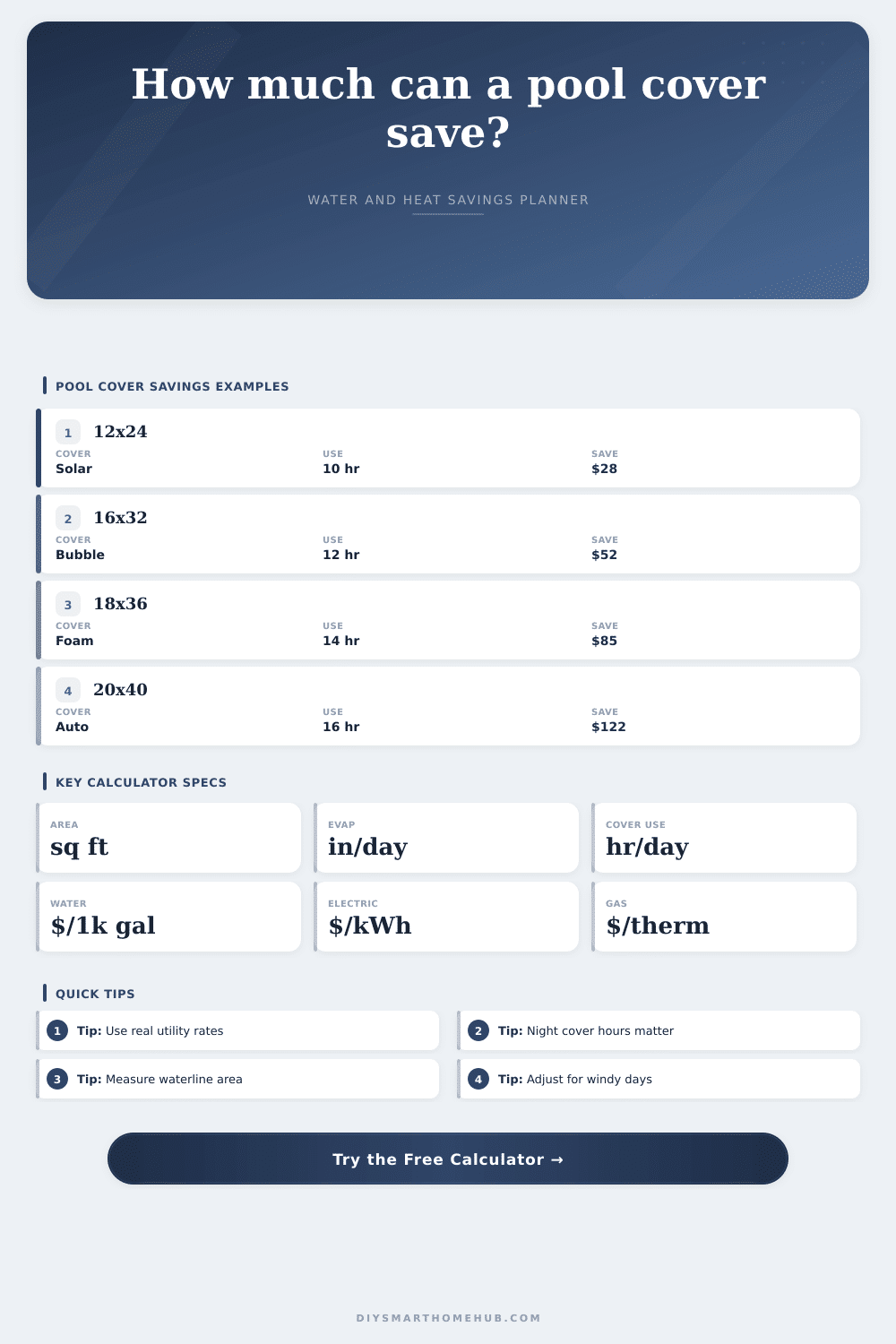
Estimate surface area, uncovered evaporation gallons, cover reduction, heating kWh and therms saved, and monthly savings using your own water and energy rates.
📌Pool Cover Presets
⚙Calculator Inputs
📊Current Cover Spec Snapshot
📘Cover Type Comparison
📈Evaporation And Heat Reference
| Profile | Uncovered Evaporation | Heat Lift Used | Typical Condition |
|---|---|---|---|
| Mild | 0.12 in/day | 8°F | Humid or shaded pool |
| Average | 0.18 in/day | 12°F | Common warm-weather estimate |
| Dry air | 0.25 in/day | 15°F | Low humidity afternoons |
| Windy | 0.32 in/day | 18°F | Exposed water surface |
| Heated pool | 0.22 in/day | 20°F | Warm water against cool air |
💧Pool Size Example Table
| Pool Size | Surface Area | Uncovered Loss at 0.18 in/day | Water Saved at 90% for 12 hr/day |
|---|---|---|---|
| 8 x 8 spa | 64 sq ft | 7 gal/day | 99 gal/month |
| 12 x 24 pool | 288 sq ft | 32 gal/day | 484 gal/month |
| 16 x 32 pool | 512 sq ft | 57 gal/day | 861 gal/month |
| 18 x 36 pool | 648 sq ft | 73 gal/day | 1090 gal/month |
| 20 x 40 pool | 800 sq ft | 90 gal/day | 1346 gal/month |
⚡Water Heat Formula Table
| Formula Step | Equation | Conversion | Used In Result |
|---|---|---|---|
| Water mass | Gallons x 8.34 | lb of water | Heat saved |
| Heat Btu | lb x ΔF | 1 Btu/lb/°F | Energy base |
| Electric kWh | Btu / 3412 | kWh equivalent | Electric path |
| Gas therms | Btu / 100000 | Therm equivalent | Gas path |
🧮Monthly Savings Components
| Component | Driver | User Rate | Monthly Output |
|---|---|---|---|
| Refill water | Gallons saved | $ per 1,000 gal | Water utility savings |
| Electric heat | kWh equivalent saved | $ per kWh | Water + electric path |
| Gas heat | Therms equivalent saved | $ per therm | Water + gas path |
| Cover hours | Hours covered / 24 | No rate needed | Effective reductions |
💡Calculator Tips
Until the invoice appears, most pool people thinks of water as free. Fill up the basin. Skim out the leaves. Add some chemicals; when the color’s right, job done!
And then you realize that the water level is sinking lower than normal. This happens especially on a hot dry week. Where’s all that water going? It is evaporating, draining your savings account and sending your energy bills through the roof.
Why Pool Covers Save Money
Of all the high-return upgrades available, covering the water are at the top of the list. To get its full benefits, however, you must understand physics involved. Why? Because hot water molecules evaporate into drier, cooler air. It’s both a heat issue and a water issue: that water goes away from the pool, and so do your dollars spent on heat.
A thermal cover (or a solar blanket) create a barrier. It keeps the water from becoming vapor. And holds onto the heat.
Run the numbers for yourself using the calculator above. You’ll see why knowing what it calculates is helpful. It factors in your surface area. This determines the amount of water being exposed to air. The bigger your pool, the greater its volume, but the more surface it has to work with, which means more water escaping.
Next it factors in an efficiency reduction depending off the cover. Heavy thermal blankets keeps heat better than bubble blankets, which form air pockets to hold in heat. And foam covers offers tighter insulation. The gap in energy efficiency between a simple mesh cover and a thick thermal blanket may be the difference between saving a sizeable portion of your utility bill or just breaking even.
What about the climate profile? The profile is far more important than most people think. Even though humidity acts like a lid that slows the escape of water molecules, a pool in humid Florida will lose much less water to evaporation than a dry Arizona pool. (Even though the temps may be the same.) Why? Because humidity is like a lid. It stops those water molecules from escaping.
Wind is also a factor. Wind removes the warm layer of air directly on top of the pool’s surface; it speed up the loss. If your yard gets windy, then the savings from having a cover will be much higher. (That’s because the cover stops the wind-driven evaporation!) Choose the climate setting that matches your real-world conditions. Don’t assume your zip code will do it.
On a cool spring day with a breeze, a heated pool lose its heat like mad. Then again, the energy savings part become the main factor. Heating the replacement water is often the expensive part. The tool includes cost of raising newly cool water to the temperature that you want to swim. And it does so in terms of both gas and electricity. Those Btus saved have a different dollar value depending on which fuel type you use.
Electricity could be cheaper by the unit. But it is less efficient at the heater. Gas will get it hot quickly. But it can be more expensive because of a higher usage tier. Punch in your real rates and you’ll understand the true cost of ignoring the cover.
Most folks greatly under-appreciate how much water they’re adding. A few inches a week adds up fast to thousands of gallon per month. Each of these costs money. And each of those needs to be chemically balanced.
The decision about which type of cover to buy (manual vs automatic) is really about cost/benefit: What works best? How convenient is it? Automatic covers are costly. But they’re convenient, so they is always used to some extent.
Manual blankets are labor intensive. That means that people don’t use them consistently. And if you can’t be bothered to unroll the cover because it’s heavy… then you wouldn’t of saved anything. Use the best cover that you will use. Consistent use is what saves money.
Most losses occur overnight with your pool covered for 12 hours per night. That’s when evaporation rates peak, when the air cools down and the humidity goes down. Using a cover during the daytime also helps, but the temperature difference isn’t as large.
Saving money with less water isn’t the only reason for using less water. Less water mean less stress on your community’s water system. Less water means less chemical usage needed to treat the fresh water in your pool. It is a small behavioral adjustment. This change adds up to big results over time.
When you don’t lose heat and volume each and every day, the math doesn’t take long to add up. Your water becomes cleaner. Your pool will be warmer. And your wallet remains fuller. It’s basic physics at play in your free time.