Pool Pump Runtime Cost Calculator
Estimate turnover hours, schedule runtime, pump kWh, variable-speed affinity-law savings, and electricity cost from your pool volume, flow rate, watts, and daily circulation target.
Pool Pump Runtime Results
| Pump / Schedule | Typical Flow | Typical Watts | Best Use In This Calculator |
|---|---|---|---|
| Small single-speed pump | 30-45 GPM | 700-1,100 W | Measured mode with one daily runtime |
| Medium single-speed pump | 40-60 GPM | 900-1,500 W | Turnover runtime from gallons and GPH |
| Large single-speed pump | 55-85 GPM | 1,300-2,200 W | Check cost impact of long schedules |
| Variable-speed low RPM | 20-45 GPM | 150-600 W | Affinity estimate, longer lower-power runtime |
| Variable-speed mixed schedule | High plus low | Split watts | Skimming, spillover, filtration windows |
| Pool Volume | Flow Rate | 1 Turnover Runtime | Energy At Listed Watts |
|---|---|---|---|
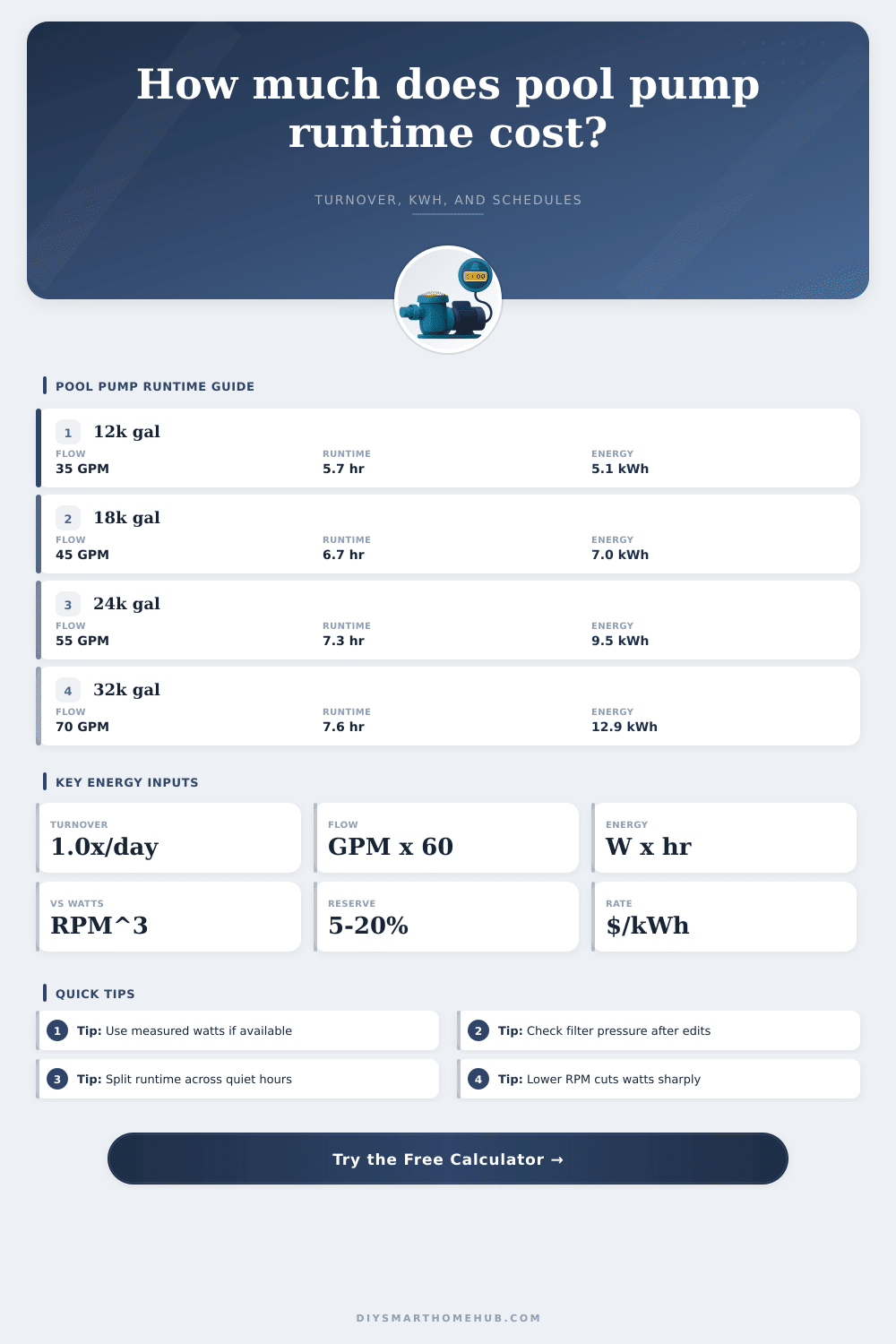
| 12,000 gallons | 35 GPM / 2,100 GPH | 5.7 hours | 5.1 kWh at 900 W |
| 18,000 gallons | 45 GPM / 2,700 GPH | 6.7 hours | 7.0 kWh at 1,050 W |
| 24,000 gallons | 55 GPM / 3,300 GPH | 7.3 hours | 9.5 kWh at 1,300 W |
| 32,000 gallons | 70 GPM / 4,200 GPH | 7.6 hours | 12.9 kWh at 1,700 W |
| RPM Change | Flow Estimate | Watt Estimate | Runtime Tradeoff |
|---|---|---|---|
| 3450 to 3000 RPM | 87% of base | 66% of base | Shorter runtime than low RPM, moderate savings |
| 3450 to 2400 RPM | 70% of base | 34% of base | Often useful for daytime filtration |
| 3450 to 1800 RPM | 52% of base | 14% of base | Long low-power circulation window |
| 3450 to 1200 RPM | 35% of base | 4% of base | May be too low for skimming or heaters |
If you own a pool, you’re likely guilty of treating your pump like a light switch that never gets turned off. Trouble is, running your pump sucks down juice and we mean that literally. Trouble is, running your pump sucks down juice and we mean that literally.
Circulating water costs money; yet most folks has no clue just how much since they use an estimate provided by the manufacturer instead of actual power consumption. Understanding how power draw relates to flow rate and pool volume change how you see your monthly power bill. Instead of a mystery, it becomes part of a doable budget.
How to Save Money on Your Pool Pump Bill
Turnover time is the name of the game. How many hours does it take to push every gallon through the filter once? For instance, an average-sized pool like 18,000 gallons at a moderate flow rate will require about seven hours for one cycle. Any more then that and you’re essentially re-circulating previously filtered water. You is burning electricity but not improving water clarity very much.
All the math is done for you by the calculator above after entering your pool’s unique gallons per minute and volume, so there’s no guesswork as to whether six hours is sufficient or ten hours are overkill. Knowing exactly what your turnover requirement is prevents wasting kilowatt hours and ensures you do not under-filter.
In the past ten years pump technology has completely changed the game; however, many households is still stuck on their old single speed motor. No matter if they need high pressure or not, those older pumps will eat a huge amount of electricity. The new variable speed pumps enables you to reduce the RPM’s drastically without sacrificing enough filtration flow.
Energy use goes down cubically as you reduce speed so going from 3,400 RPMs to only 2,000 can cuts your power usage by over half. Now that’s where the money lives (not saving an hour off the clock), but turning down the intensity level at which it works.
Consider also that your pool will want gentle circulation, or even just high pressure, some of the time. Higher speeds = higher flow rates. Which is what you need if you’re trying to skim debris off the surface. You can filter finer particles at a much slower (lower) speed during the night since there’s plenty of time for water to work its way through media. So finding a balance between efficiency & cleanliness may mean splitting your run time into an hour or two of high speed (for skimming), followed by a longer period (the remainder of the day, maybe?) on a low speed (for filtering).
Most utility companies offers discounts for using electricity during their off peak “evening” hours, so running those long low speed cycles overnight gives you a double benefit.
You can’t rely on what’s on the label, and the sticker on the side of your motor is not the same as actual wattage. Wattage nameplate ratings are conservative and rarely represent real world operating conditions unless the system is seriously restricted. Accurate data for cost projections comes from a clamp meter which allows you to see what the pump is actualy drawing. A small error in estimating watts compounds over hundreds of hours of runtime each season. Knowing exactly how much money you will save by reducing the speed by two hundred RPMs give you an accurate figure.
Surprisingly, filter maintenance figures into this as well. Back pressure from a dirty filter requires the pump to draws more power to produce the same amount of flow. Your turn over may be right on target, but your electricity bill might still be inching upward. Check the pressure gauge, and if it’s high, maybe cleaning or replacing the cartridge will drop that wattage draw low enough to make it worth the time spent. Little things like this matters when you’re looking to save money while not upgrading furnitures.
Hardware selection is only one part of it. There are also seasonal adjustments. On a cool fall day with little algal growth, there’s no reason to circulate at turnover rate. Running time down in the shoulder season will keep water clean and your bills low. The idea isn’t running at max capacity because that’s what you’re used to doing. Instead, match the circulation level to the biological load.
When you get in the habit of knowing how much each hour actualy costs, you’ll see that turning the pump down for an hour or two here and there pay for itself in a month. It’s the difference between having a passive utility expense and actively making the choice each day.