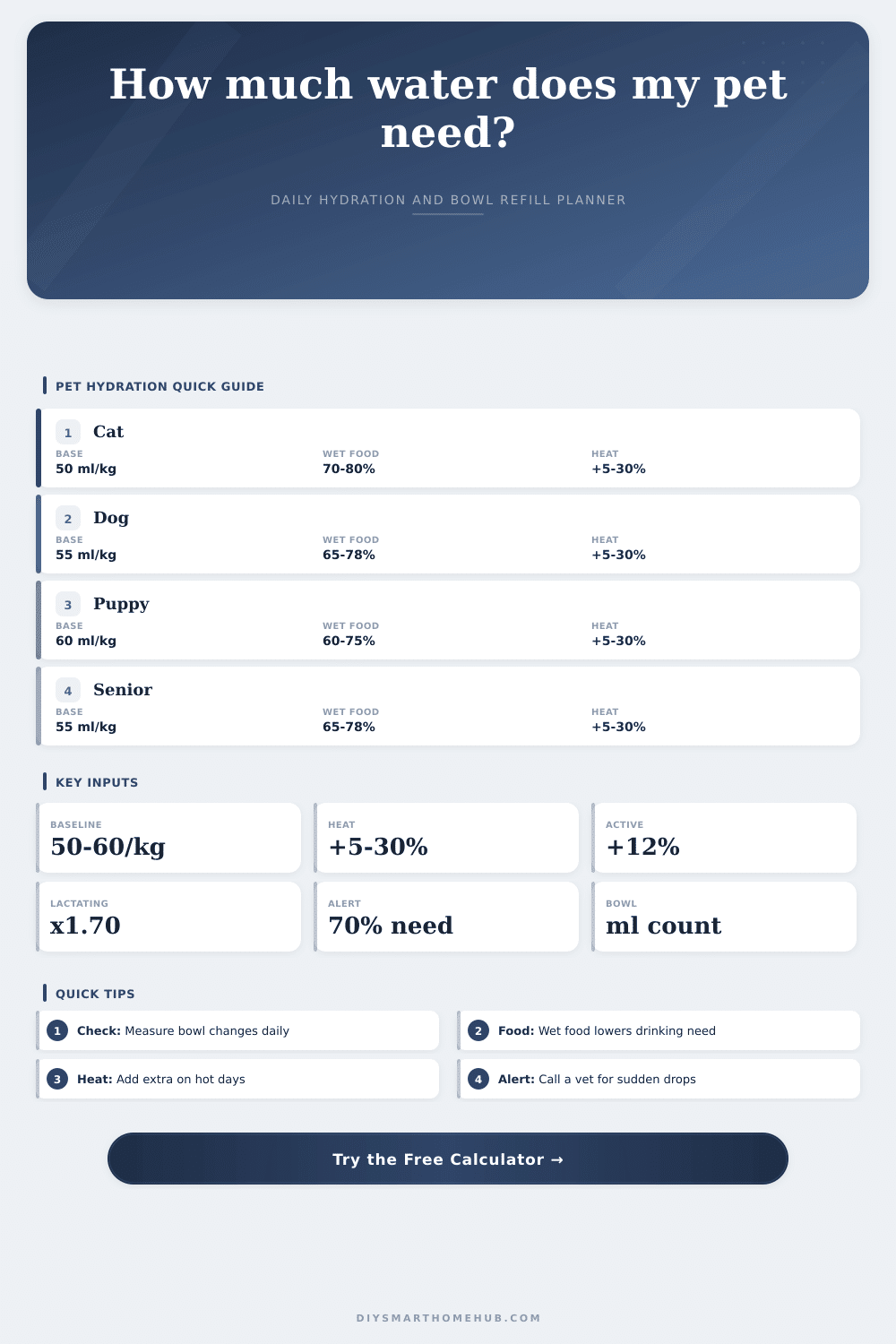
Pet Water Intake Calculator
Estimate daily hydration, food moisture offset, shared bowl refills, and low-intake warning thresholds for cats, dogs, puppies, and seniors.
Hydration estimate
| Species profile | Baseline formula | Example weight | Baseline water |
|---|---|---|---|
| Adult cat | Weight kg × 50 ml/day | 4.5 kg | 225 ml before food moisture |
| Adult dog | Weight kg × 55 ml/day | 18 kg | 990 ml before food moisture |
| Puppy or kitten | Weight kg × 60 ml/day | 8 kg | 480 ml before food moisture |
| Senior pet | Weight kg × 55 ml/day | 12 kg | 660 ml before food moisture |
| Diet type | Typical moisture | Water from 200 g food | Drinking impact |
|---|---|---|---|
| Dry kibble | 8% to 12% | 16 to 24 ml | Most water must come from the bowl |
| Mixed dry and wet | 30% to 45% | 60 to 90 ml | Moderate bowl offset |
| Fresh cooked food | 60% to 70% | 120 to 140 ml | Large bowl offset |
| Wet or canned food | 70% to 80% | 140 to 160 ml | Lower visible drinking can be normal |
| Condition | Multiplier | When to use it | Planning note |
|---|---|---|---|
| Normal indoor day | 1.00 | Comfortable room temperature | Use the baseline rate |
| Warm day | 1.05 to 1.12 | 22°C to 30°C | Expect mild extra drinking |
| Hot day | 1.20 to 1.30 | Above 30°C | Use larger bowls or refills |
| High activity | 1.12 to 1.40 | Long walks, training, sport | Pair with heat multiplier |
| Bowl capacity | Daily total | Calculated refills | Practical target |
|---|---|---|---|
| 300 ml small bowl | 450 ml | 1.5 fills/day | Refill at least twice |
| 750 ml medium bowl | 990 ml | 1.3 fills/day | Refill morning and evening |
| 1500 ml large bowl | 2200 ml | 1.5 fills/day | Use two fresh refills |
| 3000 ml fountain | 4200 ml | 1.4 fills/day | Clean and refill daily |
The first thing most folks consider in regards to water is to simply keep the bowl filled. While this isn’t necessarily wrong, it’s also not the only solution (or the right one). Water consumption is a changing equation (it considers diet), ambient temperatures, and activity levels. For example: you may fill the bowl each morning, but if their diet doesn’t contribute as much moisture as you think, then he or she can actualy remain somewhat dehydrated without showing any obvious signs. This balance is the difference between “adequate” care and actively managing their health.
Plug in your pet’s information into the calculator above (it’ll do the math for you). No need to guess at conversions or coefficients! But you’re also interested in the answer, so you should of know why those inputs matter.
Why Water Intake Changes
Begin with the diet. Dry kibble is convenient, but it’s primarily protein and carbohydrate with hardly any water. So when you feed wet food, you’re feeding not only nutrition, but moisture as well. In fact, if your pet eats solely dry food, they will has to drink quite a bit more from the bowl different than a cat that eats canned food. So if your pet eats wet food, they may seem to barely touch their water dish. And this isn’t necessarily a problem. It shows that their hydration needs is being met through their meals.
The other big variables are temperature and activity. High temperatures don’t just feel hot; they also cause pets to lose body fluids quickly as they pant to cool down. By factoring in ambient temperature with a multiplier for higher temps, the tool provide an estimate that accounts for it. For example, if you’re out exercising your dog during the heat of the day, their need will spike. Likewise, a lactating mom’s need for fluid production is huge! You don’t want to underestimate and that’s why taking into account these factors are important.
This is where the calculator comes in, it includes these multipliers to give you a more accurrate target than a simple rule of thumb. The warning threshold is one of the best parts. According to most vets, when your pet’s intake drops below 70% of what they’re estimated to require, it’s worth looking into. That’s the line the tool draws. You don’t need to be a veterinary expert to see the pattern. You just need a number to go by and something to compare it against.
If your pet suddenly doesn’t drink as much, it could simply be a new habit, except without an expected amount, you have nothing to compare it to. Once you’ve got a baseline, however, it becomes information worth sharing with your vet. This is especially true for older animals who might suffer from declining kidney function, which can happen slowly over time.
The other side of that equation is practicality; bowl management. There are a lot of people who own massive bowls or have gigantic water fountains because they think bigger = better hydration. But big bowls tends to be intimidating for little pets, and sitting still in one place means the water will eventually go stale. Use the calculator to find your pets’ total water consumption and how often it needs to be replaced. This works for any bowl size you are using. It changes hydration from an abstract idea into a logistics plan. How much should I expect? When do I need to fill up again?
Also be aware that animals get used to things. Even something as simple as what the water bowls is made of may impact how much they drink. Did your pet stop drinking altogether? Before assuming it’s health-related, check out the surroundings. A drafty area or a nasty water bowl might just make them less inclined to drink… especially if they’re finicky.
Your eyes will tell you the story, the numbers comes from the calculator. It’s not a box that can be checked once. It’s something you do every day. You learn how activity, heat in the environment, and food moisture interact with each other so you have some control over this vital element of care. The goal is not just to provide water, but to ensure it is consumed. We want them to drink.
Filling the bowl is the simple task. Getting them to actually hydrate themselves is a little more involved. That’s where most folks fail.