Pet Daily Calorie Calculator
Estimate daily dog or cat calories from RER, life stage, activity, neuter status, body condition, weight goal, food calories per cup, and treat calories.
Daily calorie and feeding result
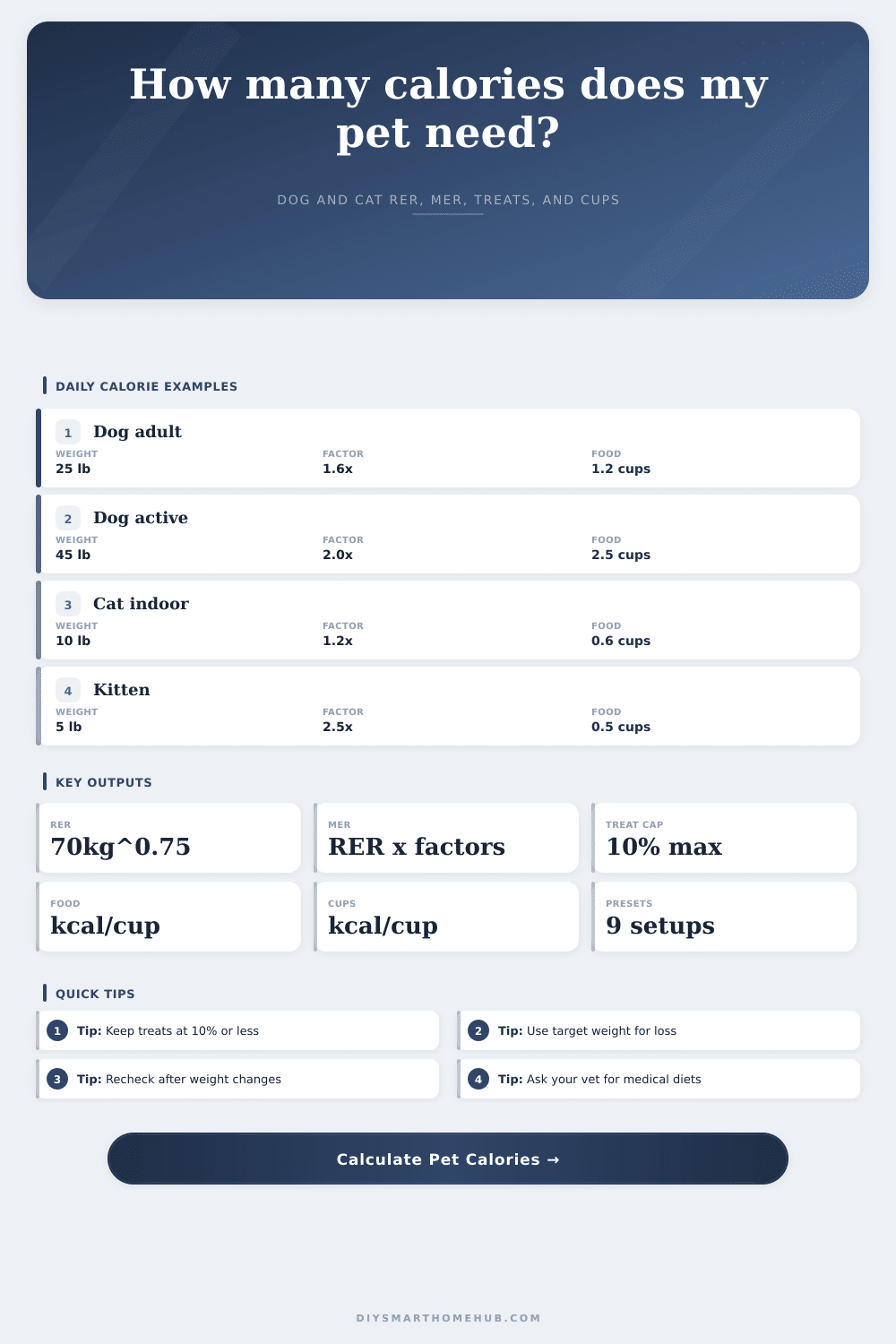
RER = 70 x calculation weight kg ^ 0.75
MER = RER x life-stage factor x activity factor x neuter factor x goal factor
maximum treat calories = MER x 0.10
meal calories = MER - entered treat calories, with treats capped for the warning status
food cups/day = meal calories / food kcal per cup
cups/meal = cups/day / meals per day
| Input | Dog factor | Cat factor | Use in calculator |
|---|---|---|---|
| Adult, neutered | 1.60 baseline | 1.20 baseline | Base adult maintenance factor before activity and goal changes. |
| Adult, intact | 1.80 equivalent | 1.40 equivalent | Neuter factor raises the baseline to intact adult maintenance. |
| Under 4 months | 3.00 growth | 2.50 growth | Growth factor replaces adult baseline for young pets. |
| 4-12 months | 2.00 growth | 2.00 growth | Juvenile growth factor for older puppies and kittens. |
| Pregnant or lactating | 1.80 to 3.00 | 1.60 to 2.50 | High-demand life stages should be confirmed with a veterinarian. |
| Daily MER | 10% treat cap | Food at 300 kcal/cup | Food at 450 kcal/cup |
|---|---|---|---|
| 200 kcal/day | 20 kcal | 0.60 cup after treats | 0.40 cup after treats |
| 400 kcal/day | 40 kcal | 1.20 cups after treats | 0.80 cup after treats |
| 800 kcal/day | 80 kcal | 2.40 cups after treats | 1.60 cups after treats |
| 1200 kcal/day | 120 kcal | 3.60 cups after treats | 2.40 cups after treats |
| Preset | Species | Weight | Life stage | MER factor | MER kcal | Treat cap | Cups/day |
|---|
When feeding pets, we usually measure using visual assessment of our scoop and hope it’s enough. We do this at our own peril and raise a soft (and expensive) animal.
Calories are a physiological need in pet nutrition. Calorie requirements varies based off the body condition, age and activity level of the animal. Do you ever think about whether that midday treat might be OK because it seems harmless? Then you ask yourself, why can’t my cat get up on the couch? What about those treats?
How to Feed Your Pet the Right Amount
The calculator above breaks the question down into components and lets you calculate an estimated daily caloric requirement. It begin with the resting energy requirement, which is the number of calories your pet burns at rest (i.e., when asleep). Resting energy requirement (RER), is completely dependent upon bodyweight. But the relationship is not linear; a 20-lb cat doesn’t burn half of what a 10-lb cat does. The power function captures the fact that metabolism is based on body surface area rather than weight. It’s a neat little trick.
Multiply by 70 times the weight in kilograms raised to the 0.75 power. Looks like some high school math stuff right there. What does it tell us? Small creatures are very inefficient engine. A small pet requires proportionately more food per pound then a large one.
The calculator applies multipliers for life stage, activity, and neuter status. The calculator apply multipliers for activity levels to help determine your pet’s daily calorie needs. The life stage are a multiplier. Here’s where most folks get it wrong. Your pet’s life stage, activity level, and whether they are neutered can drastically affect how many calories they need per day. For example, an active intact male dog could need twice his base amount, while an older indoor kitty would likely needs much less.
Usually, you need to lower that multiplier and limit treats when weight loss becomes an issue. Many times, folks will reduce the primary meal by 10% but then add 20% more in the form of jerky and cheese. Those add-ons don’t impact the scale though.
The calculator makes you consider treats ahead of time. It restricts treats to no more than 10% of the overall daily calories eaten. That keeps portion sizes in check and the math honest. Since treats are entered first, the rest of food volume is correct. That way, the pet receives full nutrition from the main food source.
This depends critically on body condition score. That’s what takes it from a purely mathematical exercise into a vet checkup. If your pet scores higher than a seven out of nine, it means their current diet are not maintaining their weight. Their weight needs to be their target weight. This typically implies that you feed them less food than they’re getting now. Does this sound counterintuitive? Yes, you feed an overweight pet less, because that results in a deficit. Too slow and their metabolism doesn’t change.
The auto presets is useful if you don’t know where to begin. There are common options like the typical indoor kitty cat or the active working dog. Those presets load appropriate defaults for life stages and activities. Adjust those as you see fit. For example, your cat may not be strictly indoor or your dog could be a little older than the typical profile.
The result shows cups per meal and cups per day. To get this working, you need to input the kilocalories per cup of the food you’re using. Not all kibble are created equally! Some types has a lot more calories per cup than others. If your pet’s food is low in calories and they have a tiny tummy, then that’s important. The reference table will show you how those two dimensions interact. For example, a growing pup requires more energy than a similar adult that is not active. So does a lactating animal.
How much do they eat? At what times? That’s where feeding comes in. Feed the correct amount at the correct time. You don’t want your pet to be sated but not stuffed to the gills. You want your pet to feel satisfied without overfilling their tank, which leads to lethargy and eventual weight gain.
And there is one last thing that no calculator will do: Monitor it. Sure, the numbers give you a jumping off place, but the number on the scale isn’t the only way you get feedback from your pet. If their ribs are not visible but easily felt, you’re on target. If you can see them without feeling, you’re underfeeding. Increase or decrease food slowly (a tenth of a cup at a time). Weigh your pet again every few weeks.
This process take time. Be patient. That’s the only way to keep your companion active and healthy. Correcting calories eliminates guessing from pet care. Every meal becomes an intentional act of care instead of a chance for error.