Pet Crate Size Calculator
Estimate inside crate length, height, width, growth allowance, and travel kennel clearance from your pet's nose-to-tail, standing height, shoulder width, and turning space.
Recommended inside crate size
grown standing height = measured standing height x (1 + growth allowance)
grown shoulder width = measured shoulder width x (1 + growth allowance)
grown turn width = turn radius/width x (1 + growth allowance)
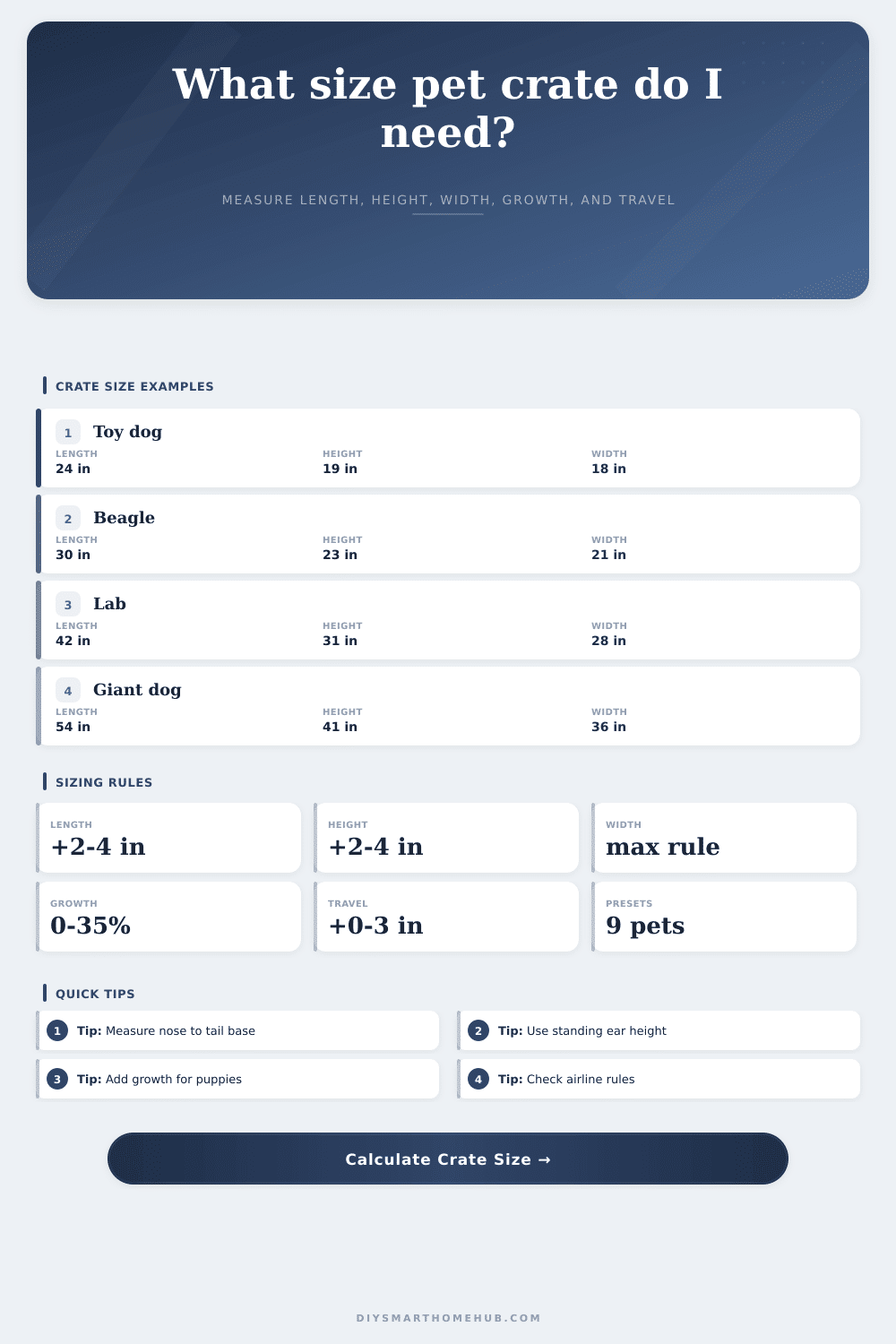
crate length = grown nose-to-tail + 2 to 4 in comfort clearance + travel kennel margin
crate height = grown standing height + 2 to 4 in comfort clearance + travel kennel margin
crate width = max(grown shoulder width x 2, grown turn width) + travel kennel margin
suggested stock size = first common crate size that meets or exceeds length, height, and width
| Common class | Typical nominal size | Approx metric | Often fits | Use note |
|---|---|---|---|---|
| Extra small | 18 x 12 x 14 in | 46 x 30 x 36 cm | Kittens, tiny dogs | Use only when length and turn width are both very small. |
| Small | 24 x 18 x 19 in | 61 x 46 x 48 cm | Cats, toy breeds | Common carrier and small home crate size. |
| Medium | 30 x 21 x 23 in | 76 x 53 x 58 cm | Beagle-size dogs | Good when shoulder width x 2 stays under 21 inches. |
| Intermediate | 36 x 24 x 27 in | 91 x 61 x 69 cm | Cocker to collie | Often chosen when height is the limiting dimension. |
| Large | 42 x 28 x 31 in | 107 x 71 x 79 cm | Retriever-size dogs | Check actual interior width before buying. |
| Extra large | 48 x 30 x 33 in | 122 x 76 x 84 cm | Large shepherds | Often needs a divider for growing puppies. |
| Giant | 54 x 36 x 41 in | 137 x 91 x 104 cm | Giant breeds | Verify doorway clearance and crate floor support. |
| Adjustment | Calculator setting | Applied to | Best use |
|---|---|---|---|
| Comfort clearance | +2 to +4 in | Length and height | Daily home crate sizing when adult measurements are known. |
| Width rule | max(shoulder x 2, turn) | Inside width | Prevents a crate that is long enough but too narrow to turn. |
| Growth allowance | 0% to 35% | All body measurements | Puppies, kittens, and pets not at adult body size yet. |
| Travel kennel margin | +1 to +3 in | Length, height, width | Car travel, airline-style checks, recovery cone clearance. |
| Preset | Use | Measurements | Growth | Travel | Recommended inside size | Nearest stock size |
|---|
There are lots of crate sizes from which to choose when you shop. You tend to pick big one: More room must be better, right? No. When you get the wrong size, it doesn’t do its job.
A crate should serve as a secure den. By their nature, dogs (and cats) crave an enclosed space. If the crate is too large, then one end becomes their sleep zone while the other end become their bathroom zone. Maximum volume isn’t what you want. What you want is something big enough so they can move around in there, yet small enough so that housebreaking is encouraged.
How to Pick the Right Crate Size
The calculator turns your tape measure readings into actual dimensions. Biology trumps optimism. Measure the animal. Don’t estimate because they aren’t weighted by their length. Long bodied dog (e.g., Dachshund) don’t weigh as much as you’d think just by looking at them. Deep chested dogs (e.g., Greyhound) don’t either.
You want to know the length from the tip of its nose to where the tail meets the body. That’s the key length measurement. Most folks include the tail in their measurements. Why? Because that makes the number bigger then it needs to be. A dog can curl up, hide its tail, and flex. What’s important for lying down is how long the spine are when standing.
Get your dog to stand still on a hard surface. Have something like a treat near his/her nose to hold him/her steady. Use a soft tape measurer. Mark the number down. This will become your starting point.
The second thing that’s non negotiable is height. You want your pet standing up inside the crate. They shouldn’t be able to touch their head or ears on the ceiling. Breeds vary by standing height. Two dogs with the exact same weight may be very different heights (example: Bulldog versus a Collie). Take a measuring tape from the ground to the top of the head. For dogs whose ears go up, measure from the floor to the top of the ears.
A cramped head room will lead to anxiety. It will also cause scratches on the wire bars.
Width is another overlooked element. Most crates are rectangles. The width will tell you whether your dog is comfortable enough to turn around. This tool compares shoulder width against its turning radius. If your dog has wide shoulders, then the width become the determining factor for crate size. In this situation, length doesn’t determine the size.
This is an introduction to time. Puppies bring time into it. If your Border Collie is only three months old, what good does purchasing a crate for him do? He’s going to double in size! Don’t get a tiny crate now and a giant crate in a few weeks. No. Get the giant crate now and use a divider. By getting an adult-sized crate from the start, you purchase the crate once and use it forever. You simply slide over a partition in the middle. This limits the dog’s living area to his present size. Each week (or day, even!) you slide the divider over to make more room as he get bigger.
To know how big to project the adult crate, you need to plan ahead. This means knowing the adult dimensions. The calculator has a way of accounting for this. It predicts how much your little buddy should grow based on a percentage. Twenty percent is common for late-stage puppies. Thirty-five percent is reasonable for real young puppy or kittens. Knowing this helps keep you from buying a too-small crate which will feel like a closet later.
Constraints come with travel. The home crate caters to comfort by allowing for denning behavior. The travel kennel caters to compliance and security. The airline has rules. And those rules include ventilation, specific hardware and interior dimension requirements such that the animal can comfortabley sit, lie down and turn around in the crate.
Margin comes into play in all three of these scenarios. Slightly more forgiving is car travel. Yes, extra clearance is needed when a harness might be worn inside a crate or a recovery cone used after surgery. That means an Elizabethan collar takes up a lot of room. With all this equipment, a typical crate becomes cramped. Add another inch or two of travel margin to ensure the pet isn’t rubbing against the bars.
A reference table follows, comparing typical stock sizes to the calculated need. Most likely, you won’t find a crate that fits perfectly. In most cases you’ll go up one size. Never down. If it’s a half inch short on length, the tail gets tucked under painfully. If it’s a half inch too short on height, there is bruised ears.
Commercial stocks represent the minimum available size. They meet or exceed the calculated minimums. They’re not suggestions; they’re a safety net.
That’s the mathematics. But that’s only the beginning of the test. Lay out the blanket in whatever crate you’re thinking of for your pet. Ask your pet to enter. Observe how he or she settles. Is there any resistance getting his/her back legs stretched out? The length is marginal. Is he or she hunched? There is not enough height. Any hesitation turning around? The width is too small.
Math provides the numbers. Sight provides the confirmation. Training will be easier when you have the numbers down. The good size crate isn’t a prison. It’s a room. And it’s one that fits its occupant perfectly.