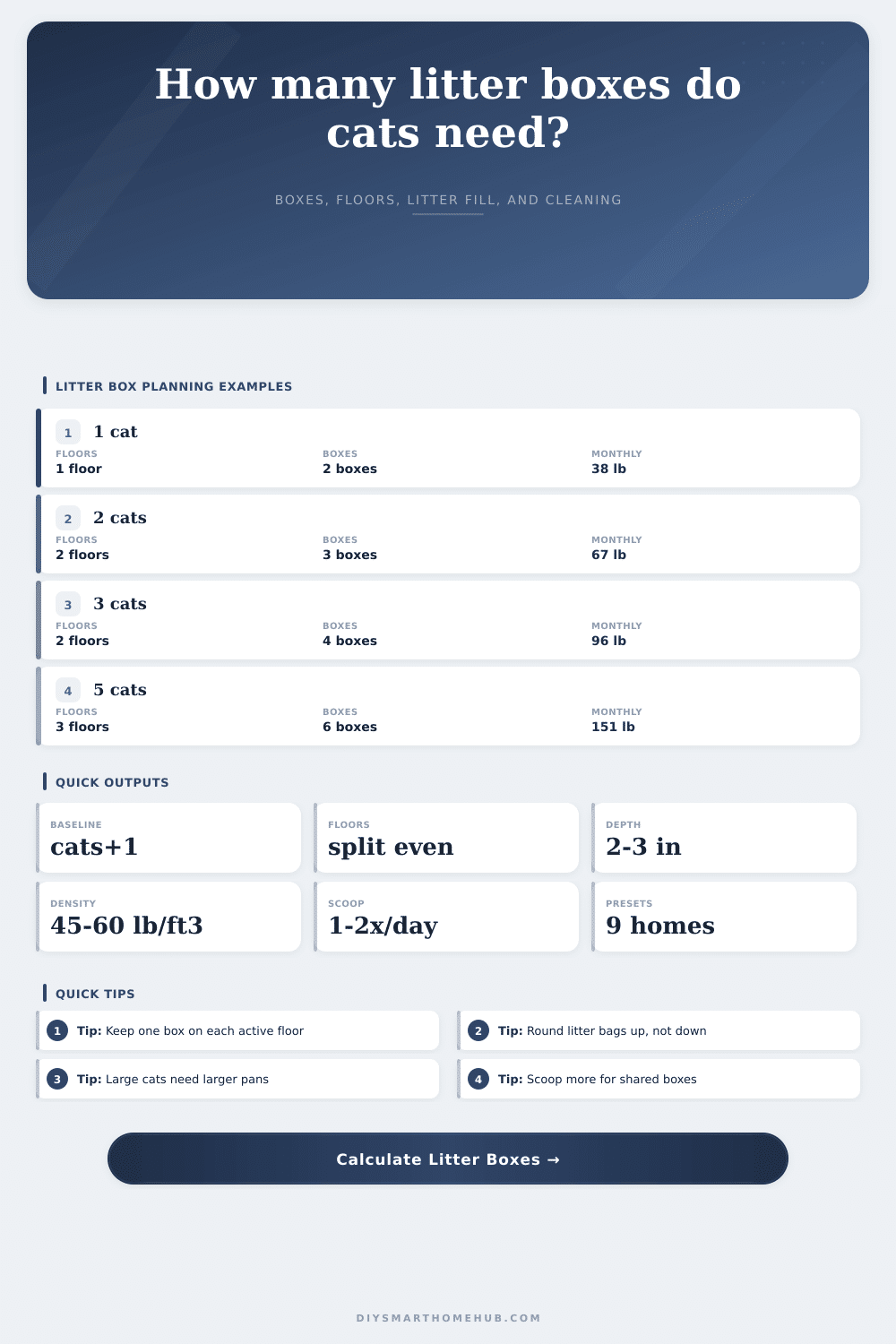
Litter Box Count by Cats Calculator
Estimate the cats+1 baseline, distribute boxes across floors, size litter volume from box area and depth, and plan monthly litter weight plus cleaning frequency.
Litter box plan
recommended boxes = max(cats + 1, floors used)
floor distribution = whole boxes per floor + remainder placed on lower numbered floors
box area ft2 = length in x width in / 144
litter volume ft3 = box area ft2 x depth ft / box x recommended boxes
initial fill lb = litter volume ft3 x density lb/ft3
monthly litter lb = ((initial fill lb x 30 / full change days) + (cats x waste lb/day x 30)) x (1 + buffer)
cleaning actions per day = recommended boxes x scoops per box per day
| Cats | Baseline boxes | 1 floor | 2 floors | 3 floors | Planning note |
|---|---|---|---|---|---|
| 1 cat | 2 boxes | 2 | 1 / 1 | 1 / 1 / 1 if all floors are active | Small homes can still use two locations. |
| 2 cats | 3 boxes | 3 | 2 / 1 | 1 / 1 / 1 | Common balanced multi-floor plan. |
| 3 cats | 4 boxes | 4 | 2 / 2 | 2 / 1 / 1 | Add capacity where cats spend most time. |
| 4 cats | 5 boxes | 5 | 3 / 2 | 2 / 2 / 1 | Watch shared boxes for heavy traffic. |
| 5 cats | 6 boxes | 6 | 3 / 3 | 2 / 2 / 2 | Even splits are easier to maintain. |
| Inside pan size | Area | 2 inch depth | 3 inch depth | Clay fill at 55 lb/ft3 |
|---|---|---|---|---|
| 18 x 14 in | 1.75 ft2 | 0.29 ft3 | 0.44 ft3 | 16.0 to 24.1 lb |
| 20 x 15 in | 2.08 ft2 | 0.35 ft3 | 0.52 ft3 | 19.1 to 28.6 lb |
| 22 x 16 in | 2.44 ft2 | 0.41 ft3 | 0.61 ft3 | 22.4 to 33.6 lb |
| 24 x 18 in | 3.00 ft2 | 0.50 ft3 | 0.75 ft3 | 27.5 to 41.3 lb |
| 28 x 20 in | 3.89 ft2 | 0.65 ft3 | 0.97 ft3 | 35.6 to 53.5 lb |
| Traffic level | Cats per box | Scoop target | Full change range | Calculator input to try |
|---|---|---|---|---|
| Light | 0.3 to 0.6 | 1x daily | 21 to 30 days | 1 scoop, 21 to 30 days |
| Normal | 0.6 to 1.0 | 1 to 2x daily | 14 to 21 days | 1.5 scoops, 21 days |
| Busy | 1.0 to 1.5 | 2x daily | 10 to 14 days | 2 scoops, 14 days |
| Heavy | 1.5 or more | 2 to 3x daily | 7 to 10 days | 3 scoops, 7 to 10 days |
Adding a cat to the family? You may believe having a single large box will take care of it all. That’s where many people goes wrong. Territory and habit are key for cats. Their bathroom preferences depend more on privacy and accessibility different than on how much space there is. Adding a cat to your home mean adding another set of behavioral expectations. Fail to meet them and expect litter on the rug.
There’s a reason we call this the cats plus one rule. It isn’t some random guideline; it’s a safeguard from territory issues and competition. Once you’ve determined your living situation and how many cat you own, the calculator above does the math for you, you don’t need to guess at numbers. But it’s important to understand what that number represent.
Why You Need More Litter Boxes
If you live in a house with multiple floors, a box located on the first floor won’t help if your cat mostly hangs out on the third floor. That cat is practical: He’ll go right next to his bed rather than walking through three rooms (or past a loud dog) to take a leak. The tool will help you spread out boxes within your active zones so there isn’t one that become a bottleneck. How much you spread them out tends to be more important then how many you have.
The majority of box owners don’t fill their boxes sufficiently, just barely so that nothing is buried well and it all just kinda gets kicked around. At minimum, you want to have 2-3″ of stuff in there. This may sound like a lot but it’s needed to keep things smell free. The tool takes the size of your pan and how much you’d like to put in (depth) and turns that into a number (volume). It also take into account what kind of litter you’re using and its density. Many users becomes tripped up on this part since different types of litter can vary greatly when it comes to weight (clay is heavy, silica crystals are light).
When you change out from something heavy like clumping clay to an airy plant based version, the weight will be a LOT less, but the volume won’t. So the calculator adjusts to match the change in density and gives you an accurate weight instead of generic one.
Monthly plans based off intuition tend to fail. Just getting litter doesn’t happen once a month. After a scoop or two, you’ll need to top it off again; then the stink will force another change. The calculator takes into account how much you produce each day and how long before you need a full change. Almost nobody guesses correctly. This accounts for the first fill, regular top-ups to cover spills and tracking, and the occasional big cleanout. Smart to add a buffer too. Boxes get overturned. Tracking goes outside the box. Life happens. Ten percent is enough to avoid that “oh no! I’m gonna run out on a Sunday night” panicking.
The amount you clean depends on how much it’s in use. One box for one older cat isn’t going to be as dirty as one box used by two cats. If the box gets heavy traffic then daily cleaning isn’t enough. Bacteria and stinky ammonia will build up, causing them to avoid their litterbox entirely. Suggested scooping amounts is calculated according to the number of cats per box. Not only does this ensure an unclean box doesn’t get left sitting around, it keeps the resource usable. If you can’t use a resource, it is as useless as a closed door.
I have boxes on all the floors I am actively livig. That way each cat can access one if necessary. And so far it seems to eliminate the possibility of them having an accident which makes the house happy. The system takes a little math and measuring at first but then is a workable solution for everybody. You know when you are going to run out (and how much) and your cats knows where to go when they want to do their business. It removes all the guesswork.
The math cleans the air. Literaly.