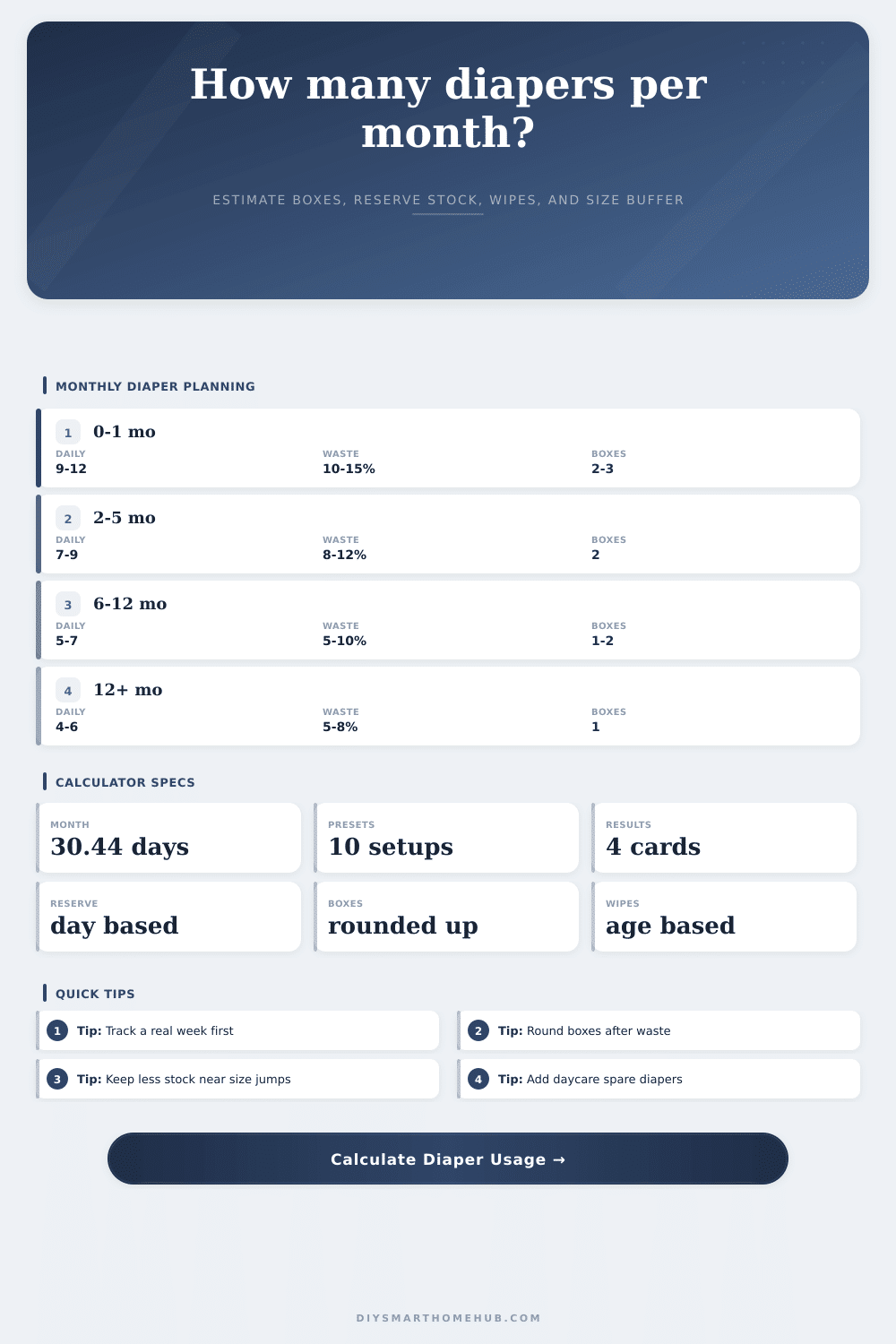
Diaper Usage Per Month Calculator
Estimate monthly diapers, boxes to buy, cost, reserve stock, wipes, and size transition buffer from your baby's age, weight, daily changes, overnight use, daycare routine, and pack details.
Monthly diaper plan
| Estimated size | Common weight band | Typical daily diapers | Transition buffer rule |
|---|---|---|---|
| Newborn | Up to 10 lb | 9-12 per day | Keep 7-10 days if near 10 lb |
| Size 1 | 8-14 lb | 8-10 per day | Keep 10-14 days if near 14 lb |
| Size 2 | 12-18 lb | 7-9 per day | Keep 10-14 days if near 18 lb |
| Size 3 | 16-28 lb | 5-7 per day | Buying a month is usually safer |
| Size 4+ | 22 lb and up | 4-6 per day | Stock larger boxes when fit is stable |
| Situation | Waste buffer | Reserve target | Wipes estimate |
|---|---|---|---|
| Normal home routine | 5-10% | 7-10 days | 2.0-2.5 per diaper |
| Newborn or blowouts | 10-20% | 10-14 days | 2.5-3.0 per diaper |
| Daycare routine | 8-12% | 10-14 days | 2.0-2.5 per diaper |
| Near size transition | 5-10% | 5-7 days in current size | Use normal wipe rate |
| Scenario | Effective diapers/day | Monthly diapers | Monthly boxes at 168 count |
|---|---|---|---|
| High-change newborn | 11.0 | 369-386 | 3 boxes |
| Steady infant | 8.0 | 256-268 | 2 boxes |
| Daycare weekday infant | 7.7 | 254-262 | 2 boxes |
| Older baby or toddler | 5.0 | 160-168 | 1 box |
Your first week home with baby isn’t really about parenting; it’s logistics management. All of a sudden this thing require absolutely no food except milk, and it creates an insane amount of waste. Around day four (usually), panic strikes as you’re realizing that there isn’t a single extra box left from the hospital bag, and you’re now spending most of your time running to the grocery store. If you’re like most parents, you’ll be guessing on quantities when buying diapers, leading to either a half-full diaper genie or a panicked late-night trip to drugstore.
The number of diapers doesn’t tells the whole story. There is other factors that use some but not all of your supply, things we can’t see that require estimation too. And this is where the calculator kicks in. Entering your baby’s starting weight and age helps estimate their current diaper size and predict future growth, meaning when they may transition to another size. However, the true benefit lie in its detailed options such as how frequently you change them and amount of waste per change.
How to Plan Your Baby Diaper Supplies
For example, if your newborn blows out or leaks (which happens a lot), then that diaper is now useless after only one hour. Without factoring in waste, you’ll quickly run out. The first month should of have a 10-15% waste buffer. Is that being pessimistic? No. That’s reality.
Most people forget about the added complexity of daycare. Typicaly, when you drop your baby off at daycare, you’ll send a spare diaper with them, “just in case.” Over the course of 5 days per week, that’s almost 200 extra diapers per year. To account for this, the tool allow you to enter how many daycare day there will be each month and will adjust your monthly projection accordingly. For example, it also considers number of overnight diapers used independently, because overnight diapers tend to be bulkier but still need to be the right size. Does your baby wear a heavier overnight diaper? Is that going to come from your standard supply of diapers or do you buy them in bulk?
The last stressor is cost. Because we’re talking about diapers here, there’s a constant variable (they change size), and prices also varies depending on sales cycles. So the calculator estimates what your monthly diapers will cost based off the price, pack size, and whether or not you’re taking advantage of subscription discounts. That way you can compare apples-to-apples; the real cost-per-diaper, versus the sticker price of a given box. You’ll see where it looks like you’re getting more for less buying in bulk (say a 3-pack), but your little one only wears them for 2-3 weeks before moving onto her next size. You’ve wasted some money on all those extra furnitures. That’s why the size transition buffer exists. It tells you how many boxes of your baby’s current size you should hold in reserve until she reaches the next size band. It help avoid that very same error!
Emptying the tub makes people think about wipes, which they forget to plan for at first. How much will they actualy use? It depends on their diet and age. A toddler who eats solids may go through more wipes per change then a breastfed newborn. Based off the baby’s age, the tool can guesses how many wipes you’ll use; so you know how many packs of wipes to stock up on. It saves you from running out of diapers but not having any way to clean up.
The best way to get an idea of what your true base is is to track your use for a week and then crunch the numbers. Theory is one thing, reality another. With this information, the app generates a reserve stock. This covers any periods where you might run out due to a delay in the supply chain. What was a random expense becomes a solvable inventory issue.
Guesswork is replaced by planning. Knowing precisely when the next shipment will arrive relieves a huge amount of stress. It only took a couple of minutes to create the profile. Having just enough, but never too little, and knowing when to reorder next gives you peace of mind.