Motorized Curtain Travel Time Calculator
Estimate full-open and partial-open curtain timing from track length, panel layout, motor speed, start delay, soft-start acceleration, daily cycles, and battery rating.
Results will appear after calculation.
Good for smaller windows where simple charging and slower quiet movement matter more than speed.
A common balance for living rooms, bedrooms, and dual-panel center-opening tracks.
Often loses speed under blackout fabric, long carriers, or curved track sections.
Useful where multiple curtains need to finish together without long scene delays.
Travel time by panel distance
| Panel travel | 3 in/s | 5 in/s | 7 in/s |
|---|---|---|---|
| 36 in / 0.91 m | 12.0 sec | 7.2 sec | 5.1 sec |
| 60 in / 1.52 m | 20.0 sec | 12.0 sec | 8.6 sec |
| 84 in / 2.13 m | 28.0 sec | 16.8 sec | 12.0 sec |
| 120 in / 3.05 m | 40.0 sec | 24.0 sec | 17.1 sec |
Single vs dual-panel travel
| Track length | Single draw | Dual draw | Timing effect |
|---|---|---|---|
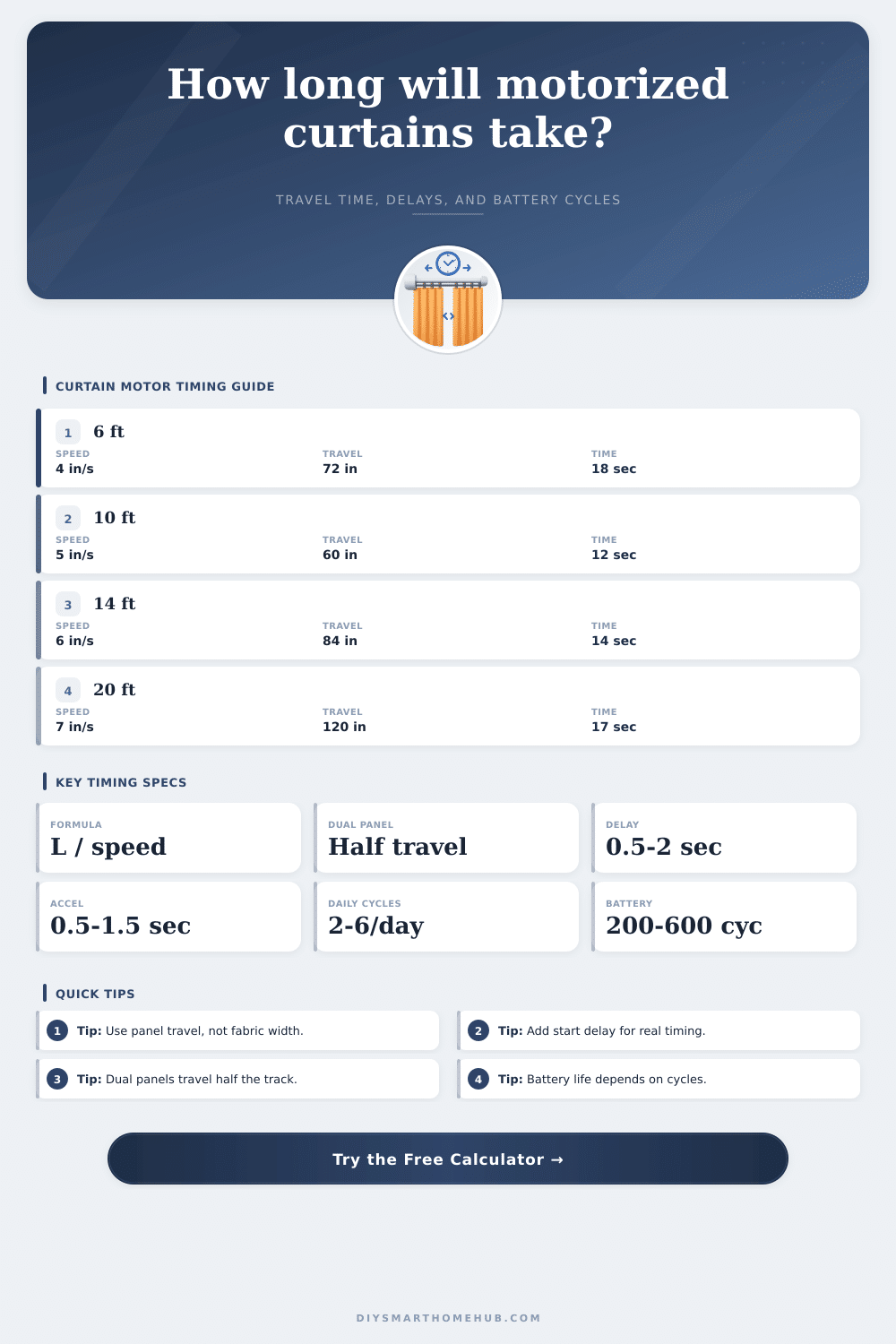
| 6 ft / 1.83 m | 72 in | 36 in | Dual is about half |
| 10 ft / 3.05 m | 120 in | 60 in | Dual is about half |
| 14 ft / 4.27 m | 168 in | 84 in | Dual is about half |
| 20 ft / 6.10 m | 240 in | 120 in | Dual is about half |
Battery cycle planning
| Rated cycles | 1 cycle/day | 2 cycles/day | 4 cycles/day |
|---|---|---|---|
| 150 cycles | 150 days | 75 days | 38 days |
| 300 cycles | 300 days | 150 days | 75 days |
| 450 cycles | 450 days | 225 days | 113 days |
| 600 cycles | 600 days | 300 days | 150 days |
Common curtain automation examples
| Project | Track | Open target | Likely time |
|---|---|---|---|
| Bedroom pair | 8 ft / 2.44 m | 100% | 10-14 sec |
| Patio slider | 12 ft / 3.66 m | 100% | 22-32 sec |
| Nursery scene | 7 ft / 2.13 m | 70% | 8-12 sec |
| Office bank | 18 ft / 5.49 m | 85% | 16-24 sec |
Then you open the blinds (or at least try to). You pull out your phone to open the curtains for morning light. Slowly. It is annoying because you know it is daylight now, but the bunched-up fabric is still blocking your view. It’s not typically an issue of too weak motors; it’s a math problem.
Most folks think “ten foot track” means the curtain goes ten feet across. But they forget that two panels meet in the middle and need extra room to stack back when closed. So instead of twelve seconds, you wait twenty because someone made a math mistak. But more importantly, it eliminates any guess work by making you consider the real amount of distance that the curtain travels. The length of the tracks are not the same as the travel distance.
Why Smart Curtain Math Matters
You need to think about what type of operation the curtains is doing. If you have two panels with a dual opening then each panel will only cover half the track. They’ll meet in the middle and pull across the full width of the track (unless you add ties or something else) but either way the geometry change and you don’t want to get stuck guessing. The tool takes all that into account automatically. It also deducts for the stack allowance, which is the chunk at the end of the curtain that sits there, does nothing, and just bunches up the carrier. You can ignore that, but it would inflate your estimate and make it seem like the job take longer than it actualy does.
Six inches per second sounds easy enough until you bring weight into the mix… A spec sheet could claim that of a lighter swatch of sample material. The loaded speed factor in the inputs accounts for the drag caused by heavy blackout drapes. That’s a small percentage drop, but it adds up over a long track; try syncing several windows in your livig room or office and you’ll see what I mean. A slow open on one set, a zipping past on another: The scene is broken, and the calculator can help you foresee those sync problems before they occur.
There is also the issue of acceleration and delay at startup. Motors don’t teleport from 0-100% immediately. They has to be woken up from standby mode. They recieve the command and must then ramp up their torque, taking an additional second or two for every movement. It seems like nothing much until you’re programming a sunrise sequence across the entire house, and those seconds add up when multiplied by five rooms. So the tool distinguishes latency in systems vs. Mechanical movement, and isolates out pure travel time from any other operational lags so you can see exactly where the clock is ticking.
Another secret ingredient to curtain automation are battery life. (Who buys wireless tracks, which have a clean look, and then forgets about the batteries draining rapidly with frequent cycling?) The calculator tells you how many days of use you’ll get before needing to recharge, depending on your opening-closing frequency. If you’re using curtains as a light controller (i.e., opening/closing them three times daily), you’re chewing through cycles. You need to be aware of this fact rather than burning through batteries without knowing what’s going on. It turns an abstract battery rating into a practical maintenance schedule, so you stop wondering why the motor died after two months and realize you were overworking it by design.
Why did the motor die off in two months? The same holds true with heavy blackout fabrics: They pull harder on the track, creating micro-stutters in the system if the motors not powerful enough. That means you have to change the load factor here for accuracy so that your timing estimate takes into account how hard dense material pulls on aluminum rails. Sluggish curtains will make the whole illusion of effortless control go down the tubes; so you may decide that spending a little more now for a faster motor is worth it just to ensure smooth movement and predictable timing.
Deciding which system. Battery or plug-in, is a question of ease vs. Wiring: Plug-ins can manage greater loads (since they have uninterrupted power) while battery systems are cleaner but need more careful pattern-of-use consideration (hence the tables as reference). Knowing what level of automation you want to achieve will inform whether or not a wireless system works for you; if you’re planning on lots of adjustments during the day, hardwire may end up being a smarter long run.
The timing of travel matters too; well-timed, smooth movements makes a big difference to the feeling of control over the space. Unpredictable, laggy curtains remind you that there’s tech involved instead of masking it. When you account for delays and really feel what your real-world stroke looks like, you can set realistic expectations about what happens with the curtains. It’s simple math, but difficult to do in your head, which is why delegating the variables to the tool means spending fewer moments glaring at immobile cloth and more enjoying the light streaming through.