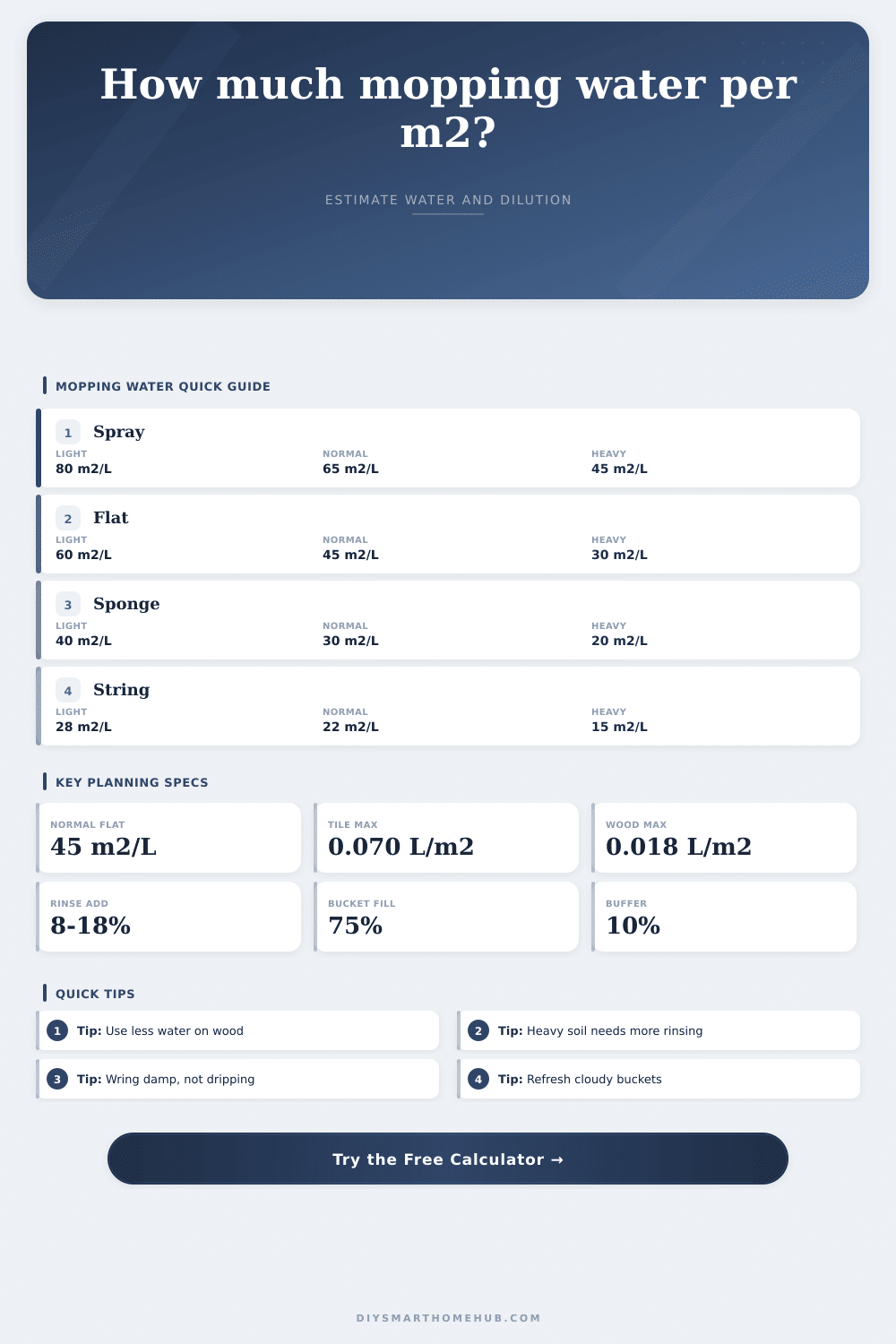
Mopping Water Per Square Meter Calculator
Estimate mopping water, rinse water, bucket changes, wetness per square meter, and cleaner dilution from floor area, mop release, wring level, soil, floor tolerance, and unit system.
Detailed mopping breakdown
| Mop type | Base release | Normal coverage | Best use case |
|---|---|---|---|
| Spray mop damp pass | 0.014 L/m2 | About 70 m2/L | Finished floors, light dust, daily maintenance |
| Microfiber flat mop | 0.022 L/m2 | About 45 m2/L | Most homes, vinyl, tile, laminate with careful wringing |
| Steam mop pad moisture | 0.018 L/m2 | About 55 m2/L | Sealed tile or vinyl where heat is allowed |
| Spin mop well wrung | 0.028 L/m2 | About 36 m2/L | Mixed rooms where manual wring control matters |
| Sponge mop | 0.034 L/m2 | About 29 m2/L | Small kitchens, spill pickup, smooth hard floors |
| Cotton string mop | 0.046 L/m2 | About 22 m2/L | Tile, concrete, heavily soiled utility zones |
| Compact auto-scrubber | 0.030 L/m2 | About 33 m2/L | Large durable floors with controlled solution feed |
| Floor material | Planning cap | Coverage at cap | Calculator warning meaning |
|---|---|---|---|
| Sealed hardwood | 0.018 L/m2 | 56 m2/L | Use a barely damp mop and avoid wet edges |
| Sealed cork | 0.020 L/m2 | 50 m2/L | Keep water low around seams and transitions |
| Laminate flooring | 0.025 L/m2 | 40 m2/L | Reduce release when calculations exceed the cap |
| Vinyl plank or sheet vinyl | 0.040 L/m2 | 25 m2/L | Moderate damp mopping is usually acceptable |
| Sealed natural stone | 0.045 L/m2 | 22 m2/L | Use compatible cleaner and avoid oversaturation |
| Glazed tile or sealed ceramic | 0.070 L/m2 | 14 m2/L | Can handle wetter cleaning when grout is sound |
| Sealed concrete | 0.080 L/m2 | 13 m2/L | Durable floor; soil load usually controls water use |
| Soil level | Release multiplier | Rinse multiplier | Typical cue |
|---|---|---|---|
| Dust and light footprints | 0.75x | 0.60x | Mop water stays mostly clear after one pass |
| Normal weekly soil | 1.00x | 1.00x | Light grey water, no sticky residue trail |
| Sticky kitchen residue | 1.35x | 1.25x | Mop drags or leaves dull patches without rinse |
| Heavy mud or entry soil | 1.75x | 1.55x | Visible soil loads the mop quickly |
| Greasy film or workshop soil | 2.10x | 1.80x | Water darkens fast and a second pass is common |
| Project area | Area | Typical water | Likely bucket plan |
|---|---|---|---|
| Small bathroom tile | 5 to 8 m2 | 0.3 to 0.7 L | Partial bucket or spray reservoir |
| Kitchen or dining zone | 12 to 25 m2 | 0.7 to 1.8 L | One small bucket with rinse margin |
| Open-plan living area | 35 to 60 m2 | 1.3 to 3.2 L | One normal bucket, refresh if cloudy |
| Apartment hard floors | 55 to 95 m2 | 2.2 to 5.5 L | One bucket, sometimes two for heavy soil |
| Garage or utility floor | 25 to 45 m2 | 2.0 to 5.0 L | Durable floor with heavier rinse allowance |
Damp maintenance pass
Best for dust, sealed wood, laminate, and routine smart-home cleaning schedules. Water rate stays low, and coverage per liter is high.
Standard bucket mop
Works for weekly cleaning on tile, vinyl, and mixed rooms. Wring efficiency and rinse cycles drive most of the water estimate.
Recovery clean
Heavy soil, mud, or sticky residue needs more water per square meter because mop loading and rinse water dominate the final total.
Estimate exactly how much water to put in your mop bucket (so it doesn’t dry out too fast or pool in corners). When you do this, most folks act as if there is no end to their supply: The bucket is basically a bottomless well until the water looks like swamp mud. Volume management, not scrubbing, is what mopping are all about. You need enough water to pick up dirt, but not a drop too much or else it will force its way into the seams and cause damage. Get the ratio right to save your back and your floors.
Here’s how it works: The math is done by calculator for you, but knowing why it does what it does makes the answer more believable. Usually, the mop itself are the thing that matters most. For example, a flat mopping system with microfibers can covers more square meters per liter and it will hold very little water. Efficient. But also unforgiving. When you realy wring it out it goes dry in a hurry.
How to Use the Right Amount of Water
Then there’s the thirsty beast… A sponge or string mop that soaks up gallons and lets go in a form of heavy wet blanket. It is great for a concrete garage floor, but it is a disaster waiting to happen on a sealed hardwood floor. The tool uses these release rates to adjust how much water is needed depending on whether it comes from a bucket or a spray bottle.
Another important part of the puzzle are floor material tolerance. This is where many DIY’rs goes wrong… and pay through their noses for it. Tile = no problem with a wet mop. Glazed ceramic cannot handle puddles being left behind for an hour or more. But wood? Not so much. Sealed hardwood only takes so much water before it start seeping in between boards, warping them, cupping them, etc.
The calculator will compare how wet you think it’ll get vs. What the material can safely tolerate. Here is a warning. You’re planning on dumping too much H20 on something that won’t be able to soak it up. What is the solution? Don’t use as much? That’s not the solution. The solution is switching from wet-scrubbing to damp-wiping.
Changes in soil level also makes a difference. If it’s just a light layer of dust, almost nothing will happen; the friction does all the heavy lifting. Mud or sticky kitchen goop? Not so much. Dissolving the film takes volume. Rinsing it off also takes volume. Often people forget about the rinse cycle when they’re doing a manual estimate. Fill up a bucket, mop the floor, walk away. But did they take into account second bucket of clean water required to wash out the mop head, which has now turned into a grime-spreader?
With the tool, that rinse allowance is added automatically and you have an exact number of buckets to prep for before you set foot inside the room. There is also dilution. This is the technical sounding bit, but it’s nothing more than getting your mix right. Use too much concentrate and you’ll end up with a sticky film that trap dirt instead of preventing it. Too little? You’re just moving water.
With the calculator you can set how much total solution volume you need and it measure out the amount of concentrate for you. That means no making more than you need, or leaving a residue trap behind. It even allows for a small overage buffer. There are corners, doors and furnitures in real rooms that will consume additional water. Ten percent buffer covers those edge cases without bloating your supply needs.
Cleaning a floor well doesn’t require a degree in mathematics. It only requires that you quit guessing. When you know your square footage and how your floor and mop work together, you can make a plan instead of playing catch up. You should of known this earlier. Add the proper quantity of water, add the appropriate amount of cleaner, and wring the mop to its best effect.
What you end up with is a good looking floor. It stays looking good for longer since you didn’t use too much water. Water is tile’s best friend and wood’s worst enemy. Know your floor. Use the numbers. Minimize puddling.