Cat Water Fountain Refill Calculator
Plan refill timing from cat count, body weight, daily hydration targets, wet-food water offset, evaporation, splash loss, pump minimum line reserve, and reservoir capacity.
Detailed refill breakdown
| Planning target | Formula | 5 kg cat | 11 lb cat |
|---|---|---|---|
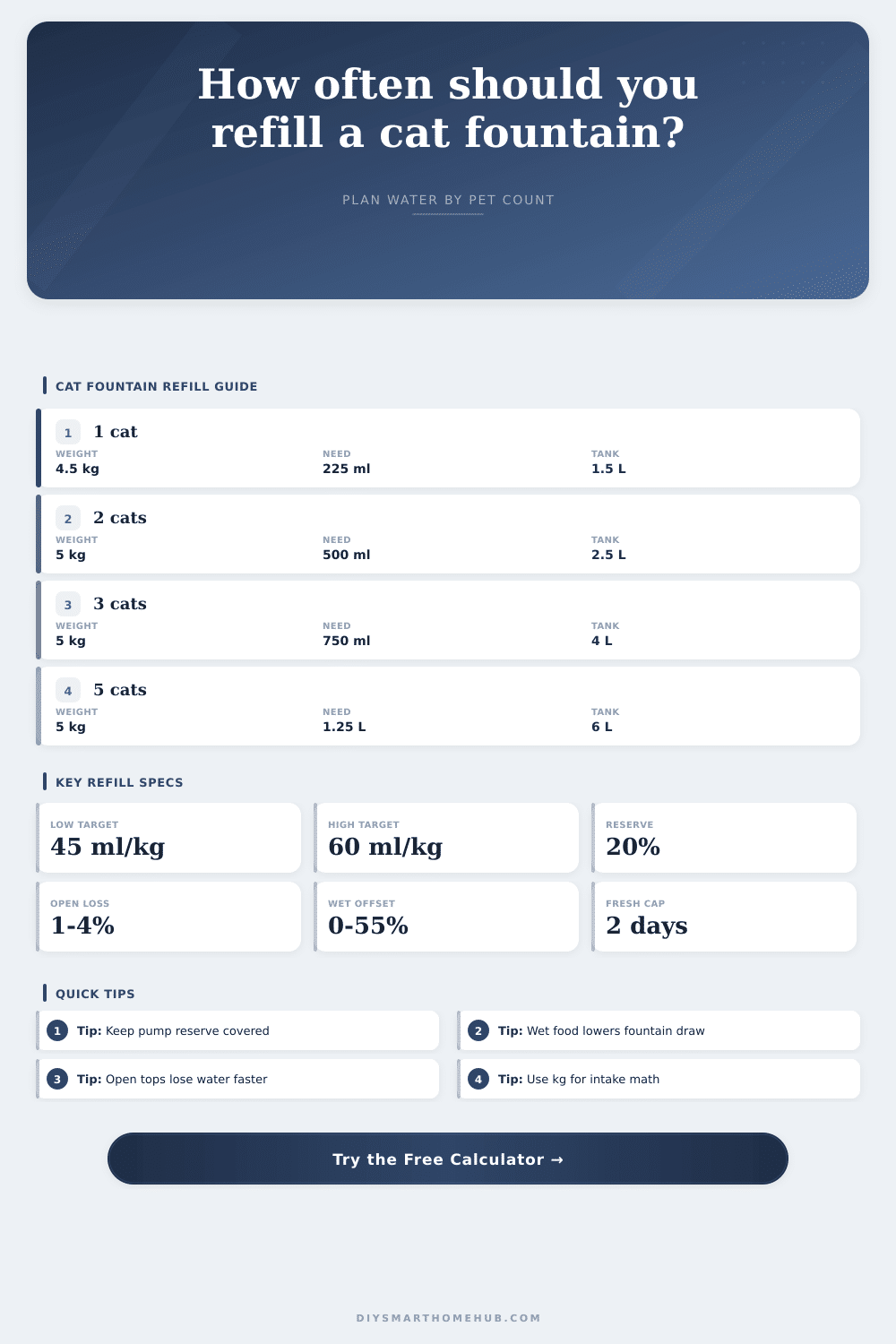
| Lower adult planning | 45 ml/kg/day | 225 ml/day | 7.6 fl oz/day |
| Typical mixed-home target | 50 ml/kg/day | 250 ml/day | 8.5 fl oz/day |
| Dry-food or active cat | 55 ml/kg/day | 275 ml/day | 9.3 fl oz/day |
| High planning target | 60 ml/kg/day | 300 ml/day | 10.1 fl oz/day |
| Diet pattern | Fountain offset | What it means | Use when |
|---|---|---|---|
| Dry food only | 0% | Nearly all planned water comes from drinking | Kibble is the main food source |
| Small wet-food share | 15% | Some water arrives with meals | Occasional wet meals or toppers |
| Mixed feeding | 30% | Fountain draw is reduced, but still important | Wet and dry food are both routine |
| Mostly wet food | 45% | Meal moisture covers a large share | Canned or pouch meals dominate |
| Wet-food dominant | 55% | Fountain is mainly supplemental drinking | High-moisture meals are consistent |
| Advertised capacity | Typical pump reserve | Usable water | Best fit |
|---|---|---|---|
| 1.5 L / 51 fl oz | 250 ml / 8 fl oz | 1.25 L / 42 fl oz | One cat or daily refill habit |
| 2.5 L / 85 fl oz | 350 ml / 12 fl oz | 2.15 L / 73 fl oz | Two average cats with buffer |
| 4 L / 135 fl oz | 600 ml / 20 fl oz | 3.4 L / 115 fl oz | Three cats or longer interval |
| 6 L / 203 fl oz | 900 ml / 30 fl oz | 5.1 L / 172 fl oz | Large multi-cat station |
| Household | Diet offset | Daily draw range | Useful reservoir |
|---|---|---|---|
| One 4.5 kg indoor cat | 0% to 30% | 180 to 275 ml/day | 1.2 L usable for several days |
| Two 5 kg adult cats | 15% to 30% | 420 to 575 ml/day | 2 L usable for 3 to 4 days |
| Three dry-food cats | 0% to 15% | 850 to 1,050 ml/day | 3.5 L usable for 3 days |
| Five-cat shared station | 0% to 30% | 1.3 to 1.8 L/day | 5 L usable for 2 to 3 days |
| Mostly wet-food senior cat | 45% to 55% | 110 to 180 ml/day | 1 L usable with fresh cap |
Enclosed reservoir
Use a low evaporation factor because less surface water is exposed. The pump reserve still matters, so advertised capacity is not the same as usable refill capacity.
Open-top fountain
Use a higher open-bowl loss when the water tray is wide, warm air moves across it, or cats splash while drinking. Refill timing can shorten by hours.
Shared multi-cat station
Use a larger sharing buffer for crowding, spills, and uneven drinking behavior. A second water station can reduce the load on the fountain.
Moddern cats don’t drink enough water; they’re used to getting moisture from their prey and this poses a problem when fed on dry kibble. To remedy this, you’ll want to provide a water fountain that helps them stay hydrated.
Treat it like a hydration system (not just a bowl) which means planning for capacity. So I built a calculator (above) to take away all that math. You input how many pets is in the tank and what kind of food they eat. Then, let the calculator work out how much water your pump will handle and how much evaporates.
How to Pick the Right Cat Water Fountain
It begins with intake and target weight goals. A 5 kg cat eating dry food need about 250 milliliters of water each day. If you use wet food, that figure decreases. Why? Because wet food contain some water already. That’s why the calculator takes that into account. One cat that eats nothing but kibble will draw more water from the reservoir then another that eats four cans a day. This makes a difference. It helps ensure you don’t get a tank that are too small or too large.
There’s also some confusion between what’s called total capacity versus what’s called usable capacity. The total size of the fountain is what’s advertised, however, that’s not necessarily how much water there is to drink. There has to be enough water in order for the pump to submerge. The pump could overheat and run dry if there isn’t enough water. That space reserved for the pump isn’t space for hydration. So you’re thinking you’ve got two liters of water, but you need three hundred millimeters for the pump? Well, you only really have one point seven liters. The calculator automatically subtracts this reserve from the water so that it provides you with a realistic look at when the water is going to last.
Secondly, evaporation lowers the water. Closed fountains lose water more slowly than open top ones. This happens even more if your room is warm or breezy. Even a small percentage loss per day add up over a week. Daily draw will be higher if it’s an open bowl with three cats. The tool considers how much water will evaporate and provides a little buffer for splash ups. That becomes important if you’re looking to refill less frequently. If they don’t factor that into the water draw, the water level will go down faster then expected. This could expose the pump or even cause you to rush home for an emergency refill.
Behavioral variables enter in multi-cat households. Water sources can be territorial; cats won’t drink if another cat’s in their space. Even if the math says the water lasts long enough, a single fountain might not suffice for group of five cats. You can increase your sharing buffer (the amount added to the daily draw) on the calculator. That’s to account for competition/ spills as well as the possibility that some cats won’t use main station. That way no single cat drinks it all up.
Water must be fresh: there’s a constraint here. Even though a big tank can store 10 days worth of water, that water will get stale and that’s bad. Stale water loses its appeal to cats with sensitive noses. How often should it be replaced? Every two-three days according to experts. The tool compares how often you replace the water vs. It compares how often you replace the water to the expert recommendation. If the water gets old before you refill it, it will warn you. That forces you to balance convenience and health. Maybe you only want to refill once a week but what if the water goes sour at day four? This is not healthy for your cats to drink.
So, how does one choose the proper-sized fountain? Choose the right equipment for your lifestyle. If you have one senior wet-food-eating cat, the little one is fine. But if you have an active household of kittens, nope. It won’t work. Those are some of the situations described in the reference tables on this page, which illustrate the factors involved (diet, number of pets) and the required sizes. No need to commit them all to memory…
Just remember that keeping the water fresh and covering the pump keeps it going so that your cats might actualy use it. You should of checked everything before buying new furnitures.