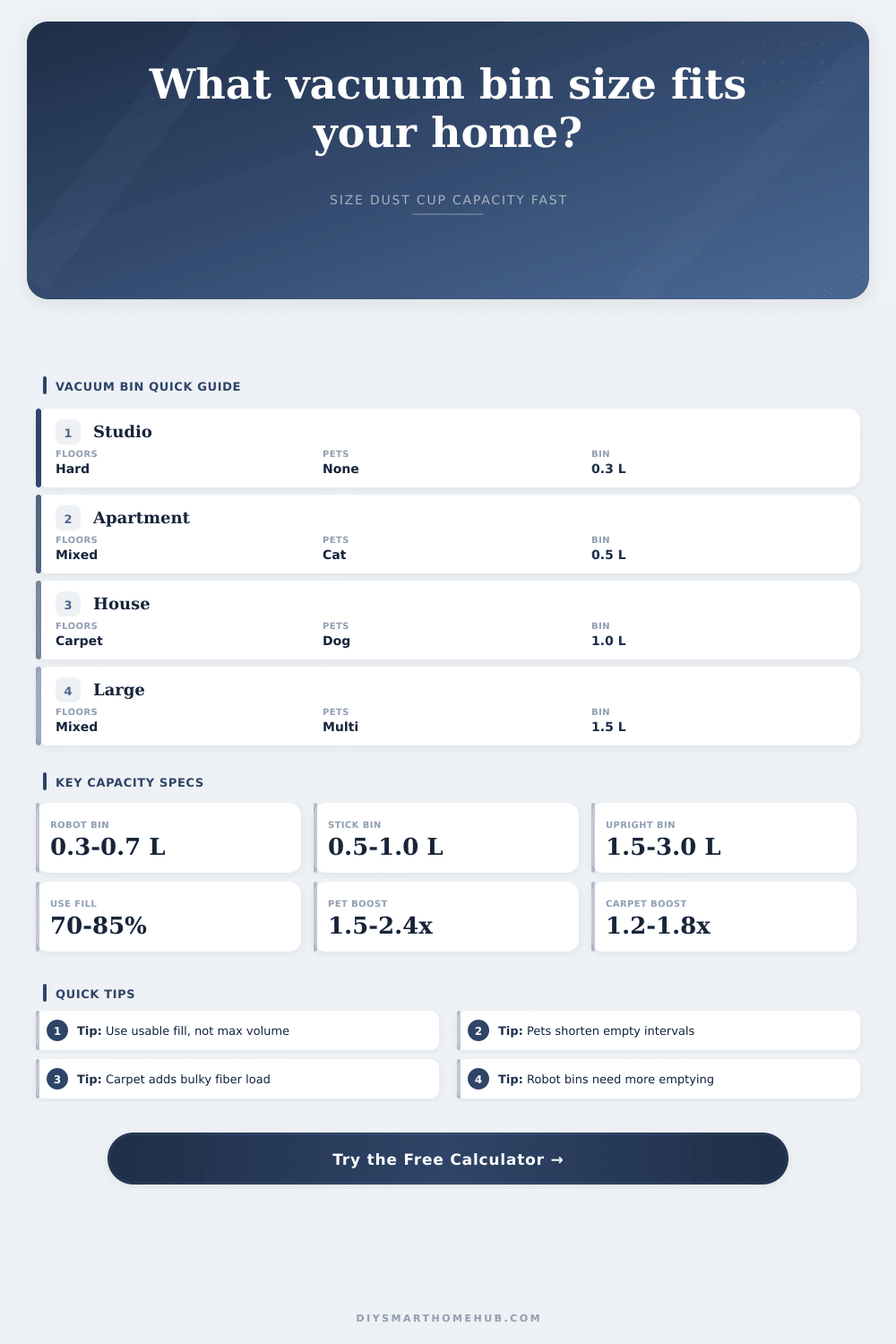
Vacuum Bin Capacity by Home Size Calculator
Estimate dust cup capacity, robot vacuum emptying interval, and usable bin margin from home size, occupants, pets, carpet share, soil load, and cleaning frequency.
Detailed capacity breakdown
| Vacuum category | Typical bin capacity | Best fit | Emptying expectation |
|---|---|---|---|
| Compact robot vacuum | 0.30 to 0.45 L | Small homes, daily passes, hard floors | Often every 1 to 3 runs without a dock |
| Standard robot vacuum | 0.45 to 0.70 L | Apartments, mixed floors, light pets | Usually every 2 to 5 runs |
| Self-empty robot dock | 2.0 to 3.0 L bag equivalent | Frequent automation, multi-room routes | Often weeks, depending on pet hair |
| Cordless stick vacuum | 0.50 to 1.00 L | Quick cleanups and mid-size homes | Usually once per full-home clean |
| Upright bagless vacuum | 1.50 to 3.00 L | Large carpeted homes and heavy shedding | Often one or more full-home passes |
| Condition | Volume effect | Why it matters | Capacity adjustment |
|---|---|---|---|
| Hard floors, shoes off | Lower grit load | Less trapped fiber, faster visible pickup | Can use smaller bins if cleaning often |
| Mixed rugs and carpet | Moderate bulk | Carpet releases lint, hair, and embedded dust | Add 20% to 40% bin headroom |
| High carpet share | High bulk | Brushrolls pull bulky fibers from pile | Add 40% to 80% bin headroom |
| One shedding pet | High hair volume | Hair fills space before it weighs much | Plan around usable fill, not max fill |
| Multiple pets | Very high bulk | Hair mats can block bin airflow early | Prefer larger bins or self-empty docks |
| Cleaning pattern | Debris per run | Bin pressure | Typical strategy |
|---|---|---|---|
| Daily robot route | Low per run | Small but frequent fills | 0.5 L can work if emptied often |
| Three times weekly | Moderate per run | Good balance for mixed homes | 0.5 to 0.8 L robot or stick bin |
| Weekly manual vacuum | High per run | Large accumulated load | Use 1.0 L or larger for fewer stops |
| Pet shedding season | Very high per run | Hair reaches airflow limit early | Empty every run or use a dock/base |
| Home profile | Cleaned area | Likely bin size | Notes |
|---|---|---|---|
| Studio or small condo | 350 to 650 sq ft | 0.30 to 0.50 L | Hard floors and frequent passes lower capacity needs |
| Apartment with pet | 650 to 1,000 sq ft | 0.45 to 0.80 L | Hair load matters more than floor area alone |
| Average family home | 1,200 to 2,000 sq ft | 0.75 to 1.50 L | Robot bins may need mid-week emptying |
| Large mixed-floor home | 2,000 to 3,500 sq ft | 1.00 to 2.50 L | Use larger manual bin or self-empty base |
| Heavy carpet, multi-pet | Any size | 1.50 L plus | Bulk hair can hit usable fill before max volume |
Robot vacuum bin
Small onboard bins suit frequent automated cleaning. They work best when the route is short enough that the bin stays below the practical fill limit.
Stick or canister bin
Mid-size bins handle quick whole-home passes better because the user can cover a larger area before airflow and pickup begin to fade.
Upright or dock base
Larger bins and self-empty bags are better for heavy carpet, pet hair, and large homes where stopping to empty a small cup breaks the workflow.
The last thing you want to do after cleaning the living room is go out there with the vacuum cleaner only to find yourself staring at the emptying vacuum bin wondering: How can this thing be full? Even though bag is rated for one liter, even by the time you’re in the hall, it’s overflowing. That kind of frustration, it happens all too often; comes from not understanding what vacuum capacity realy means in the real world.
Once you enter your home size and pet load into the calculator (above), the numbers will save you having to convert and juggle factors. But equally valuable is understanding why those inputs matter.
Why Vacuum Bin Size Matters
Here’s what you really need to know: a water jug ain’t no vacuum bin. Water has density and behaves predictably. Fluff like lint, dust, and pet hair is neither dense nor predictable. They takes up more space without adding much weight. This is where everyone gets tripped up.
Bin capacity ratings measure space, not weight. What this means is that your half-liter bin will hold more mess when filled with fine dust compared to when it’s crammed with long dog hair. The air pockets made by the hair decrease the actual capacity. Also, it block the filter sooner. Clogged filters kill suction before the bin is even physically full. Bottom line: usable fill rate trumps max capacity.
Consider your floor surfaces. How does your home’s floor grab and release dirt? Carpet is like a sponge, it absorbs and slowly lets out debris. Hard floors accumulate grit on their surface. Bulkier particles like fibers from carpet gets pulled up during vacuuming and are then held inside the bin. Mixed floors create an uneven debris load.
This is where the tool comes into play, because it changes based off carpet % in your home. For example, a mostly-hardwood house requires smaller bin space different than another similarly-sized home fully carpeted in thick rugs. The square footage doesn’t matter as much; instead, it is about how much that floor type can hold.
That changes everything for pet owners. If you shed (and that’s a given if you’re a dog owner), you’ll get twice as much junk then someone without pets. And it doesn’t pack down. That hair forms into mats and clogs air flow. No wonder smaller-bin robots aren’t so great in houses with pets. They clean great. But when the bin gets close to full, the robot quits cleaning. You end up with a fully-loaded bin, yet your robot hasn’t made it through a single room.
The reference table on the page makes this clear: it shows how having pets increases the capacity need. You either buy a bigger storage solution, or you’ll be emptying the bin way too frequently.
It also has to do with how often you clean. If you vacuum daily, there won’t be as much crap in there each time. A smaller bin will work, since you’re never picking up a week’s worth of crud all at once. But if you only have time for weekly deep cleans, then a bigger bucket is needed to catch up on the backlog.
It is a choice between convenience and capacity. Get a bigger upright bin (or a self-emptying dock) if you don’t want to think about your vacuum. Go for a lightweight stick vac with a modestly sized bin if it’s no big deal to pause and dump out the dust cup.
That’s why we want to make sure you’re getting the right size for your space, no more, no less. That’s why a small robot bin isn’t ideal for someone with 3 dogs in a big house. They’ll outsmart it and it won’t work for them. That’s also why a huge 3 liter bin isn’t needed if you don’t have any pets and only have hard surface flooring in your small studio apartment. Overkill. Overkill.
We know what works best because we’ve taken all these factors into consideration. We put them into an equation to help us calculate the “balance” between too much and too little for you. Think of it this way: How much trash do you think you produce? Then divide that number by frequency (how many times per day/week/month/etc) you’d be OK dumping the contents of the robot cleaner. Our calculator does that math for you. It takes those variables and makes it simple for you.
So you can bypass the headache of stopping mid-clean. Having a good sized container ensures you can keep going without stopping. When the time comes and the container is full, it doesn’t feel like it’s broken on you. It feels like you just did a damn good job.