mAh to Wh Converter
Convert battery milliamp-hours, amp-hours, and watt-hours using nominal voltage, pack count, usable capacity, output voltage, conversion efficiency, and load watts.
⚡Battery Conversion Presets
🔋Battery And Output Inputs
Battery conversion result
Calculation breakdown
📊Conversion Spec Grid
⚙mAh, Ah, Wh, And Output mAh Compared
mAh
Charge capacity. Good for comparing batteries only when the voltage is the same.
Ah
The same charge capacity at a larger scale. One Ah equals 1000 mAh.
Wh
Stored energy. Best for comparing batteries across different voltages.
Output mAh
Equivalent charge after changing voltage and applying conversion efficiency.
📘Battery Voltage Reference
| Battery or output type | Typical voltage | Use in formula | Calculation note |
|---|---|---|---|
| NiMH rechargeable cell | 1.2 V nominal | mAh x 1.2 / 1000 | Common AA and AAA rechargeable cells. |
| Alkaline cell | 1.5 V nominal | mAh x 1.5 / 1000 | Capacity changes strongly with load and cutoff voltage. |
| Li-ion / LiPo cell | 3.6-3.7 V nominal | mAh x 3.7 / 1000 | Most power-bank labels are based on internal cells. |
| High-voltage phone cell | 3.85 V nominal | mAh x 3.85 / 1000 | Used by many modern phone and tablet batteries. |
| USB output | 5 V output | Wh x 1000 / 5 | Output mAh is lower than cell-side mAh after boosting. |
| 12 V sealed lead acid | 12 V nominal | Ah x 12 | Small UPS and alarm batteries often use Ah labels. |
| 12.8 V LiFePO4 pack | 12.8 V nominal | Ah x 12.8 | Four LiFePO4 cells in series are often rated 12.8 V. |
| 24 V / 48 V systems | 24 V or 48 V | Ah x system V | Wh scales directly with voltage at the same Ah rating. |
| Example battery label | Nominal voltage | Energy result | Equivalent output at 5 V |
|---|
| USB power mode | Fixed voltage | Max current commonly used | Power reference |
|---|---|---|---|
| USB default | 5 V | Up to 3 A on USB-C | Up to 15 W before higher PD steps. |
| USB PD SPR | 9 V | Up to 3 A | Common fixed step for phone fast charging. |
| USB PD SPR | 15 V | Up to 3 A | Common fixed step for tablets and small laptops. |
| USB PD SPR | 20 V | Up to 5 A with a 5 A cable | Standard Power Range can reach 100 W. |
| USB PD EPR | 28 V / 36 V / 48 V | Up to 5 A with EPR cable | Extended Power Range reaches up to 240 W. |
| Same charge rating | At 3.7 V | At 12 V | At 48 V |
|---|---|---|---|
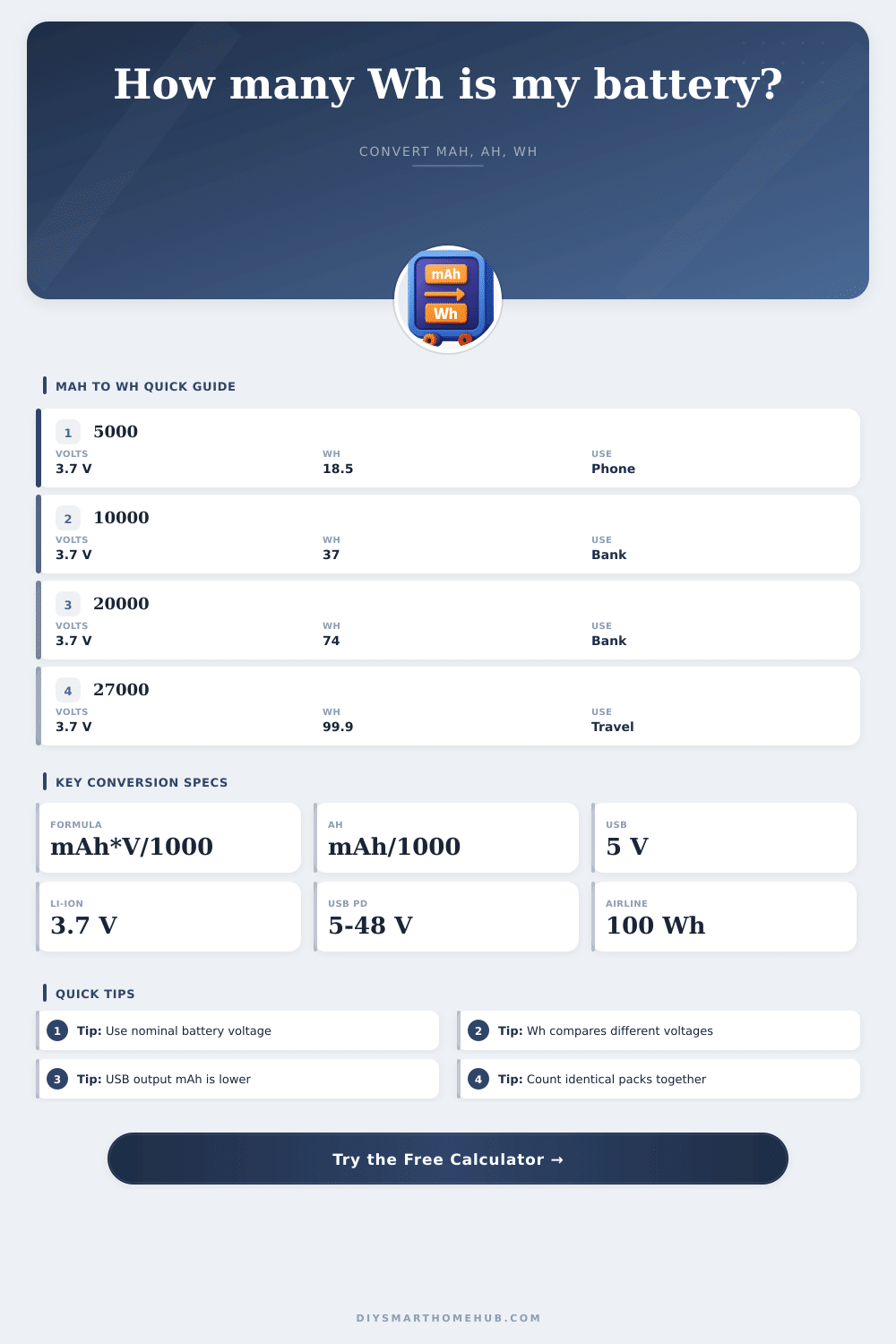
| 5000 mAh / 5 Ah | 18.5 Wh | 60 Wh | 240 Wh |
| 10000 mAh / 10 Ah | 37 Wh | 120 Wh | 480 Wh |
| 20000 mAh / 20 Ah | 74 Wh | 240 Wh | 960 Wh |
| 100 Ah system battery | 370 Wh | 1200 Wh | 4800 Wh |
🔧Conversion Tips
Then you go to the store, pick up a new power bank, and see the big number: Twenty thousand milliamp hours! It sounds good, till you plug into it and realize that within an hour, the battery’s empty. What gives? Turns out that number tell you half the story. You’re looking at charge capacity, not voltage. You’ve measured the width of a bucket without bothering with its depth.
Watt hours are the true units for measuring what’s important. How much energy is being stored. That’s why the conversion tool here isn’t just fun but actualy helpful. It connects dots between marketing specs on those batteries and how long they’ll last powering your stuff. Plug in your own settings for voltage and efficiency, and let calculator do all the work. Avoid wasting time trying to guess if that big ol’ capacity number will be meaningful or not.
Why Watt Hours Matter More Than Milliamp Hours
Most consumer electronics runs on lithium ion cells with a nominal voltage of 3.7 volts. Portable power banks, phone batteries, that’s the normal base line. Take the milliamp hours, times three point seven, divided by a thousand and there ya have it. That is your watt hours. It’s all the juice in the pack before any electricity has exited the thing.
Why does this matter? So many people try to compare amp hour rating of a five volt USB gadget against the amp hour rating of a twelve volt car battery and think they’re comparable. They are not even close, because the battery hold much more power.
In practice, no energy conversion is perfect. The tool acknowledges this fact about our dirty little world of electricity. When you plug something into your power bank that’s running at three point seven volts and it boost it up to five volts to charge your phone, or steps it down from five volts to twelve for your router, some energy is lost and heat are created. That’s why there’s an efficiency slider on the calculator; moddern boost converters typically perform at around eighty eight percent. If you enter one hundred percent in that field, your estimated runtime will be too high. Accounting for those inefficiencies provides a much more accurate estimate of when your device will realy run out of juice.
If you work remotely or travel frequently, this is big. Airlines don’t limit battery charge. In fact, they strictly limit their energy capacity. In fact they strictly limit their energy capacity. Usually it’s around a hundred watt hours for carry on batteries. That is about 27,000 milliamp hours when the battery is at 3.7 volts. With this tool, you’ll know what those numbers mean and avoid packing something that will be confiscated during security checks. You won’t need to pull out your phone and do the math yourself while standing in line; just use reference table provided with the tool for a clear breakdown of these typical benchmarks.
This conversion logic also works for more than just flight, such as anywhere different voltages are powered by batteries. For example, a solar battery might be storing its energy at forty eight volts, and then converting that via an inverter into regular household voltage for your home appliances. The watt hour number does not change during those conversions, except as lost due to inefficiencies, which we discussed above. That is why the watt hour works as a universal measure for energy storage. It lets you compare something like a tiny AA rechargeable cell phone to a giant server room backup unit all on the same scale.
Another factor to consider in finding your power requirements is usable capacity. If you expect to get more than one full cycle out of a battery, do not let it go all the way down to zero, as batteries doesn’t like that. You should of accounted for this. You can modify the “usable” slider on the calculator accordingly (say to 80% for instance) and account for some headroom. Sometimes this tiny change is the difference between getting through the day or not having any power just when you realy needed it most. This is a nice addition to the manufacturer’s number crunching to make things feel a little bit more real.
So what does this all boil down to? Milliamp hour conversion equals watt hour conversion. It takes you out of that place of confusion around capacity numbers and puts you squarely in the area of informed power decision-making. Whether you’re purchasing a new phone case, planning your next camping adventure, or packing for a flight with batteries in your carry-on, understanding how to read charge as energy allows you to take command of the situation. You move from guesswork on a large number to a plan based off true power. Next time you encounter a battery rated in any way, go beyond the headline number and ask what that really mean in the way of real-world power.