Joules to Watt Hours Converter
Convert joules, watt-hours, kilowatt-hours, and smart-home power over time using the exact 1 Wh = 3,600 J relationship plus efficiency, duty cycle, battery, and buffer factors.
⚡Smart Home Energy Presets
🔌Conversion Inputs
Energy conversion result
Full calculation breakdown
📊Core Conversion Specs
📘Reference Tables
| Energy unit | Equivalent Wh | Equivalent joules | Common use |
|---|---|---|---|
| 1 joule | 0.000277778 Wh | 1 J | Base SI energy unit for small pulses and measurements. |
| 1 watt-second | 0.000277778 Wh | 1 J | Same energy as one watt flowing for one second. |
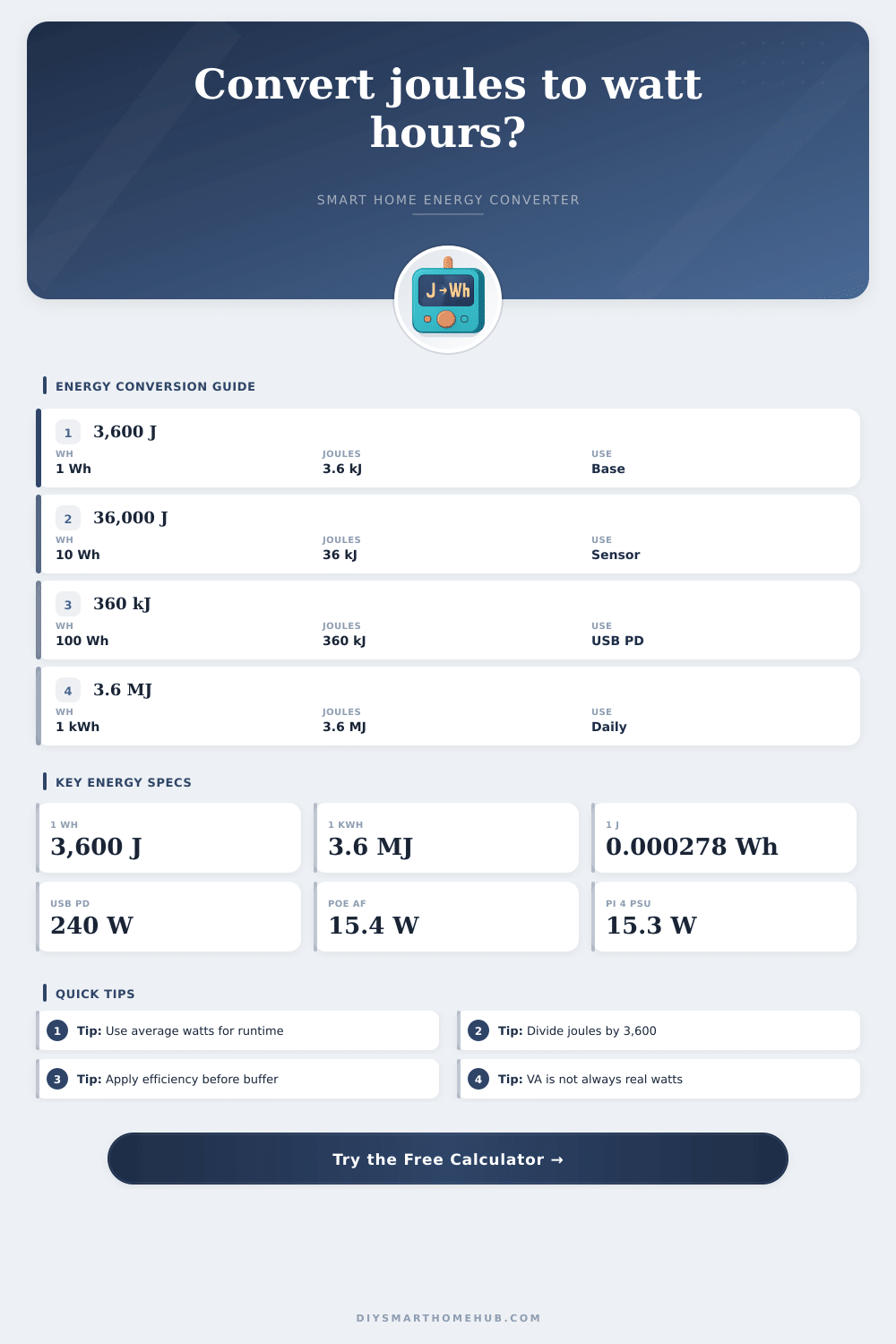
| 1 watt-hour | 1 Wh | 3,600 J | Battery packs, USB power banks, and small load estimates. |
| 1 kilowatt-hour | 1,000 Wh | 3,600,000 J | Household energy meters and daily smart-home totals. |
| 1 megajoule | 277.778 Wh | 1,000,000 J | Larger storage comparisons and high-energy conversions. |
| Smart-home spec | Rated input | Power basis | Energy for 1 hour | Energy in joules | Planning note |
|---|---|---|---|---|---|
| USB Power Delivery 3.1 EPR | Up to 48 V, 5 A | 240 W maximum | 240 Wh | 864,000 J | Use the negotiated device wattage, not only the charger maximum. |
| USB Power Delivery SPR | 20 V, 5 A cable mode | 100 W maximum | 100 Wh | 360,000 J | Useful for laptop docks, tablets, and compact hubs. |
| IEEE 802.3af PoE port | Power sourcing port | 15.4 W maximum | 15.4 Wh | 55,440 J | Powered-device budget is lower after cable loss. |
| Raspberry Pi 4 power supply | 5.1 V, 3.0 A DC | 15.3 W supply | 15.3 Wh | 55,080 J | Use measured board load for runtime, especially with peripherals. |
| Philips Hue 60 W equivalent A19 | Smart LED lamp | About 9 to 12 W | 9 to 12 Wh | 32,400 to 43,200 J | Dimmed scenes usually draw less than full rated power. |
| Video doorbell transformer class | 8 to 24 VAC, up to 40 VA | VA limit, not exact W | Depends on power factor | Use measured watts | For energy, convert real watts over time, not transformer VA alone. |
| Scenario | Average watts | Runtime | Watt-hours | Joules | What it helps compare |
|---|---|---|---|---|---|
| One 9.5 W smart bulb | 9.5 W | 3 hr | 28.5 Wh | 102,600 J | Evening lighting scene energy. |
| 12 W router | 12 W | 24 hr | 288 Wh | 1,036,800 J | Always-on network backup sizing. |
| 15.4 W PoE port | 15.4 W | 24 hr | 369.6 Wh | 1,330,560 J | PoE camera or access point daily port budget. |
| 100 W USB-C load | 100 W | 1 hr | 100 Wh | 360,000 J | High-power charging session. |
| 240 W USB-C EPR load | 240 W | 0.5 hr | 120 Wh | 432,000 J | Short high-power dock or workstation burst. |
| Energy source | Nominal rating | Wh formula | Wh result | Joule result | Best calculator mode |
|---|---|---|---|---|---|
| CR2032 lithium coin cell | 3 V, 225 mAh example | 3 x 0.225 | 0.675 Wh | 2,430 J | Battery voltage and Ah |
| Two AA alkaline cells | 3 V, 2.5 Ah example | 3 x 2.5 | 7.5 Wh | 27,000 J | Battery voltage and Ah |
| Small USB power bank | 10,000 mAh at 3.7 V | 3.7 x 10 | 37 Wh | 133,200 J | Battery voltage and Ah |
| Portable station | 256 Wh stated capacity | Stated Wh | 256 Wh | 921,600 J | Watt-hours to joules |
| Home energy meter | 1 kWh reading | 1,000 Wh | 1,000 Wh | 3,600,000 J | Watt-hours to joules |
🔧Conversion Tips
Next time you have one of those tiny little USB batteries you carry around in your pocket to plug into your phone when you run out, read label. How many milliamp-hour hours does it say it has? Ten thousand, probably. It won’t tell you what that really means, though: how much juice it contains. A milliamp hour is only a measure of electron movement through a wire. There’s no thought given to voltage loss or the inefficiency of the charge/discharge cycle.
To understand if that battery are capable of running your light show while you’re hunkered down in a storm, you need to be looking at watt-hours and joules. Those is the true measures of stored work; not simply the flow of electricity. It’s that straightforward. Three thousand six hundred joules = one watt-hour. It’s a law of physics; it never changes. The key to the equation is understanding what you’re measuring… Because watts measure rate (the speedometer), while joules and watt-hours measures amount (the size of the fuel tank). Get those mixed up and you’ll get your math wrong by a factor of time. I.e., your backup won’t work when the sun rises.
Why Watt-Hours Are Better Than Milliamp-Hours
The calculator above does all the number-crunching for you when you input your load duration, removing the need to guess at the conversions or coefficients. Everyone begins at the rated power of their device. It’s a smart bulb, which consumes twelve watts. It needs to run for five hours. Multiply them together to get sixty watt-hours. Divide that by three thousand six hundred, you’ve got twenty-one thousand six hundred joules. That’s the minimum you need.
Okay, but now reality gets fuzzy. Batteries aren’t perfect. Inverters (which convert DC into AC) isn’t perfect. Energy is lost as heat during every exchange. Plan without accounting for efficiency, and you’re working with fiction. That is why the tool has an efficiency field. For example, a standard power bank could well be 90 percent efficient. In other words, in order to supply ten watt-hours to your device, the battery would need to contain eleven point one watt-hours to account for the loss. Then on top of that, you put a buffer because batteries do get worse over time, and they also sag under heavy loads. And all of that is a small thing, but still important if you’re trying to run something like a router overnight.
The page itself does have a handy reference table that shows you how many raw joules convert to usable hours for popular things like Raspberry Pi hubs or PoE cameras. But there’s also voltage. And it matters, particularly when considering bigger storage setups. A 12v battery rated for 10ah stores one hundred twenty watt-hours. However, a 5v battery rated for 10ah store just 50 watt-hours. Even though they have the same capacity rating, it stores different energy. Many DIYers fall into this trap by purchasing their batteries solely based off ah (amp-hour) rating without knowing the voltage of their system. It isn’t your amperage that you’re storing. It’s your energy, or more specifically, your volts x amps over time.
Many smart home installations is a hodgepodge of devices. For example, a door bell transformer may state a 40 volt-amp rating. That’s the apparent power, not the real work it does. Depending on its power factor, it’ll consume less energy in real-world operation. To oversize your backup based off the maximum VA rating is unnecessary and wastes money. Knowing what each device draw in watts paints a more accurate picture. Better to err on the side of caution than find yourself with a dead battery when you need it most: in the middle of the night.
It’s arithmetic, and the conversion part is straight up math. But the planning? That takes judgment: how much are you using on average (not peaks), etc? Maybe your security camera pulls one hundred watts when someone triggers a motion capture, but sits idling at two watts all day. If you use that peak number for twenty-four hours it’ll wildly overestimate. This is where the duty cycle input comes in to help smooth things out; it allows you to balance how much time it’s actualy being used versus when it’s sitting around standby. It turns a simple unit converter into a useful sizing tool.
Trust: That’s what it all comes back to when we’re talking about managing energy. Do you trust your battery to have some juice in it if the grid drops out? Removing the sticker label ambiguity makes everything simple by converting between watt-hours and joules. It puts various voltage systems and battery chemistries on the same playing field. When you realize that one watt-hour is three thousand six hundred joules regardless of where it came from, there’s no more guesswork, just calculation. The transition from guesswork to arithmetic is what distinguishes a reliable system from one that’s just hopeful. Account for the efficiency losses and keep your units consistent, and you’ll be surprised how long your smart home can last.