BTU to kWh Converter
Convert total BTU or BTU per hour into thermal kWh, estimated electrical kWh, average watts, and standby-adjusted energy for HVAC and smart-home monitoring.
⚡Smart Home HVAC Presets
📟BTU And Runtime Inputs
BTU to kWh estimate
Calculation breakdown
📊Conversion Spec Grid
📋BTU And HVAC Reference Tables
| Conversion item | Reference value | Formula used | Use in calculator |
|---|---|---|---|
| International Table BTU | 1 BTU = 1,055.056 J | BTU x 0.000293071 = kWh | Base thermal energy conversion. |
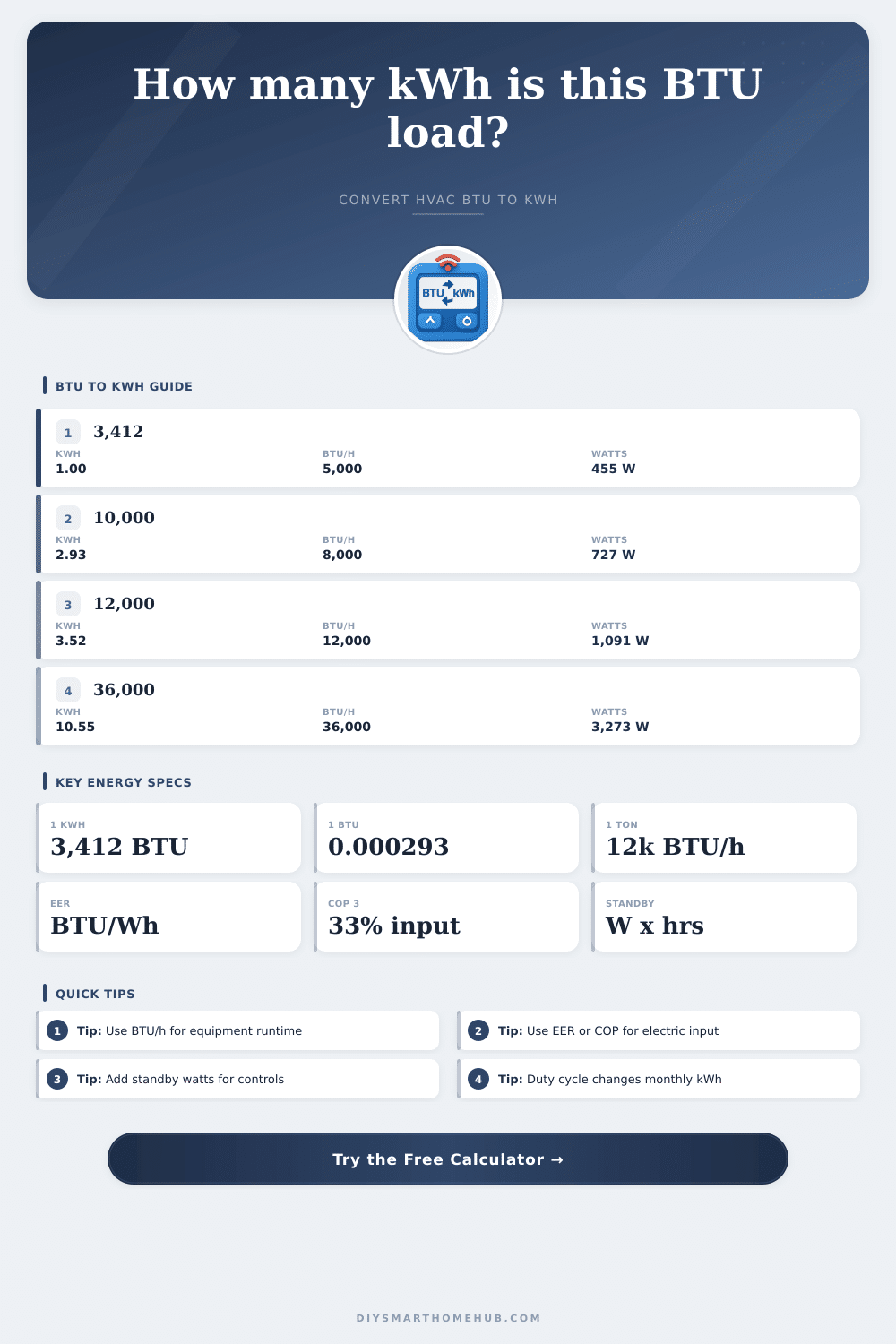
| Kilowatt-hour | 1 kWh = 3,412.141633 BTU | BTU / 3,412.141633 = kWh | Main conversion for every result. |
| Cooling ton | 1 ton = 12,000 BTU/h | Tons x 12,000 = BTU/h | Useful for central AC and heat pumps. |
| Watt-hour relation | 1 Wh = 3.412141633 BTU | BTU / rating = Wh for EER | Links BTU/h rating to electrical watts. |
| Equipment context | Rating input | Electrical formula | Typical planning range | Smart-home use | Watch item |
|---|---|---|---|---|---|
| Direct conversion | No efficiency adjustment | BTU / 3,412.141633 | Exact energy unit conversion | Comparing logs, dashboards, and utility data | Not appliance input power. |
| Electric resistance | Efficiency percent | Thermal kWh / efficiency | 95-100% delivered electric heat | Space heaters and electric duct heaters | Fan or controls may add watts. |
| Room AC EER or CEER | BTU per Wh | Total BTU / EER / 1,000 | About 9-16+ for room AC units | Smart plug estimates from BTU/h capacity | CEER includes standby/off-mode power. |
| Seasonal SEER | Seasonal BTU per Wh | Total BTU / SEER / 1,000 | About 14-22+ for many systems | Seasonal thermostat runtime summaries | Seasonal rating is an estimate. |
| Heat pump COP | Output kW / input kW | Thermal kWh / COP | About 2.0-4.5 depending on conditions | Heating runtime and automation reports | COP falls in colder conditions. |
| Common load | BTU/h | Rating assumption | One full-load hour | Eight-hour use |
|---|---|---|---|---|
| Small window AC | 5,000 | EER 11 | 0.45 kWh electric | 3.64 kWh before standby |
| Efficient 8k room AC | 8,000 | CEER 16 | 0.50 kWh electric | 4.00 kWh before standby |
| 12k mini split | 12,000 | SEER 22 | 0.55 kWh seasonal estimate | 4.36 kWh before standby |
| 18k heat pump heat | 18,000 | COP 3.4 | 1.55 kWh electric | 12.41 kWh before standby |
| 3 ton central AC | 36,000 | SEER 16 | 2.25 kWh seasonal estimate | 18.00 kWh before standby |
| Project size | Input method | Runtime basis | Primary result | Secondary result |
|---|---|---|---|---|
| Single room cooling check | 8,000 BTU/h, CEER 16 | 8 h/day, 60% duty, 30 days | 72.0 kWh electric | 1.6 W standby adds 1.2 kWh/month |
| Bedroom heat pump report | 12,000 BTU/h, COP 3.2 | 6 h/day, 50% duty, 30 days | 98.9 kWh electric | 316.5 kWh thermal delivered |
| Central AC thermostat month | 36,000 BTU/h, SEER 16 | 10 h/day, 35% duty, 30 days | 236.3 kWh electric | 3,780,000 BTU processed |
| Electric heater schedule | 5,118 BTU/h, 100% | 6 h/day, 100% duty, 30 days | 270.0 kWh electric | 921,240 BTU delivered |
| Direct dashboard conversion | 341,214 BTU total | No runtime needed | 100.0 kWh thermal | Use equipment mode for input power |
🔧Actionable Calculation Tips
Electric bills might seem like a confusing series of numbers until you catch on to what each charge represents: Kilowatt-hours, which cost money, represent either the heat being removed from your environment (cooling) or added to it (heating). Where people get tripped up is that way utilities bill you (in electricity) doesn’t line up with how HVAC specs measure (in British thermal units). In effect, you’re trying to translate between two different languages of energy, with no translation dictionary.
A kWh measures the work required to move heat, while BTUs directly measure heat content. That difference matter if you want to understand and manage your home’s comfort, especially if you have smart thermostats or mini-splits that provide complex data. If you look at it this way, there’s only one conversion factor that you need to remember: The core conversion factor. For every 1 kWh of electricity, there are about 3,412 BTUs of thermal energy (this isn’t some sort of marketing trick; it’s determined by physics). If you convert all of that electricity into heat with zero loss, then that’s how many BTUs of heat you have. The pure quantity of heat produced by each kWh of electricity.
How to Calculate Your AC Electricity Cost
Everyone stops here, thinking that they should of now divide their AC’s BTU rating by 3,412 and voila! They’ll know how much power their AC uses. And this completely misses the point of mechanical efficiency. An air conditioner or a heat pump doesn’t create heat via resistance, like an old toaster does. Instead, they’re moving pre-existing heat from one location to another, and that takes much less electrical input compared to raw generation.
In other words, capacity is less important than equipment ratings here. Your 8,000 BTU/hour window unit won’t gobble up 2.35 kWh per hour of runtime. That’d cost both the grid and you money. Instead, you need to factor in the energy efficiency ratio. These days, units will move several BTUs of heat with each watt-hour of electricity used. For example, a good unit may cool out 12 BTUs using only a single watt-hour of input power.
After you pick the proper mode for equipment, the page’s calculator crunches that number for you (no division required). This allows you to concentrate on the implications of those numbers. How much power are you using per month? To make things even more complicated, HVAC systems doesn’t run constantly at full blast. The system turns on and off to keep your house warm (or cool). According to your thermostat log, if your heating/cooling unit runs for eight hours in a day, it likely didn’t ran at max power for all eight hours.
That’s called the duty cycle. It can vary greatly depending on what the outdoor weather is like. On a mild spring day, your system may be operating only ten percent of the time; on a hot July afternoon, it could be pushing ninety percent or higher. Without accounting for this variation, you’ll get wildly inaccurate cost estimates. You have to account for actual fraction of time the compressor is active during its runtime window.
Another low-noise culprit many overlook is standby power. Even with the main compressor turned off, monitoring plugs, relays, and smart home gadgets suck down watts. It’s a small amount of power per item, yes, but it adds up to real kWhs on your bill over the course of a month. The reference table on the page explains this well; control electronics increase the overall load. Adding this buffer makes sure you’re estimating based off real-world conditions, not some perfect lab experiment.
Should you care about EER (instantaneous) or SEER (seasonal)? It depends; both have their uses. If you want to know how much electricity something will cost over time, then a seasonal rating is what you need, because it averages over the year’s variations. For short-term budgeting, an instantaneous ratio tells you more about how much it will suck when it’s realy hot outside on a certain day. Matching the metric to your question, that’s key. It is more important to make sure we are measuring what we mean to measure than it is to find “the right number.
So in conclusion, while there’s some math behind this conversion, what matters most is grasping the concept of “kWh” (electricity) versus “BTU” (heat). Keep in mind, too, that the total calculation shown below is an approximation. This approximation combines efficiency ratings, run times, and even small amounts of standby use. Understanding all these variables allows you to transform vague utility bills into clear dollars while also controlling your climate. Which, after all, is why we want cooling in the first place. The exercise is not strictly one of unit conversions, then, but of learning how your house uses energy.