Lithium Battery Bank Calculator
Estimate daily Wh, usable storage, nameplate kWh, amp-hours, series and parallel strings, inverter current, and BMS sizing for lithium backup banks.
📌 Lithium Bank Presets
🔧 Load And Battery Inputs
📊 Lithium Bank Results
⚙ Lithium Chemistry Spec Grid
Stable DIY bank choice, often modeled at 80 to 90 percent planning DoD.
Higher energy density, commonly protected with stricter thermal and BMS limits.
Lower nominal voltage per cell with strong cycle life and high current capability.
Factory module style where each unit is treated as one parallel battery block.
📘 Lithium Bank Reference Tables
| Chemistry | Nominal unit | Typical planning DoD | Best calculator use |
|---|---|---|---|
| LiFePO4 cell | 3.2 V cell | 80-90% | DIY solar, home backup, RV banks |
| NMC lithium-ion | 3.6 V cell | 70-85% | Compact packs where energy density matters |
| Lithium titanate | 2.4 V cell | 80-95% | High-cycle or high-current specialty banks |
| 12.8 V drop-in LFP | 12.8 V module | 80-90% | RV, boat, van, small inverter banks |
| 51.2 V rack LFP | 51.2 V module | 80-90% | 48 V inverters and whole-home critical loads |
| System voltage | Best fit | 1,000 W DC current | Planning note |
|---|---|---|---|
| 12 V | Small DC or RV loads | 83.3 A | Current rises quickly with inverter size |
| 24 V | Medium backup systems | 41.7 A | Balanced choice for moderate loads |
| 48 V | Solar and home backup | 20.8 A | Common inverter voltage with lower current |
| 51.2 V | LFP rack batteries | 19.5 A | Sixteen LFP cells in series nominally |
| 72 V | Special DC systems | 13.9 A | Requires matching inverter and protection |
| Load profile | Daily Wh range | Common voltage | Bank planning signal |
|---|---|---|---|
| Network and router | 500-1,500 Wh | 12 V or 24 V | Small bank, long runtime, low BMS current |
| Fridge plus controls | 1,500-3,500 Wh | 24 V or 48 V | Surge and inverter efficiency matter |
| Cabin essentials | 3,000-7,500 Wh | 48 V | Autonomy days drive final kWh |
| Workshop backup | 5,000-12,000 Wh | 48 V | BMS surge rating may dominate |
| Whole-home critical | 10,000+ Wh | 48 V or higher | Rack modules reduce parallel complexity |
| Formula | Calculator method | Output affected | Why it matters |
|---|---|---|---|
| Daily Wh | AC Wh / inverter eff. + DC Wh / DC eff. | Usable kWh | Separates inverter loads from direct DC loads |
| Nameplate kWh | Usable need / DoD | Bank size | Prevents confusing rated and usable storage |
| Bank Ah | Nameplate Wh / system voltage | Amp-hours | Connects kWh sizing to DC bank capacity |
| Series count | System voltage / cell or module voltage | S count | Sets pack voltage before parallel strings |
| BMS current | Inverter watts / voltage x margin | BMS amps | Checks continuous and surge current paths |
💡 Planning Tips
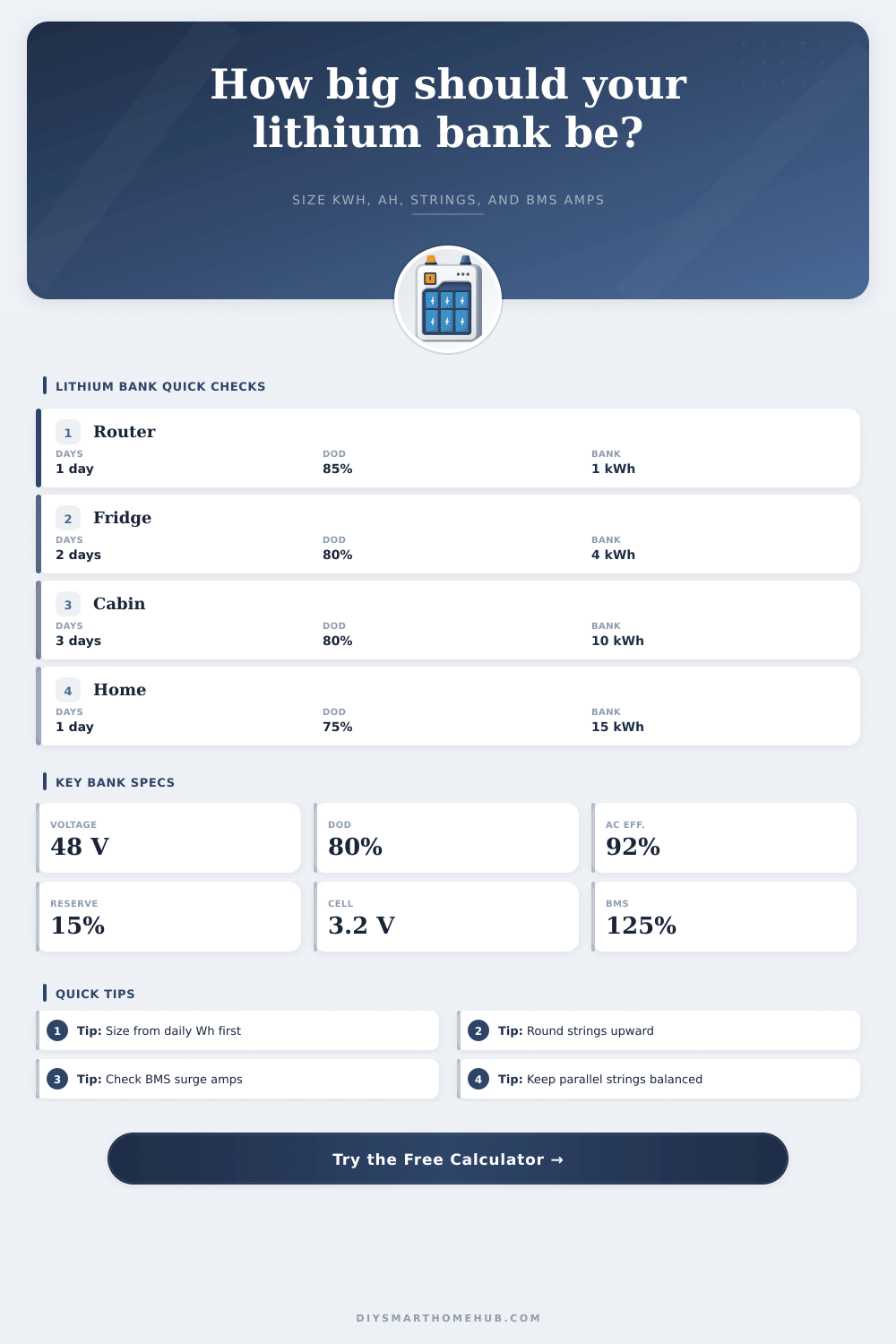
The biggest doesn’t mean best; it’s all about matching the right size battery for your habit. Because sizing them to ensure they do last all night is the real chalenge, if you don’t account for usage or tripping a breaker, then your system fails. So it isn’t just about finding the biggest battery… It’s about translating your habits into a specific bank size that actualy lasts all night.
That’s why projects die on the drawing board: we think we need something when we really just need something else. If you’ve identified the lights you want on in the event of an outage, now you need to figure out how to connect them to lithium cells. To do this, we need to calculate the limits of each cell (discharge limit), plus efficiency losses of the inverter. And you shouldn’t waste time doing this math by hand. Instead, enter your loads to let calculator above work through the math for you.
How to Choose the Right Battery Size
An inverter wastes energy just doing its job of converting power, so it makes sense to segregate DC loads from AC loads. Running a fridge via inverter means paying twice (once for the draw of compressor), but also for waste heat of conversion. Most inverters is rated at roughly ninety-two percent efficient, which means eight percent of all stored energy are lost when converting it back to AC. Forcing a load like a fridge onto an inverter is a double-waste penalty avoided completely with direct DC loads.
Networking gear, LED lights, or any other equipment that can run directly from the battery bus should stays put there, separating the loads saves watt hours that you may never even feel when your runtime runs out on a cloudy day. How long can you go off-grid? These is called autonomy days. Autonomy days represent how many hours you can survive without sunlight or connection to the grid. If it’s one autonomy day then you need to last 24 hours. If it’s two autonomy days, then you’re covered if something goes wrong with charging or if weather turns ugly. A standard setup for homes is around one or two autonomy days. Beyond that, storage gets too expensive up front in terms of equipment.
The other thing is depth of discharge, which sounds like a sci-fi movie villain but isn’t. With lithium iron phosphate batteries, they only recommend using roughly eighty percent of their capacity. Users of lead acid is typically limited to half (50% of capacity), so lithium banks ends up being smaller even though they hold as much total energy. It’s like you’re paying for a bigger package of product while getting more of it.
The thickness of your wires depends on system voltage. The more voltage in your system, the less amperage (current) there is, which means you can use thinner wires. So while 12-volt systems are fine for things like a simple RV fridge circuit, above that voltage level they quickly get difficult to manage. As voltage goes up, current go down, as shown in the reference table on this page. That’s why virtually all whole-home backup systems runs at 48 volts or greater. Why? You want electrons to flow efficienty without fighting their way through heavy gauge wire due to resistance.
Your battery management system (BMS) are the brain of the operation. It provides over-discharge protection, cell balancing, and temperature monitoring. Your inverters will require surge currents at motor startup. Compressor kick-on may pull twice the continuous watts for several seconds. The BMS has to be able to handle this spike or it’ll shut off the entire system. Usually you want a bit more than the max current your calculations predict because it’s not an average. It’s the worst case peak demand. You need to survive it without nuisance trips.
Complexity comes from paralleling strings, something not fully understood by many beginners. To balance two branches you need equal length wiring, same temperature batteries and age of battery. One mismatched string will work harder then the others, causing it to fail early. Generally it’s better to have fewer large modules than lots of smaller module wired together. Rack batteries today make this easier as they has several cells in a smart package. There’s less modularity but more simplicity.
In the end, picking the correct bank size is about finding that sweet spot between peace-of-mind and wallet. If you only have a few lightbulbs, it’s overkill to get a massive battery just to store enough energy for them. However, if you have some critical loads and want them to run during your average power outages, you should of been prepared to go big enough to cover those. Take the daily watt-hours, apply a factor to account for efficiency loss, and round up to nearest hardware option. It doesn’t take long before the math becomes a bit ugly, but the process helps keep you grounded in real world applications versus what the marketing folks say.