Lithium Battery Bank Calculator
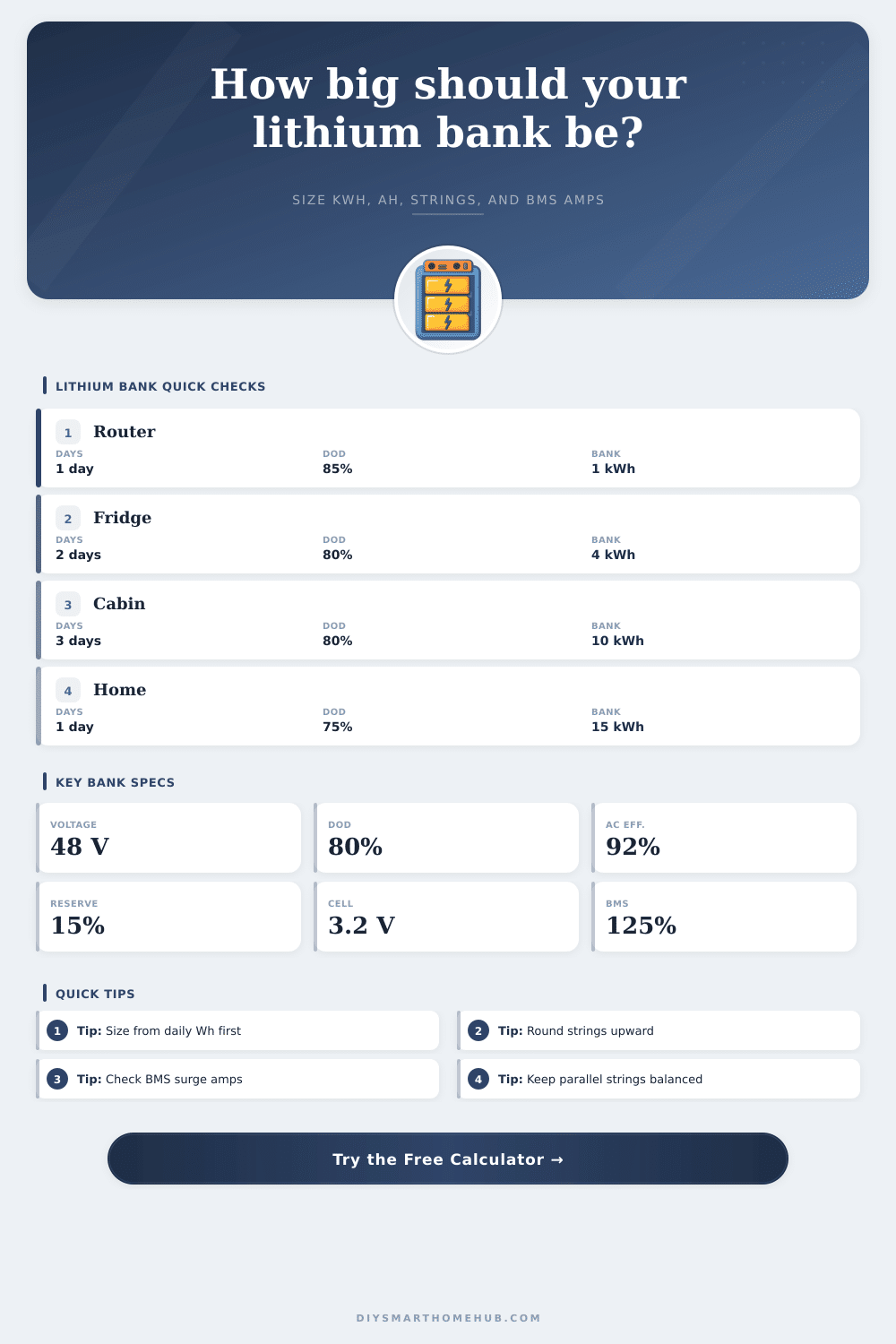
Estimate daily Wh, usable storage, nameplate kWh, amp-hours, series and parallel strings, inverter current, and BMS sizing for lithium backup banks.
📌 Lithium Bank Presets
🔧 Load And Battery Inputs
📊 Lithium Bank Results
⚙ Lithium Chemistry Spec Grid
Stable DIY bank choice, often modeled at 80 to 90 percent planning DoD.
Higher energy density, commonly protected with stricter thermal and BMS limits.
Lower nominal voltage per cell with strong cycle life and high current capability.
Factory module style where each unit is treated as one parallel battery block.
📘 Lithium Bank Reference Tables
| Chemistry | Nominal unit | Typical planning DoD | Best calculator use |
|---|---|---|---|
| LiFePO4 cell | 3.2 V cell | 80-90% | DIY solar, home backup, RV banks |
| NMC lithium-ion | 3.6 V cell | 70-85% | Compact packs where energy density matters |
| Lithium titanate | 2.4 V cell | 80-95% | High-cycle or high-current specialty banks |
| 12.8 V drop-in LFP | 12.8 V module | 80-90% | RV, boat, van, small inverter banks |
| 51.2 V rack LFP | 51.2 V module | 80-90% | 48 V inverters and whole-home critical loads |
| System voltage | Best fit | 1,000 W DC current | Planning note |
|---|---|---|---|
| 12 V | Small DC or RV loads | 83.3 A | Current rises quickly with inverter size |
| 24 V | Medium backup systems | 41.7 A | Balanced choice for moderate loads |
| 48 V | Solar and home backup | 20.8 A | Common inverter voltage with lower current |
| 51.2 V | LFP rack batteries | 19.5 A | Sixteen LFP cells in series nominally |
| 72 V | Special DC systems | 13.9 A | Requires matching inverter and protection |
| Load profile | Daily Wh range | Common voltage | Bank planning signal |
|---|---|---|---|
| Network and router | 500-1,500 Wh | 12 V or 24 V | Small bank, long runtime, low BMS current |
| Fridge plus controls | 1,500-3,500 Wh | 24 V or 48 V | Surge and inverter efficiency matter |
| Cabin essentials | 3,000-7,500 Wh | 48 V | Autonomy days drive final kWh |
| Workshop backup | 5,000-12,000 Wh | 48 V | BMS surge rating may dominate |
| Whole-home critical | 10,000+ Wh | 48 V or higher | Rack modules reduce parallel complexity |
| Formula | Calculator method | Output affected | Why it matters |
|---|---|---|---|
| Daily Wh | AC Wh / inverter eff. + DC Wh / DC eff. | Usable kWh | Separates inverter loads from direct DC loads |
| Nameplate kWh | Usable need / DoD | Bank size | Prevents confusing rated and usable storage |
| Bank Ah | Nameplate Wh / system voltage | Amp-hours | Connects kWh sizing to DC bank capacity |
| Series count | System voltage / cell or module voltage | S count | Sets pack voltage before parallel strings |
| BMS current | Inverter watts / voltage x margin | BMS amps | Checks continuous and surge current paths |
💡 Planning Tips
The conventional wisdom about off-grid living says this: Plan to be energy independent and wind up staring at a spreadsheet in disbelief. You’ve got a few solar panels, an electrical load, and now you’re wondering how to link them all together without wasting money on excess capacity or blowing something up. Our calculator does it for you, but what are the inputs? What makes a system work or not during the next power outage?
The typical response is: “How much do I need?” Usually expressed as kilowatt-hours, which seems like the right answer, but it’s actualy backwards. First, determine how many watt-hours per day you consume. Let’s say a fridge running 300 watts for 20 hours per day consumes only six thousand watt-hours for cooling.
How to Choose the Right Battery Size for Off-Grid Power
The calculator distinguishes between DC and AC loads (because the inverter eats some power converting direct current to alternating current). Forget that inefficiency and you’ll undersize your battery bank before even thinking about depth of discharge. It is a small detail but it makes a big difference when grid shuts off one cold winter night.
That brings us to depth of discharge, an area where our intuitions fail. If you were taught anything with lead-acid batteries, it was to never run the pack down past half of its capacity, because then your battery wouldn’t last long. Lithium iron phosphate flips the entire equation. Running at eighty or ninety percent of rated capacity won’t stress the chemistry; you’re safe to do so.
That’s reflected in how the tool works. It lets you define the percentage of the rated capacity you want to use regularly, instead of buying three kilowatt-hours of storage just to get two usable ones. That’s what makes lithium the default option for everything from whole-home backup systems to small RV applications. Over the next decade, you’ll pay less because of fewer replacement cycles and less wasted space.
While it is true that raw numbers aren’t everything, neither is physical setup of the bank. Current flows. That’s why we’re not stacking cells, but managing current flow. Your target system voltage sets the number of strings in parallel and how many series strings each one has. More voltage, such as forty-eight volts, reduces your current demand for any specific wattage, keeping your breakers manageable while maintaining thinner wires.
For example, twelve-volt batteries is OK for a large workshop backup, but you’ll be pulling down into the hundreds of amps when they surge. That means big wiring and tough protection that can cost more than buying the batteries. Look at the current draw in the table above and you’ll see by comparing voltage profiles that its clear.
Part of any such system include battery management systems which watch the cells for balancing, for short circuiting and for overheating. But they also watch the surge and continuous current. Your inverter may be rated at a thousand watts surge when starting a motor but if your BMS trips out on a thousand watts your inverter won’t work either. The calculator adds a safety margin to the calculated continuous current so you can choose something that can handles the worst situations. It isn’t only storing but it’s whether or not your switchgear survives the draw.
In real life, things don’t go as perfectly as they do in the plan. Lithium isn’t available at cold temps, and your batteries will age and lose capacity over time. It’s smart to have some reserve margin to account for this. Fifteen percent will be enough to handle changing weather and extra load. This will also allow you to avoid buying an entire new bank tomorrow.
You also want your autonomy days to reflect your actual weather patterns, not necessarily the typical sunny day. In a region where there may be weeks of clouds, one day of storage may look like plenty on paper, but it will leave you powerless.
When you get beyond the learning curve of getting the size right, there’s no downside to lithium. It has a flat voltage curve, predictable performance, stable chemistry, and long cycle life. No need to baby it compared to the older chemistries. Just size it appropriately and be mindful of current limits and your actual loads. Get your daily watts first and everything else will fall into place.
Every penny you spend goes straight toward run time instead of surprise costs down the line. This discipline keeps your head out of the weeds. It turns an overly complicated electrical problem into something as straightforward as inputs vs outputs. This keeps those lights on when you realy need them to be.