Keypad Code Length Recommendation Calculator
Compare PIN length, active user codes, blocked common codes, retry lockouts, and daily guess exposure for a keypad-style smart lock or alarm panel.
1.Scenario presets
2.Code policy inputs
Formula breakdown
3.PIN space reference
4.Recommendation matrix
| PIN length | Raw combinations | Raw entropy | Typical smart-home use | Policy note |
|---|---|---|---|---|
| 4 digits | 10,000 | 13.29 bits | Interior low-risk keypad | Weak for exterior doors with many users. |
| 5 digits | 100,000 | 16.61 bits | Garage, utility, detached storage | Better only when retry lockout is strict. |
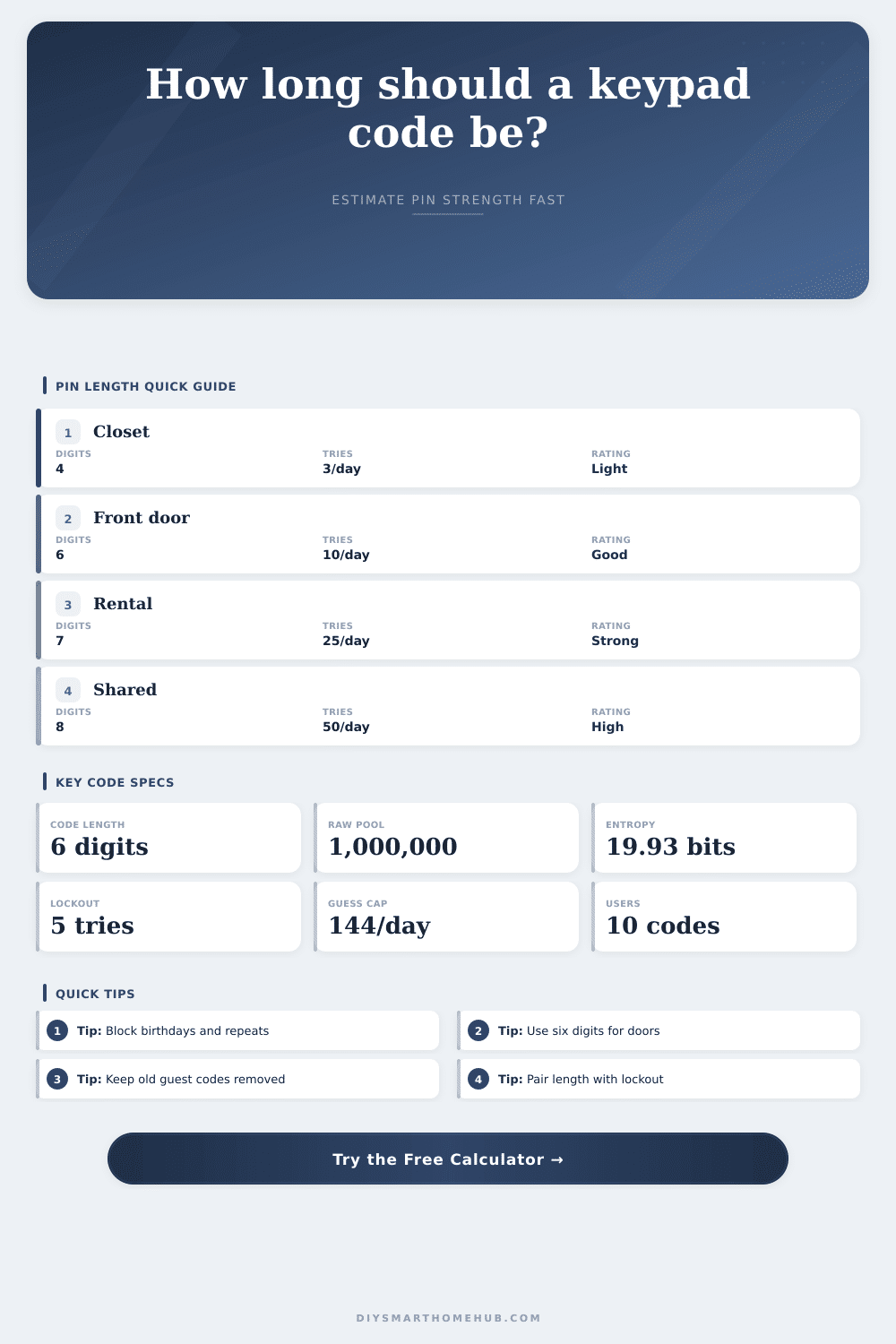
| 6 digits | 1,000,000 | 19.93 bits | Front door and household smart lock | Common baseline for exterior smart locks. |
| 7 digits | 10,000,000 | 23.25 bits | Rental, office, shared vendor access | Useful when many temporary codes exist. |
| 8 digits | 100,000,000 | 26.58 bits | High exposure alarm or multi-user keypad | Strong, but harder for guests to remember. |
5.Retry lockout reference
| Wrong tries | Lockout | Max cycles/day | Max guesses/day | Best fit |
|---|---|---|---|---|
| 3 | 15 min | 96 | 288 | Strict panels with few users. |
| 5 | 30 min | 48 | 240 | Common smart-lock safety setting. |
| 5 | 60 min | 24 | 120 | Exterior doors with guest codes. |
| 10 | 30 min | 48 | 480 | Convenience-first household use. |
| 10 | 0 min | No cap | Input-limited | Use only with monitoring or low exposure. |
6.Excluded-code examples
| Blocked group | Examples | What it reduces | Typical count | Calculator treatment |
|---|---|---|---|---|
| Repeats | 0000, 111111 | Easy memorized guesses | 10 to 80 | Subtracted from raw combinations. |
| Sequences | 1234, 987654 | Keypad walks and order patterns | 20 to 200 | Added to common-code blocklist. |
| Dates | birth years, MMDD | Personal-information guesses | 50 to 400 | Best handled by local policy rules. |
| Reserved | master, vendor | Non-user active or protected slots | 5 to 100 | Subtracted from available pool. |
7.Six-column comparison grid
Think of keypad codes as your passwords, the ones you keep around and don’t really care about, since you pick something easy to remember rather than something hard to guess. Because of this, you probably select numbers that are easy to remember more then difficult to guess. And because they’re quickly typed and less likely to be remembered while fumbling in the dark, four digit is what you usually go with. But four digits present minimal resistance against an attacking key.
With only ten thousand possible combinations, it’s trivial for someone with nothing better to do than try each possibility until breakfast. If you’d like to see exactly how much time it would take to brute-force crack your existing combination given your lock’s daily exposure and retry limits, just plug those into calculator above, and it’ll spit out the answer for you.
How to Make Your Keypad Code Safe
And that’s the thing: the length of the code alone isn’t really the problem. What matters is the pool of active targets. If you’re using your smart lock to dispense codes for family members, occasional guests, dog walkers, and cleaners, then each valid code represent another opportunity for a random guess to work. This is why user count is such an important part of security math. With eight active users, all the bad guy have to do is try one of those eight keys, they only need one. But when you go from cracking the system to randomly selecting any one of its valid entries from the pile, things change dramaticly.
That’s where people miss the boat. They look at total number of possible combinations, but they don’t consider how many actually exist. That’s part of the solution, preventing some common codes does help. If your lock lets you block repeats (e.g., blocks 0000) and sequences (e.g., blocks 1234), then you knock off the low-hanging fruit. You feel better, because you accomplished some technical task, but without also upping length, you’re still livig in low-entropy land.
Adding just one digit multiplies your possible combinations by ten. Switching from four digits to six goes from ten thousand options to a million. That added margin make brute-forcing hard unless someone has inside information. It is a tiny tweak but a huge barrier. The other half of the equation are retry lockouts.
No lock should of have a keypad that lets people make as many attempts as they like; it’s simply asking for trouble. Contemporary locks only permit you to enter a password five or ten times before locking you out for anywhere from half an hour to a couple hours. That helps slow down casual intruders, who depend on fast entry and also helps block automated guessing tools. But if you set the wrong number of tries or the wrong length of time to be locked out, someone will still go through and guess the codes in a matter of days. It all comes down to table of reference on the page, which explains that certain lockout times effectively limit daily attempts at cracking your lock.
What you want is both: long codes and strict lockout policies. Without one or the other, there’s a hole waiting for crafty adversaries to fall into. Consider your circumstances. Your front entry probably require stronger protection than a closet door within your home. Once an intruder gets past the perimeter, he’s already in. Interior doors tend to be more convenient than secure. There is no chance of being attacked from outside; a four- or five-digit code is enough.
Exterior doors, particularly if located in a shared building or rental property, present greater exposure and potentially, more users. When dealing with frequent visitors, such as temp help, seven or eight digits is worth the slightly increased typing time. It’s also crucial to delete past codes as soon as they expire. Each abandoned cleaner code represent another open invitation.
You don’t make something secure by making it unbreakable; you do it by making it too hard for an opportunistic hacker to break into. Most hacks aren’t the result of a precise piece of coding; most break-ins are crimes of convenience. By controlling who has keys and making the code longer, you make your lock too difficult to crack easily. You won’t stop somebody who has a dictionary of common PIN numbers, but you will keep them from trying your doors when there’s another one next door. That is the whole point. Good security isn’t about being impenetrable; it’s about becoming too much trouble to bother hacking.
If you can find that right mix of length plus lockout plus user control, you end up with a system that work and holds together over time, without driving you crazy at home.