Heat Pump Energy Calculator
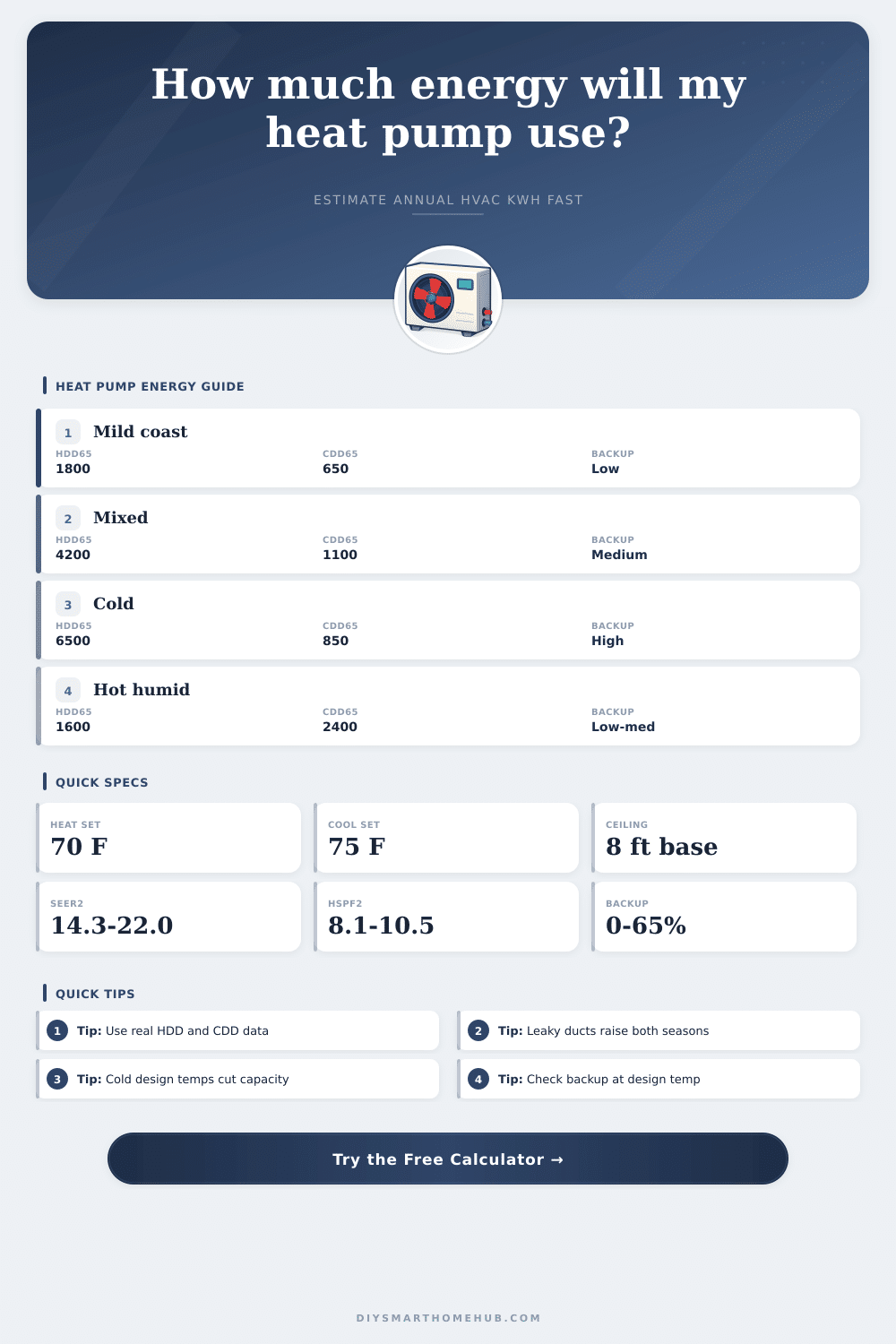
Estimate whole-home heat pump energy use from floor area, ceiling height, envelope tightness, climate degree days, duct losses, and low-temperature capacity so annual kWh stays tied to real heating and cooling conditions.
📌Preset Scenarios
Loaded preset: Suburban Ranch with attic ducts, mixed-climate degree days, and a 3-ton inverter ducted system.
⚙Home and System Inputs
⚡Estimated Energy Results
📊System Snapshot
📑Reference Tables
| Climate | HDD65 | CDD65 | Designs |
|---|
| Envelope | UA/ft2-F | ACH | Use case |
|---|
🏠Scenario Benchmarks
| Scenario | Area | System | Annual kWh |
|---|
💡Calculation Notes
Use real weather and setpoints
Degree-day estimates only work when HDD65, CDD65, and winter design temperature match the site. Overwrite climate defaults when local weather data differs from the preset.
Read backup as a sizing clue
A nonzero backup share does not mean strip heat runs every day. It means the chosen unit runs short often enough at design conditions that some seasonal heating shifts away from compressor-only operation.
Warm pump is machine that by means of mechanical or thermal energy moves heat from one place to another. It combines the role of heater stove and central air conditioner. Such device heats and cools homes absorbing heat from the air and later releasing it.
Similarly to refrigerator it uses electricity for transport heat from cold area to warm. Like this the cold space becomes even cooler during the warm space becomes warmer. In summer months warm pumps waste heat from the house to the outside.
How Heat Pumps Work
Those intelligent utilities offer energy saving and natural replacement for oil either gas fuels. They use free the surrounding energy and only require a bit of electricity for operate. Because warm pumps simply transfer heat instead of produce it by means of lighting as traditional systems air-source variants are especially efficient.
One from them fit to give until thrice more heat energy to the house than the electricity that it swallows. In average climates they well replace stoves and air conditioners. Available several models for instance air-source geothermal absorbent and without-canal mini-split pumps.
Warm pump extracts heat from sources as surrounding air water or geothermal energy in the soil. It can even employ waste heat from factories. Later it strengthens and direct it over there where it requires.
The warm energy comes of the sun that heats air water or the ground. Electricity only serves for the moving work. Like this the efficiency surpasses 100 percentages because it pushes heat from exterior source or bucket.
Ground-source warm pumps are the most energy saving. The soil in depth does not cool like this a lot as the exterior air. In big temperature differences between interior and outside the efficiency lowers.
In cold regions some pumps cover whole heating need without help of fossil fuels. But they best operate in approximately 10 grades of difference between exterior and internal temperature. They well remove chill when it is fresh but no extremely.
In approach to 0 grades they become worse. Some model can stop heat in around -7 grades outside. In very low temperatures systems sometimes switch to helpful stove.