Water Filter Calculator
Estimate peak service flow, filter body size, media volume, and replacement timing for whole-house sediment, carbon, or point-of-use drinking water systems.
1. Quick Presets
Use a real-world starting point, then fine-tune source quality, micron rating, and target replacement interval for your specific water filter setup.
2. Household Inputs
Run the calculator to see the best-fit filter system.
You will get a recommended housing or media tank, service flow check, change interval estimate, and a quick read on pressure-drop risk.
Waiting for inputs.
4. Filter Body Specs
These conservative planning numbers are useful for comparing whole-house housings, parallel cartridges, and backwashing media tanks before you match them to exact certified products.
2.5 x 10 in cartridge
Best for light-duty polishing, single fixture branches, and low-flow cabins.
- Usable flow3-4 gpm
- Media volume0.03 cu ft
- Best fit1 bath
2.5 x 20 in cartridge
Good step up for cabins, apartments, and point-of-entry polishing with modest demand.
- Usable flow5-6 gpm
- Media volume0.06 cu ft
- Best fit1-2 bath
4.5 x 10 in Big Blue
Solid for sediment removal ahead of a softener or UV unit where footprint matters.
- Usable flow7-8 gpm
- Media volume0.14 cu ft
- Best fit2 bath
4.5 x 20 in Big Blue
Common whole-house cartridge size for balanced flow, carbon contact, and longer service life.
- Usable flow10-12 gpm
- Media volume0.28 cu ft
- Best fit2-3 bath
Twin 4.5 x 20 housings
Parallel bodies keep pressure loss down when a single cartridge housing starts to get crowded.
- Usable flow16-18 gpm
- Media volume0.56 cu ft
- Best fit3-4 bath
1.0 cu ft media tank
Useful for lighter whole-house carbon jobs where backwashing helps maintain pressure.
- Service flow6-7 gpm
- Media volume1.0 cu ft
- Best fit1-2 bath
1.5 cu ft media tank
A practical middle ground for city chlorine or polished well-water treatment with stronger contact time.
- Service flow9-10 gpm
- Media volume1.5 cu ft
- Best fit2-3 bath
2.0 cu ft media tank
Better for large homes, high contact-time goals, and demanding well-water polishing loads.
- Service flow12-13 gpm
- Media volume2.0 cu ft
- Best fit3-4 bath
5. Capacity and Flow Reference
| Filter body | Conservative service flow | Typical replacement target | Best application |
|---|---|---|---|
| 2.5 x 10 in | Up to 4 gpm / 15 Lpm | 2 to 4 months | Single point or low-demand branch |
| 2.5 x 20 in | Up to 6 gpm / 23 Lpm | 3 to 6 months | Small home polishing |
| 4.5 x 10 in | Up to 8 gpm / 30 Lpm | 3 to 6 months | Sediment before softener or UV |
| 4.5 x 20 in | Up to 12 gpm / 45 Lpm | 4 to 9 months | Whole-house sediment or carbon |
| Twin 4.5 x 20 | Up to 18 gpm / 68 Lpm | 6 to 12 months | Large homes or high overlap |
| 1.0 cu ft tank | Up to 7 gpm / 26 Lpm | 9 to 18 months | Light whole-house carbon |
| 1.5 cu ft tank | Up to 10 gpm / 38 Lpm | 12 to 24 months | Balanced chlorine reduction |
| 2.0 cu ft tank | Up to 13 gpm / 49 Lpm | 18 to 30 months | Large home carbon contact time |
6. Filter Goal Comparison
| Goal | Flow behavior | Loading behavior | Planning note |
|---|---|---|---|
| Sediment prefilter | Usually the strongest raw flow | Loads fast when silt spikes | Oversize if well water turns cloudy after storms. |
| Whole-house carbon | Needs slower flow for contact time | Stable on clean city water | Flow is often the first limiter, not gallons per day. |
| Chloramine reduction | More sensitive to empty-bed contact time | Capacity drops faster | Use a slower service rate or more carbon volume. |
| Well water polishing | Moderate service flow | Seasonal loading swings | Plan a reserve for summer draw and sediment bursts. |
| Iron or sulfur pretreat | Often needs lower face velocity | High fouling risk | Prefiltration and backwash matter more than sticker size. |
| Point-of-use drinking water | Low flow by design | Small volume, high polish | Do not size an under-sink cartridge for whole-house duty. |
7. Common Household Snapshots
| Scenario | People / baths | Demand target | Typical fit |
|---|---|---|---|
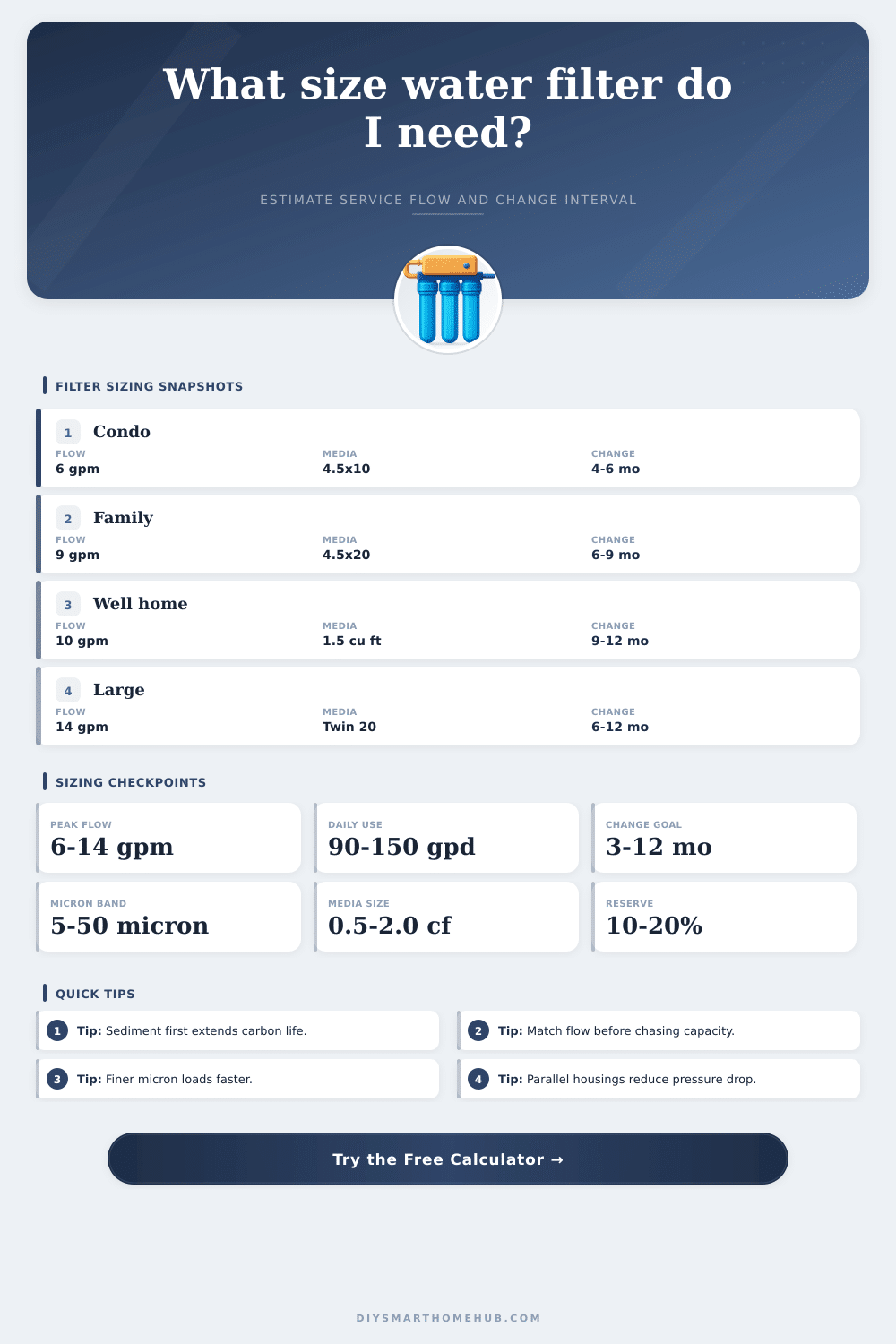
| Urban condo | 2 people / 1 bath | 5 to 6 gpm peak | 2.5 x 20 or 4.5 x 10 cartridge |
| Starter home | 3 people / 2 baths | 7 to 8 gpm peak | 4.5 x 10 sediment or 4.5 x 20 carbon |
| Family house | 4 people / 2.5 baths | 9 to 10 gpm peak | 4.5 x 20 or 1.5 cu ft media tank |
| Rural well home | 4 people / 3 baths | 10 to 11 gpm peak | 4.5 x 20 sediment plus media tank |
| Large active home | 5 to 6 people / 3 baths | 12 to 14 gpm peak | Twin 4.5 x 20 or 2.0 cu ft tank |
| Kitchen drinking line | One faucet / point use | 0.5 to 1.0 gpm peak | Under-sink cartridge or membrane system |
8. Sizing Notes
Sediment before polishing
If your source water carries sand, rust, or seasonal fines, a dedicated sediment stage keeps carbon from blinding early and preserves both flow and contact time.
Pressure drop tells the story
Households usually complain about pressure long before a cartridge reaches its theoretical gallon rating, so sizing by peak flow and reserve is often more realistic than nameplate capacity alone.
Water filter calculator helps to find the best spots for a water system. They count the running costs for reverse osmosis or nanofiltration and give report about recovery. You can use them to estimate the skill of a water softener either ion exchange system.
They serve also for exterior chemical dosing and for mention energy savings.
How to Use Water Filter Calculators
If you want to know how many media requires for fill a water system either filter cartridge, a media filter sizing calculator will be useful. Exists also a tool for count the size of a water filter tank. It applies formula for estimate the tank size or the content of already existing purifier.
For reach good water filtration, you counts service flow, backwash, and maximum flow according to tank type and size.
Industrial water calculators are available for special tasks. They estimate salt savings, boiler savings and whole hardness. Also they help to choose the apt size for industrial deionizers, reverse osmosis systems and water softeners.
Free multi-media filter sizing calculator is easy for those filters. One from them determine the diameter of round multi-media filter according to the enclosed filter speed. For industrial usages range vertical filter speeds for ideal service flows of 10 until 25 m/h, depende of water quality.
Free online calculator it is possible for determine the right size and type of industrial water filters. You can estimate the flow rate through filter for predict close drop. They help to set replacement schedule and filter capacity according to kinds.
For approximate peak flow for sizing water treatment equipment, UV systems or filters for a facility or home, you estimates the maximum number of devices, that can operate simultaneously, and sum their flow rates. That peak flow is inherent for apt equipment size.
Capacity ratings show the lifetime of filter before refill. Lifetimes of 100,000 gallons are basic for permanent use at the most of clients. Shorter, as 300 until 1,000 gallons, signal, that cartridges must achteĝi soon.
For trace water use, simple notebook suffice. Invariably when you refal a filter, you note the date for count the whole filtered water easily.