Garden Zone Plant Count Calculator
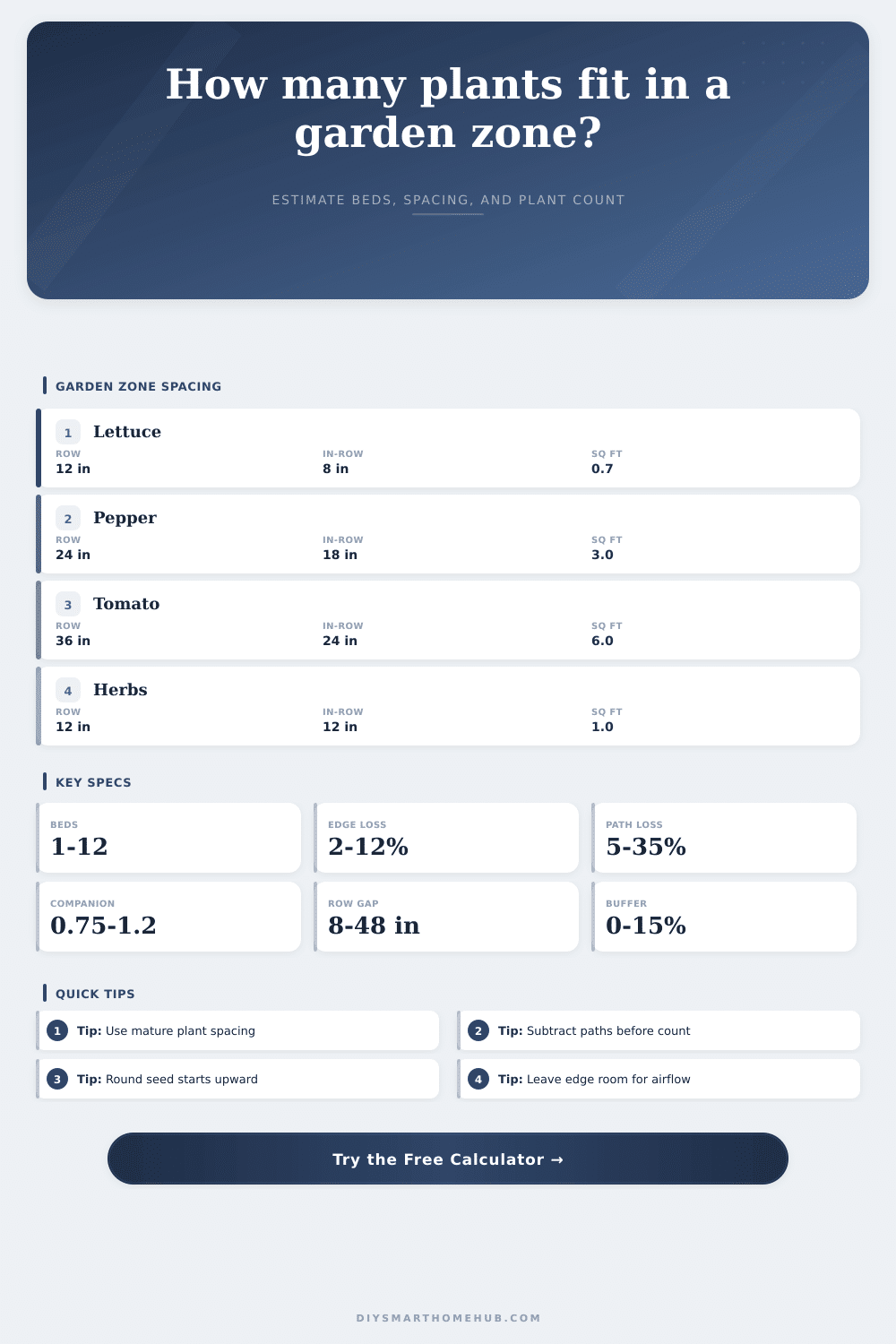
Estimate how many plants fit in one or more garden zones after bed count, paths, edge clearance, row spacing, in-row spacing, square-foot spacing, and companion planting adjustments.
Garden Zone Plant Count Results
Calculation Breakdown
| Plant group | Row spacing | In-row spacing | Square-foot count |
|---|---|---|---|
| Leaf lettuce | 10-12 in | 6-8 in | 4 plants per sq ft |
| Carrots | 8-12 in | 2-3 in | 16 plants per sq ft |
| Basil and compact herbs | 12-18 in | 10-12 in | 1 plant per sq ft |
| Peppers and eggplant | 24-30 in | 18-24 in | 0.25-0.33 per sq ft |
| Staked tomatoes | 36-48 in | 24-36 in | 0.11-0.17 per sq ft |
| Trellised cucumber | 24-36 in | 12-18 in | 0.33-0.5 per sq ft |
| Layout type | Path loss | Edge loss | Best spacing method |
|---|---|---|---|
| Single raised bed | 0-5% | 4-8% | Square-foot or dense block |
| Multiple beds in a zone | 10-25% | 5-10% | Rows for larger crops |
| In-ground row garden | 20-35% | 3-7% | Row and in-row spacing |
| Pollinator border | 5-12% | 8-15% | Dense block spacing |
| Project | Gross area | Typical crop | Approx plants |
|---|---|---|---|
| 2 x 6 balcony boxes | 12 sq ft | Herbs | 10-14 plants |
| 4 x 8 raised bed | 32 sq ft | Salad mix | 80-120 plants |
| Four 4 x 8 beds | 128 sq ft | Mixed vegetables | 35-160 plants |
| 10 x 20 row zone | 200 sq ft | Tomatoes or peppers | 25-60 plants |
| Step | Formula | Purpose | Output |
|---|---|---|---|
| Garden area | Shape area x bed count | Gross zone size | Sq ft or sq m |
| Loss adjustment | Area x remaining % | Removes paths and edges | Usable area |
| Row spacing | Row in ft x in-row in ft | Area per plant | Sq ft/plant |
| Plant count | Usable area / spacing area | Final bed capacity | Whole plants |
The calculator makes sure your garden beds is planned properly. Imagine yourself looking at your seed tray, seeing a bounty ahead. But then when it comes time for transplanting, your seedlings are packed together like sardines.
This is what most beginner gardeners believe: More seeds = more crop per square foot. Wrong! It results in diseased crops and shorter plant. Enter the size of your garden beds and the calculator does the rest.
How to Plan Your Garden Beds Correctly
No need to guess how many plants will fit in corner. All those abstract shapes become a real-life planting plan.
That’s not the gross surface of your bed space that you’re meant to plant on. On a four-by-eight raised bed, for instance, you don’t have thirty-two square feet to play with. Maybe you have twenty-eight square feet if you allow some clearance around edges, space for a path, and room to reach into the center.
That’s where the tool helps, allowing you to define what percent of the area will be lost to access and paths. It is a little input, but it makes a big difference in the output. Before you even start subtracting out the spaces that aren’t beds, you’re already ahead of the game, you’re thinking about real estate, not just numbers of things to grow.
Most people make a mistake by not leaving enough space; spacing being one of the main factors affecting yield. Carrots is tiny but still require air circulation and light. Leaf lettuce wants more breathing room then do staked tomatoes (see the table on the page).
Remember: Tomato’s a fat guy who likes his own space. If you do not use the recommended spacings, you create an environment where fungus grow easily.
The calculator requires you to pick your spacing style, such as traditional row crops. Square-foot gardening?) Consistency is what matters and both systems can work.
Companion planting can be complicated and often confuses people. Do you want to plant marigolds with your tomatoes? Great idea; hope it works well against pests. But each additional plant occupy space.
The companion spacing factor in the tool adjust total count to account for how closely you’re interplanting. Keep this factor close to one if your interplanting’s light. If it’s heavy relay planting, push it upward.
It reflects how plants live together in garden: Plants are neighbors, and they have to have some boundaries. Then there’s a bit of buffer. It is not padding, exactly but insurance. Things happen: Seedlings die; transplant shock occurs; the birds gets some of it.
To account for this, add 10 percent as a buffer. That way you’ll order more starts than you believe are necessary which will save you from buying replacements later in the season (at full retail!). Better to have too many plants in pots than unfilled holes in the beds.
The tool provides separate calculations for theoretical maximums versus practical reality. Yes, it’s also about subtraction. Subtracting the edges, the pathways. Subtract the air circulation space. You subtract what is actualy possible. At least that’s how it feels, starting out, planning within limits.
But limits makes things orderly. Order promotes growth.
In July, when you take a step back, you’ll realize why the emptiness was essential. Why the plants would of suffocated otherwise. How could they have thrived without space to breathe?
Counting serves that purpose.