Robot Mower Charging Cycles Calculator
Estimate how often a robot mower returns to the dock, how many charge cycles it uses per week and season, charging kWh, standby kWh, annual energy, and battery cycle-life outlook.
Your weekly charging cycle estimate will appear here.
Deep multi-cycle days
Large lawns can use several equivalent full cycles each week because sessions needed per mow rises above one before multiplying by mows per week.
Daily shallow cutting
Daily mowing may feel frequent, but each start can be a partial runtime event if the mower returns before fully draining the usable window.
Standby-heavy setups
Small lawns with low mowing energy can still show meaningful annual kWh because dock standby watts run every hour of the year.
Li-ion cycle depth and life
| Usable depth | Typical cycles | Cycle stress | Use case |
|---|---|---|---|
| 50% | 1200 to 2000 | Low | Shallow maintenance cycles and longer pack life. |
| 70% | 800 to 1500 | Moderate | Balanced runtime and longevity for routine mowing. |
| 80% | 600 to 1000 | Normal | Common usable window for consumer robot mowers. |
| 90% to 100% | 300 to 700 | High | Maximum runtime with more aging per cycle. |
Charger efficiency guide
| Dock type | Efficiency | What changes | Calculator input |
|---|---|---|---|
| Compact basic dock | 80% to 85% | Small supplies and warm adapters lose more energy. | 82% |
| Typical mower dock | 86% to 90% | Most modern Li-ion charging stations. | 88% |
| Efficient external supply | 90% to 94% | Cooler supply and shorter charge path. | 92% |
| Hot enclosed location | 78% to 84% | Heat and fanless adapters reduce efficiency. | 80% |
Battery Wh examples
| Battery label | Nameplate Wh | Usable at 80% | Typical mower role |
|---|---|---|---|
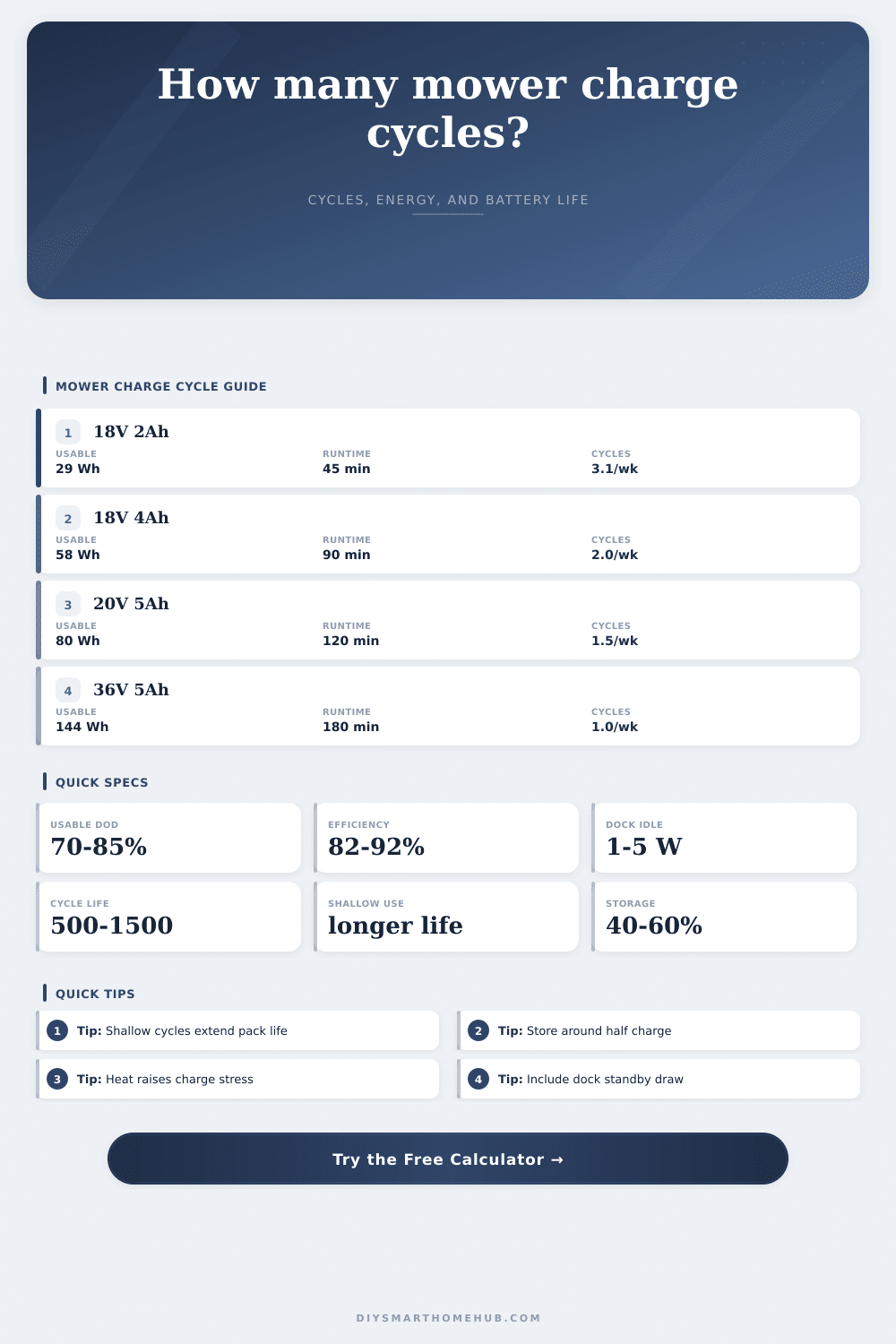
| 18 V 2 Ah | 36 Wh | 28.8 Wh | Compact bot and small courtyard trimming. |
| 18 V 4 Ah | 72 Wh | 57.6 Wh | Suburban maintenance mower. |
| 20 V 5 Ah | 100 Wh | 80 Wh | High-capacity consumer mower. |
| 36 V 5 Ah | 180 Wh | 144 Wh | Large lawn or multi-zone mowing. |
Standby power and cost
| Dock idle draw | Annual kWh | At $0.17/kWh | Reading |
|---|---|---|---|
| 1 W | 8.8 kWh | $1.49 | Very low standby dock or switched off-season outlet. |
| 3 W | 26.3 kWh | $4.47 | Common low-power dock standby estimate. |
| 5 W | 43.8 kWh | $7.45 | Older dock, connected base, or adapter losses. |
| 10 W | 87.6 kWh | $14.89 | High idle draw that may exceed mowing charge energy. |
Lower usable depth reduces equivalent full-cycle stress. If the mower can finish with smaller bites and less heat, the same weekly mowing minutes can be gentler on the pack.
For off-season storage, avoid leaving the pack empty or held at full charge for months. A moderate state of charge in a cool location slows calendar aging.
This calculator counts dock returns, cycle wear, charging kWh, and standby energy. It does not size cutting runtime alone; runtime is only one input to the cycle model.
The dock standby formula uses watts x 24 x 365 / 1000, so idle power can dominate annual kWh for small lawns or short mowing seasons.
The idea is you buy a robot mower so you can have a green lawn and don’t have to mow. In practice it’s a bit different. The machine has to come back to its dock for recharging. Depending on how frequently it does this, and unless you know that about your machine, you might end up with a failed battery after two years. Also, maybe you’ll find out your electricity bill is not what you thought it would be. Until your lawn is looking patchy, it’s all too easy to forget about the math of making this thing work.
The bot spends too many hours on the dock and not enough on the lawn. On the page, there’s a calculator that allows you to plug in your spec and get an idea of how long the battery will last. Li-on batteries is rated for how many full cycles they do. This is under best-case conditions. Under real-life usage, the mower doesn’t often do a truly full charge and full drain. Typically it’s doing partial runs and topping off and running some more.
The Hidden Costs of Robot Mowers
How much you can use the battery before you stress it are called the usable depth of discharge. Stressing the battery by letting it run down to zero every day isn’t good. Running it between twenty and eighty percent extends battery life. That minor shift in schedule make all the difference in extending life.
Also look at efficiency of charger. Not all docks is created equal. Older chargers can be very inefficient (meaning they throw away energy as heat while charging). When the charger is less efficient, you are paying to heat the surrounding air with your dock. That’s not putting it into the battery. See how a ten percent variation in charger efficiency affects the yearly cost (referenced from the table above).
Until they open up their electric bill, many owners don’t consider this variable. This issue gets made worse by having a hot, closed-in environment. Having a well-ventilated and cool location will help the system operate more efficienty.
Owners also face another surprise: standby power draw. Even with the mower parked away from the deck, the dock remains plugged in and listening for commands. It uses a few watts at a time. Yep. Over a dozen months, those watts adds up. On a small lawn that requires just two hours of weekly mowing, standby power consumption can be higher then what’s required for cutting. Sounds counterintuitive, right? But it’s a common problem.
“You buy a low-power mower, thinking it saves money,” you say. All your savings go down the drain when the dock burns power all year long. A simple solution is to unplug the outlet in the off season. Lots of manuals recommend doing this…though very few owners do.
Battery performance depends on weather conditions. Heat stresses the batteries. That speeds up cell degradation regardless of cycling counts. If it is hot where you live, keep that in mind when deciding how long the battery will last. Use the tool to dial down runtime estimates. Get a more realistic idea about what the mower can do in summer heat. Plan for a shorter session instead.
You should of not expect the battery to handle excessive stress. Summer use and proper winter storage are both critical. If you leave your lithium pack fully charged (or empty) for months, you lose some capacity. The best way to store a lithium pack is with a moderate charge, forty to sixty percent. This stabilizes the chemistry. Neither pushes cells too hard.
Treat your battery like your car in winter storage: You don’t want that thing empty or full; you want it ready to go, comfortabley. Treat your robot mower like a partner. Keep it cool. Watch it go through its cycles. Respect the limitations of the battery chemistry. It will do a better job with the grass. So will your wallet.
Yes, hands-free lawn care is kind of a hands-on thinking thing.