Greenhouse Heating Requirement Calculator
Estimate the cold-night heater size for a greenhouse from exposed surface area, glazing U-factor, target temperature, outside minimum, air changes, volume, heater efficiency, and sizing reserve.
Pick a realistic starting point, then adjust the dimensions and envelope assumptions. Surface area is estimated from footprint, average height, and roof style unless you choose direct surface area.
| Load piece | Formula | Input units | Result units |
|---|---|---|---|
| Envelope conduction | Surface area x U-factor x delta-F | sq ft, BTU/hr-sf-F, F | BTU/hr |
| Air infiltration | 0.018 x volume x ACH x delta-F | cu ft, air changes/hr, F | BTU/hr |
| Required output | Conduction + infiltration, then reserve | BTU/hr plus percent reserve | BTU/hr output |
| Heater input | Required output divided by efficiency | BTU/hr and efficiency decimal | BTU/hr input |
| Glazing type | Calculator U-factor | Typical use | Design note |
|---|---|---|---|
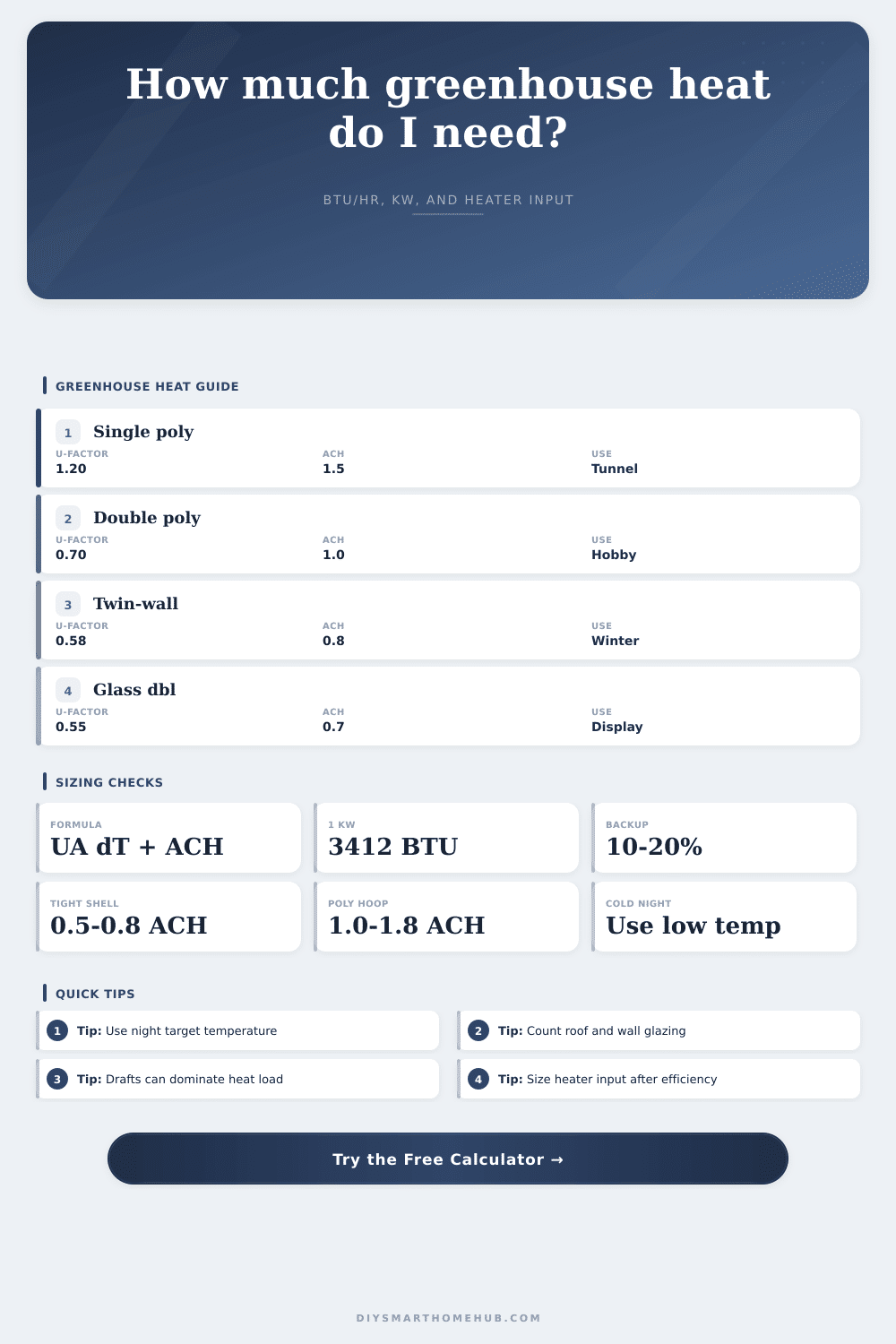
| Single poly film | 1.20 BTU/hr-sf-F | Seasonal tunnels | Use higher reserve where wind lifts or gaps are common. |
| Inflated double poly | 0.70 BTU/hr-sf-F | Hobby and crop houses | Good default when the inflation blower is maintained. |
| 8 mm twin-wall polycarbonate | 0.58 BTU/hr-sf-F | Winter greens and lean-tos | Panel framing and doors still affect real losses. |
| 16 mm triple-wall polycarbonate | 0.42 BTU/hr-sf-F | Propagation and cold regions | Lower U-factor reduces the conduction part of the load. |
| Double glass | 0.55 BTU/hr-sf-F | Display and orchid houses | Check metal framing because it can raise shell loss. |
| Infiltration profile | ACH value | Best match | Load behavior |
|---|---|---|---|
| Very tight | 0.5 ACH | Sealed panels, good doors | Conduction usually dominates. |
| Tight | 0.8 ACH | Maintained double poly | Balanced shell and air leakage load. |
| Average | 1.0 ACH | Typical hobby greenhouse | Reasonable first estimate for unknown leakage. |
| Drafty | 1.3 ACH | Older doors, vents, roll-up sides | Infiltration becomes a major load share. |
| Wind exposed | 2.4 ACH | Leaky tunnel in open site | Heater size rises quickly on cold windy nights. |
| Project | Footprint | Typical shell | Common target |
|---|---|---|---|
| Seedling tunnel | 14 x 28 ft | Double poly, 1.0 ACH | 60-65°F night |
| Winter greens | 20 x 36 ft | Twin-wall, 0.8 ACH | 42-50°F night |
| High tunnel retrofit | 30 x 72 ft | Single poly, 1.8 ACH | 38-45°F night |
| Tomato production | 30 x 96 ft | Double poly, 1.3 ACH | 58-62°F night |
| Orchid glasshouse | 18 x 32 ft | Double glass, 0.7 ACH | 62-68°F night |
Greenhouse heating load is driven by the coldest useful night planning point, not a sunny daytime average. Enter the minimum outside temperature you expect the heater to hold against.
Tall arches, gable ends, roll-up sides, and exposed doors all add shell area. Direct surface-area mode is better when you have a measured roof and wall takeoff.
Making sense of the heat: Winter greenhouse gardening pose its own set of climate-control challenges. On one chilly morning you look at the thermometer and realize your heating bill is fighting the wind-chill factor. If you’re not sizing up the heat just right, the place can quickly turn into a expensive ice box come December. The formula for keeping things going overnight isn’t complicated, but it can be easily thrown off if you guess at any of the variables involved.
How efficient is your heater? How much cold creeps in around the seams? How fast does heat seep out through walls? People tend to think in terms of square feet of floor space. That’s the wrong metric. Surface area are what conducts heat. You lose more heat through surface area then through floor area. So a tall gable roof will have more surface area than a low-slung hoop house of equal size, and lose heat to the cool night air faster.
How to Choose the Right Heater for Your Greenhouse
The calculator takes your length, width and height and translates it into total surface area, meaning all the surface that needs to be warmed. Enter those dimensions, and the calculator figures out size of envelope you are trying to keep warm. It divides that into two categories: infiltration loss due to draftiness; and conductive loss via glazing.
Why? Because you fix a leaky door different than you upgrade to double-wall polycarbonate. What’s its U-factor (heat retention)? If the material has a high U-factor (for example, single layer of polyethylene film), then heat will escape rapidly. It is inexpensive, easy to work with, and shiny as a new penny; but it is no match for January wind. To reduce the U-factor, use double-inflated poly or even twin-wall polycarbonate, which traps air between layers forming an insulating barrier.
The table of references show how swapping different materials affects the required BTU output. A mild climate may get away with single poly; if you intend to raise tender seedling into late February, insulation improvements will repay you in gas money.
A big issue that also affects efficiency of greenhouses is air leakage. You can have great glass (or whatever material you use), but if building leaks, you’ll never get up to temp. Air leakage is expressed as air entering or number of air changes per hour, i.e., the rate at which outside cold air replaces inside air. For example, a really tight house may have 1 air change/hour; whereas a high tunnel with open sides may be 2 or even 3 air changes.
This extra air leak load gets added to your conductive loss on the heating tool so that you don’t underestimate what size heater you need because you have such good windows. If your heater is just sized for conduction, you’re going to come up short whenever the wind blows and brings cold air through all the cracks.
So how do we bridge the gap between theory and reality? It’s about heater efficiency. A moddern gas heater may be rated at 95-percent condensing, so nearly all of the energy in the fuel has become usable heat within your greenhouse. By contrast, an older unvented heater could be rated at just 70-percent efficient, blowing the rest up its flue. The calculator factors this efficiency into final output demand to determine the required input capacity you need to look for on nameplate.
From there it lets you include a reserve factor, essentially a cushion for aging equipment or an extreme cold snap. Always throw something in, as better to have a heater turn off early than run all the time and still not keep pace.
It’s all about providing a consistent microclimate in which things will grow… Not merely preventing pipes from freezing. Once you learn what makes a system efficient, compared to one with high air leaks but low efficiency or low air leaks but a large surface area, you don’t have to guess anymore. You can size your system confidentely. You will know that your greenhouse stay cozy even on the coldest winter night, keeping your investment safe while avoiding fuel waste on mild ones.