Garage Door Opener Cycle Life Calculator
Estimate annual opener cycles, stress-adjusted remaining years, maintenance timing, and spring cycle-life comparison from daily openings, door balance, spring age, temperature, and rated cycles.
Balance, spring age, temperature, and door weight combined.
Rated cycles divided by adjusted annual cycle stress.
Current age multiplied by cycles per year.
Cycle allowance before stress adjustment.
Daily use to annual cycles
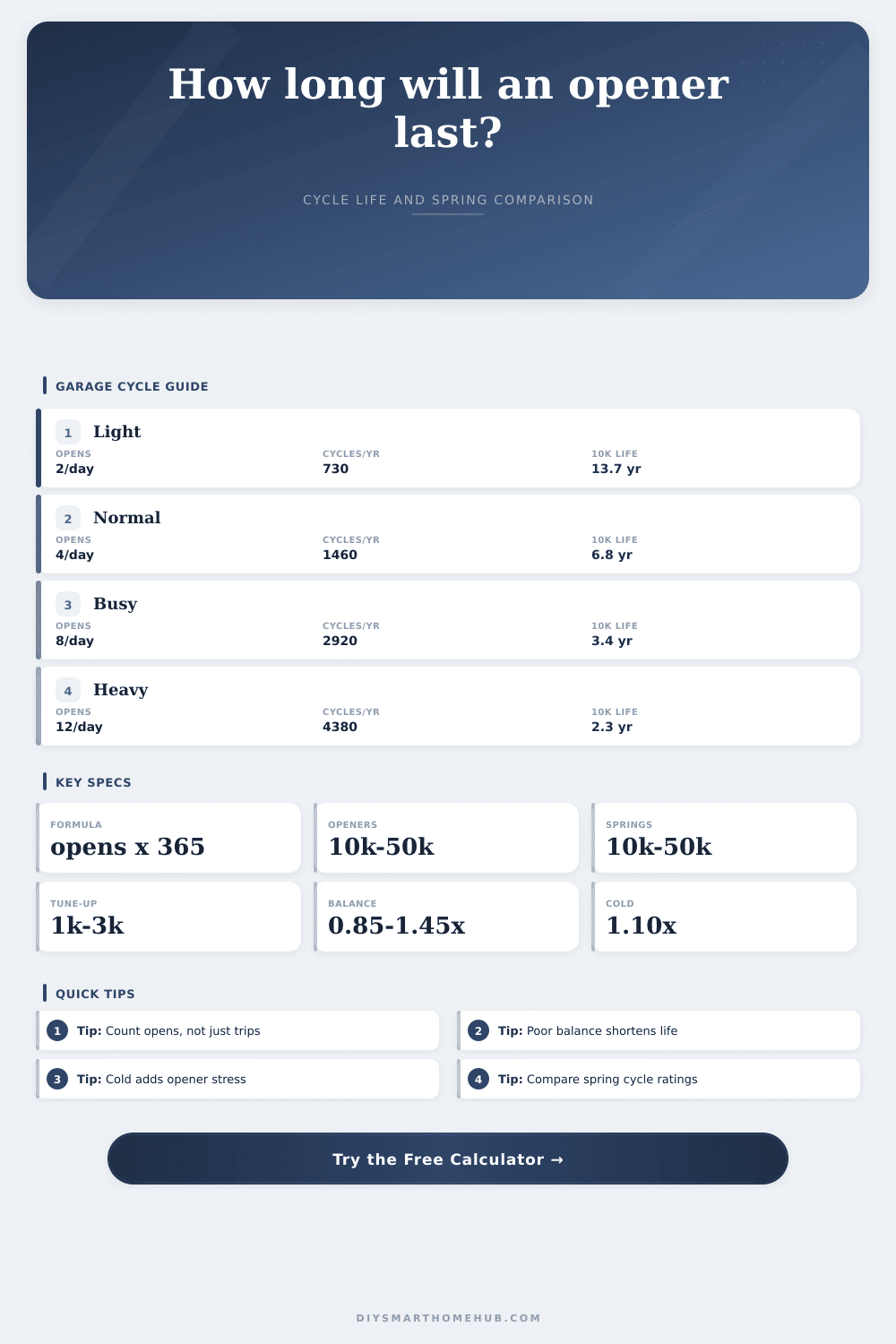
| Use level | Opens/day | Cycles/year | 10k spring life |
|---|---|---|---|
| Light single-car | 2 | 730 | 13.7 years |
| Commuter | 4 | 1,460 | 6.8 years |
| Family door | 6 | 2,190 | 4.6 years |
| Workshop | 8 | 2,920 | 3.4 years |
| Delivery access | 12 | 4,380 | 2.3 years |
Stress adjustment factors
| Condition | Factor | Effect | What it means |
|---|---|---|---|
| Excellent balance | 0.85x | Low | Door stays put halfway |
| Good balance | 1.00x | Normal | Slight drift by hand |
| Fair balance | 1.18x | Watch | Noticeable lift effort |
| Poor balance | 1.45x | High | Opener carries spring load |
| Extreme temperature | 1.18x | Watch | More drag and material stress |
Spring cycle life comparison
| Spring rating | Unadjusted life | Stress-adjusted life | Remaining from current spring age |
|---|---|---|---|
| 10,000 cycles | 6.8 years | 6.3 years | 3.3 years |
| 15,000 cycles | 10.3 years | 9.5 years | 6.5 years |
| 25,000 cycles | 17.1 years | 15.8 years | 12.8 years |
| 50,000 cycles | 34.2 years | 31.6 years | 28.6 years |
Opener rating comparison
| Rated cycles | At 2/day | At 4/day | At 8/day |
|---|---|---|---|
| 10,000 | 13.7 yr | 6.8 yr | 3.4 yr |
| 15,000 | 20.5 yr | 10.3 yr | 5.1 yr |
| 25,000 | 34.2 yr | 17.1 yr | 8.6 yr |
| 50,000 | 68.5 yr | 34.2 yr | 17.1 yr |
Maintenance interval guide
| Target cycles | 2/day | 4/day | 8/day |
|---|---|---|---|
| 1,000 | 16 mo | 8 mo | 4 mo |
| 1,500 | 25 mo | 12 mo | 6 mo |
| 2,000 | 33 mo | 16 mo | 8 mo |
| 3,000 | 49 mo | 25 mo | 12 mo |
How do you think of your garage door opener? Is it convenient? Is it noisy? Because you use it so frequently, that’s a valid thought process. When it starts making a racket, you notice the noise. When it stalls for just a fraction of a second before starting, you’re aware of the delay. But how often have you considered true cost associated with each time you open it?
It costs cycles. And cycles are the only measurement of how long your system is going to last. Until one day when you want to go somewhere in the morning, but suddenly the door won’t budge. You can run the math with our calculator up there. And it’ll tell you what it means.
Understanding Garage Door Lifespan and Maintenance
It’s simple. Your opener has a rated lifespan. Generally, that’s defined in terms of thousands of cycles. Each time you pull the trigger, you chip away at this total. If you’re a typical commuter who opens their door four times a day, they burn through almost fifteen hundred cycles per year. Sounds reasonable right?
This changes when you consider your specific garage environment. That’s when most people miscalculate. They see a 10K cycles rating, and they split that up based off how much they use it. That’s assuming a straight line to failure.
A garage door is a mechanical system in tension. Over time, the tension wears away. Age of the springs and door balance matter greatly. Those factors will change the actual load on the motor. If your springs are tired, then the door feels heavy when you try to lift it by hand. Then the opener takes up the slack; which means it is working harder than the springs should. This becomes a multiplier effect on stress, and the multiplier can greatly reduce life of the unit.
So it’s not simply a question of how many times you open the door. It’s also a question of how hard the motor must work.
There is also another, subtler killer: temperature. Metal becomes stiffer and lubricants become thicker in cold temperatures. As a result, it takes the motor longer to start and uses more power. Conversely, heat will speed up internal component wear, weaken belts and do just the opposite. In the moment you may not feel any additional stress. It’s the cumulative impact. That smoothly running door may shorten its life span because of extreme seasonal changes in your area.
Speaking of life in the spring: Spring and the opener are not necessarily a matched set. It’s what many homeowners assume, these pieces go hand-in-hand and break as one. That is not true. The torsion springs will be rated for x number of cycles. That may or may not match your opener rating. For example, if you’ve got new springs (high cycle), but an older opener, it may be the motor that dies first. Or it may be the other way around. If you have old springs but a new opener, chances are the springs will snap well before the opener’s motor bites the dust. Knowing this lets you avoid having to replace both at once. You just know which one is really at risk so you’ll replace only that.
How much you use the door will determine when it’s time for some love. For example, if you have a light use door you can probably get by visually checking once every few years. If you’ve got a busy workshop door that sees eight or more cycles each day, consider checking the tension and lubricating it regularly. You run the risk of waiting too long to maintain a high cycle system. The friction creeps up on you silently…then something snaps.
This is spelled out nicely on the page, in the form of a reference table. It shows the conversion from daily use to annual usage. If you’re considering replacing something or doing a remodel, this is a nice sanity check. You know just how long your purchase will last you. How much bang you’re getting for your buck. That’s some tangible time, and that’s what specs are supposed to be: an abstraction translated into a concrete timeframe. Instead of guessing whether a cheaper model will hold up, you can see exactly how many years of service you are buying.
Your garage door is a rare asset, one that can save you both money and frustration if you treat it as such. It’s not enough for the door to move today; it’s also about knowing what compromises have been made in order to get there. Do you want more convenient, more expensive, or longer-lasting? How many times do you want that particular compromise repeated? Stop treating the opener like a switch. Start viewing it as a machine with a limited budget of motion. Soon you’ll begin to see the maintenance decisions so much more clearly. When the door eventually stops working the way it was designed to, you won’t be surprised. You’ll should of been ready.