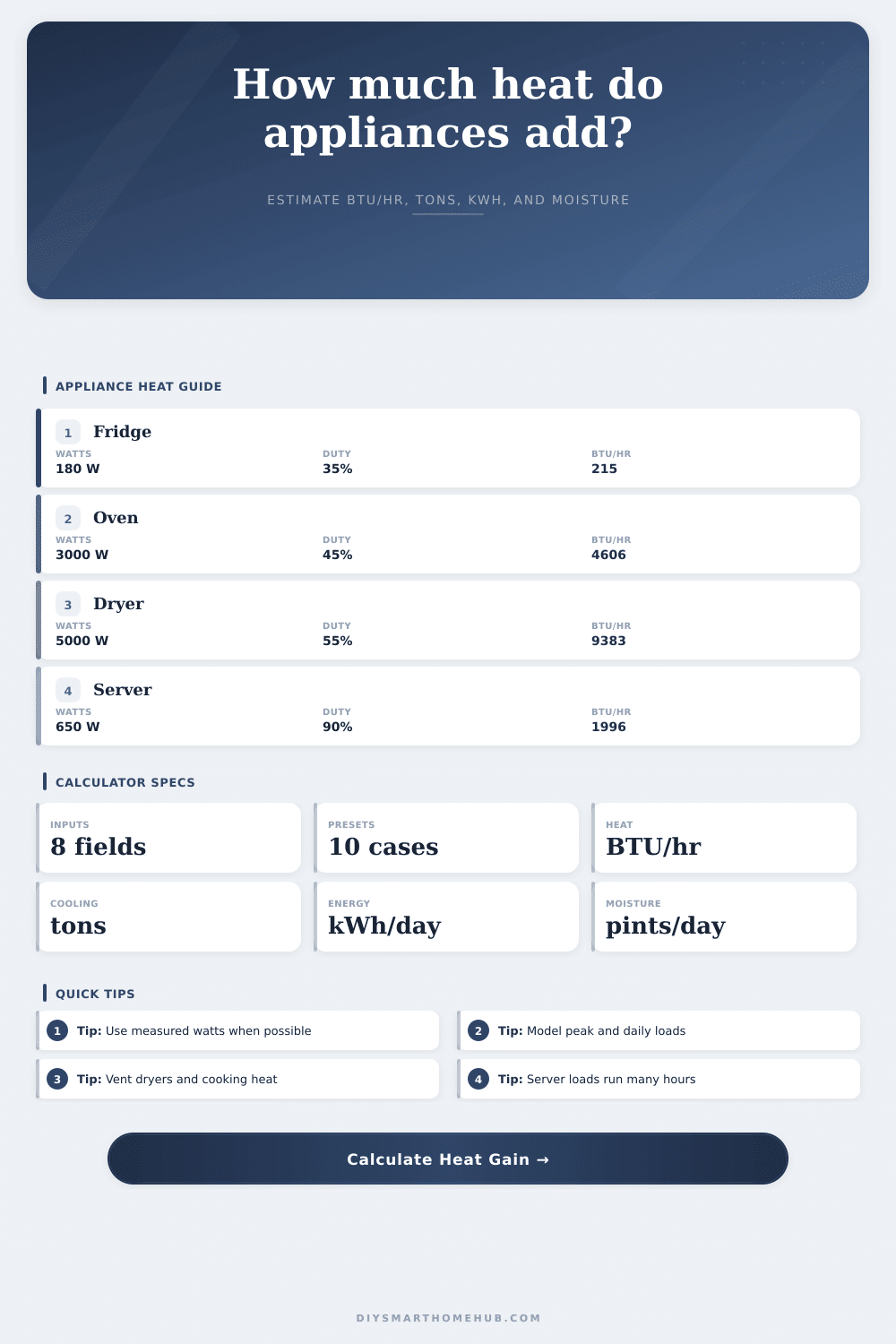
Appliance Heat Gain Calculator
Estimate appliance sensible heat in BTU/hr from watts and duty cycle, then compare cooling ton impact, daily kWh, latent moisture, room ACH, and ventilation relief.
| Appliance profile | Typical watts | Duty cycle | Sensible BTU/hr | Latent moisture note |
|---|
| Preset | Schedule | Daily kWh | Peak tons | Room note |
|---|
The hottest spots tend to be around the kitchen and behind appliances, where you feel a sudden heat hitting your neck from devices themselves. Anytime you plug something into an outlet, it becomes a heater. Box labels are typicaly marked with peak usage instead of average. This means there is no such thing as “plug it in” without knowing what you are plugging in.
Most homeowners guesses wildly about the heat load an appliance generates, they just guess! And they tend to believe that an appliance use maxed-out juice all the time, which is false. The truth is: duty cycle is the percentage of time an appliance actualy runs versus when it rests and that is a very important variable. For example, a fridge pull lots of power, but doesn’t do it all day, every day. (It sits there quietly most days). So you have to do some math based off your own assumptions about run-time.
How to Manage Heat in Your Home
When several heat sources operate simultaneously, you have to calculate their maximum loads as though they were all operating at once and that’s limited by your air conditioning equipment. An undersized HVAC system runs continually without ever drying out the air; the result: a swampy-feeling house that’s also too cold. Adjusting the thermostat won’t solve this comfort problem, you’ll need to understand how much load your system actualy has.
Another concealed variable is moisture. Latent heat (i.e., any heat added to air is also adding water vapor). If your dryer or dishwasher isn’t vented correctly, it will add to this, and even a dehumidifier can make the problem worse if it spits heat back into space. In this scenario, you’re trading humidity for warmth, and your AC needs to do extra work to rid the space of both.
Ventilation is tricky because opening windows doesn’t solve everything, since the goal is to get rid of hot air, not necessarily replace it with cooler outdoor air (which will just bring more heat into the home). That’s where well-placed exhaust fans comes in: They pull hot air away from wherever it may exist. Reducing that burden on your centralized system, such as with a dryer vent or range hood, helps, and there are resources for calculating how much difference that air flow make. Surprisingly, it does not make nearly as much difference than you might think, but insulation and sealing leaks in attic should still be your first line of defense against heat intrusion.
Electronics turn almost every watt they consume into heat, and home labs (and server rooms) is particularly challenging environments. 24/7 operation of a modest rack will produce roughly as much heat per day as heavy-duty oven running for half an hour. This can have a significant thermal impact. It can affect reliability and performance by overheating servers that slow down or even shutdown completely.
So how many BTUs is that? What does that look like in terms of actual heat output? Those baseline values let you translate the abstract notion of “watts” into something concrete: BTU/hr. They’re a starting value that you’ll be able to tweak based on what equipment you have. However, they gives you some idea of just how large the number is.
The first time I saw that one computer could contribute a tenth of a ton of cooling load, I began to think about my room differently. No longer just appliances: tools for doing things. Instead, I started seeing those same devices as heat sources that must be managed.
Balance is key to comfort. While there’s no way around the internally generated heat, you can expect it. If you account for latent loads and duty cycles, you remove the blind guessing from the equation. You can accurately determine when to increase air flow and when to dump exhaust. You would of also know when to just accept that it’s going to get hot in here ‘cause that’s how physics rolls. Knowing where your heat is coming from, as opposed to blindly battling it… Is preferable. Once you realize which enemy to fight, you gets comfortable again.