Garage Floor Coating Coverage Calculator
Estimate coating gallons, epoxy kits, flakes, primer, topcoat, crack repair allowance, and cure timing from your garage floor area and coating system.
🏚 Garage presets
📏 Floor and coating inputs
Garage coating estimate
🧪 Material snapshot
📋 Coating coverage reference
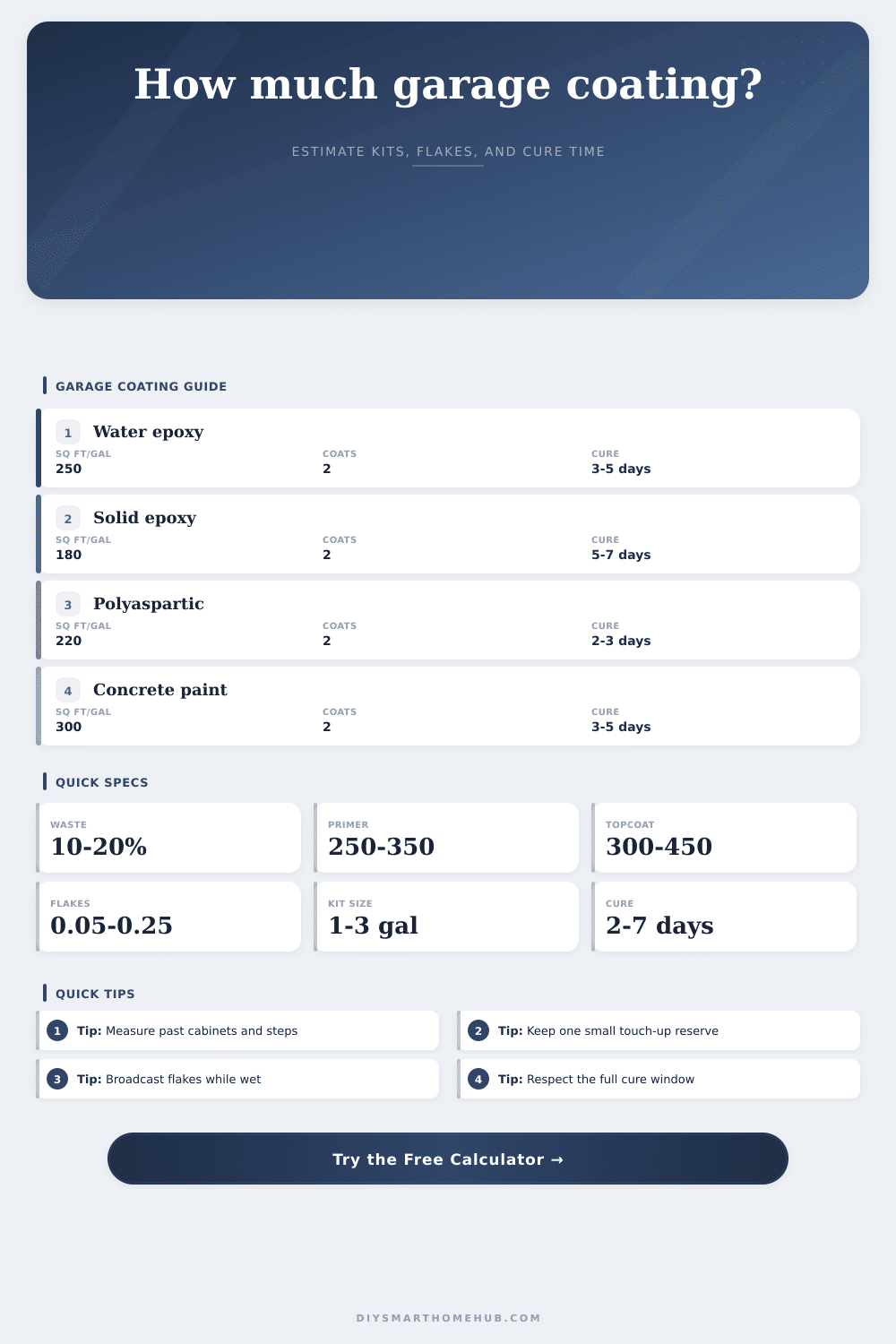
| Coating system | Typical coverage | Common coats | Cure window |
|---|---|---|---|
| Water-based epoxy | 200-300 sq ft/gal | 2 main coats | 24 hr light, 3-5 days full |
| 100% solids epoxy | 150-220 sq ft/gal | 1-2 build coats | 24-48 hr light, 5-7 days full |
| Polyaspartic | 180-260 sq ft/gal | 2 thin coats | 8-24 hr light, 2-3 days full |
| Concrete floor paint | 250-350 sq ft/gal | 2 coats | 24 hr light, 3-5 days full |
📊 Common garage scenarios
| Project | Area | Main gallons | Flakes at 0.10 lb/sq ft |
|---|---|---|---|
| One-car garage | 240 sq ft | 2.15 gal at 250 sq ft/gal | 27 lb with 12% waste |
| Two-car garage | 440 sq ft | 3.94 gal at 250 sq ft/gal | 49 lb with 12% waste |
| Three-car garage | 720 sq ft | 6.45 gal at 250 sq ft/gal | 81 lb with 12% waste |
| Workshop bay | 1,000 sq ft | 8.96 gal at 250 sq ft/gal | 112 lb with 12% waste |
🔧 Planning tips
The way I was taught it, you measure the Garage’s length and you measure its width. Multiply those two number to get total area. So you think that’s all math required to buy some paint.
Except concrete is not a piece of flat paper. Concrete cracks, breathes, and sucks up coating in all kind of ways. The formulas takes into account those variables, so you don’t have to guess. They will figure out waste, if you need primer, how dense the flakes are, and what kind of coating to use.
How to Calculate the Right Amount of Garage Floor Coating
Because once you run out of two part epoxy, you’re ruined. And you’ll end up paying delivery fees for a small emergency can weeks later. Too much? You’ve got a mess in your basement. This choice impact your materials so you’ll want to pick your coating system at the outset.
For budget jobs, water based epoxies is easy to use and coat about three hundred square feet per gallon. If you’re building something that needs a lot of protection (like 100% solids epoxy) then you can go with a heavier, longer-lasting coating but it cost more and covers less. When you change systems on the calculator, it will automatically update the number of gallons needed. It know heavy duty resins provide more protection, so they costs more per square foot. Pick the system that’s right for your stress level.
The other place most estimates fall apart is waste factors. You can enter a percentage into the tool to factor in waste. Standard garage slabs will be smooth. But older floors tend to be rough and even porous due to years of use. Running dry happens when you ignore that fact about rough concrete absorbing more product. Ten or twenty percent is a good number, not pessimistic, just realistic. This factors in corners and edges as well as spills along the way. And it allows for extra product for touch-ups as needed. I see this over and over, people think they’re saving money by not buying enough at first, only to pay extra for small cans delivered as emergencies arise down the road.
If you want some decorative flakes, it gets even more mathematical. The calculator will ask how many pounds per square foot you’d like to spread, and then it shows you how much more material you’ll need to get that coverage. You might want something very subtle, called light scatter. Or, you might want something with texture and no slip, which is a full broadcast that also conceals stains. That option use a lot more material. You just enter your desired density and it figure out exactly how many pounds of stuff you need. No more guessing about will twenty pounds be enough for my two car garage? The tool tells you precisely what you should of order so you don’t run out before you’re done broadcasting.
There are a few other variables to manage too like the cure time. Different systems will have varying cure times. For example, polyaspartic coatings will dry in a matter of hours. You might even be able to drive on them lightly after a few hours. Traditional epoxies may take days before they completely harden. Based off the system you chose, this calculates the approximate cure time. This tells you how long to wait before it’s safe to drive on or when you might be able to bring your car back into the garage (for instance, if you’re doing this over the weekend). If you don’t pay attention to the cure time, you’ll ruin your floor by trying to drive on the epoxy while it is still wet, which will leave permanent tire marks.
The page has a comparison table that shows side-by-side the coverage rates and how long each takes. The tradeoffs are made clear. Spending more gets you faster but using more stuff is generaly stronger and more expensive. It doesn’t tell you which one to choose. It tells you the numbers so you can make the choice with confidence. You can change the inputs to see how things will work out in terms of cost, and determine what’s right for your wallet.
The garage floor is a work surface. This is not a rush job but an accurate estimate because a garage floor is a work surface. Use the calculator to figure out exactly how much you need and purchase some overage. Respect the cure times so that this floor will last for years. Understanding what the numbers mean and measuring accuratley begins the process.