Evapotranspiration Watering Calculator
Estimate crop evapotranspiration, effective rainfall credit, net irrigation depth, gallons to apply, soil refill limits, and runtime from reference ETo, crop coefficient, area, efficiency, soil storage, root depth, and zone flow.
📌ET Watering Presets
Loaded preset: Cool Turf. This baseline models a common lawn zone with measured ETo, turf crop coefficient, moderate rainfall credit, and loam root-zone storage.
⚙Watering Inputs
📊Watering Method Comparison Grid
📋Reference Tables
Crop Coefficient Reference
| Plant profile | Kc | Typical root | Watering note |
|---|
Soil Holding Capacity
| Soil | Available water | Refill depth | Risk |
|---|
Irrigation Efficiency Ranges
| Method | Efficiency | Useful flow | Best match |
|---|
Preset Output Comparison
| Preset | Crop ET | Gallons | Runtime |
|---|
💡Calculation Notes
Most of us gardeners waters by guesswork or habit. When I see some dust on foliage, I run out and turn on the sprinkler. When the lawn seem dull, I give it an extra hour. Usually such treatment, based off slow visual clues that follow plant stress… Results in either crispy edges or drowned roots.
Plants will signal when they’re thirsty, but not until they’re already beginning to wilt; the soil retains moisture well past a dry-looking surface. The dynamics change because ET measures the atmospheric demand (the amount of water the sun and air are taking from the soil today) different than the plant’s distress. How much did it take away? Replace it. That’s when you consider the week-to-week amount of water lost by a standard grass surface in certain weather (called reference ETo). If it’s hot and humid and windy, more; if it’s cloudy but still dry and warm, more still.
Why Your Garden Needs Better Watering
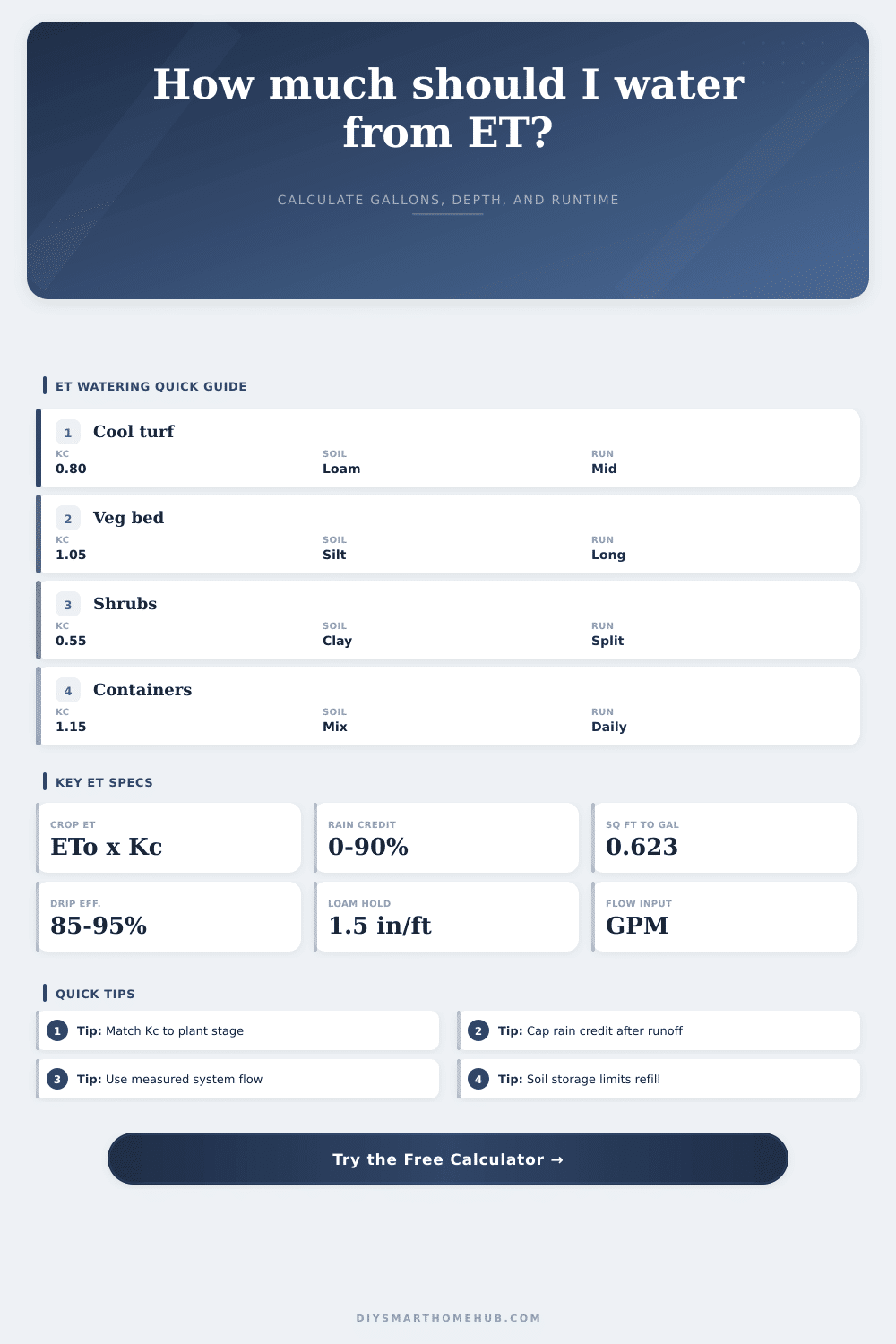
Your crops don’t lose water according to that base rate (which is why we’re talking about the crop coefficient). A vegetable bed in midseason might have a coefficient of one point zero five, meaning it lose slightly more water than reference grass due to its dense canopy and shallow roots. An area covered with cool-season turf might be at zero point eight, meaning: It loses less then the reference amount, thanks to how it grows.
That’s where the great majority of estimates go awry: We match up our actual plant stage to that coefficient. Active-growth lawn isn’t the same as dormant, for instance. The math gets trickier with rainfall, though not always in a favorable direction. One inch of precipitation in the past week doesn’t necessarily equal an inch that will soak into the root zone. If you have a sloped bed or a compacted-clay soil, heavy downpours often runs off rather than soaking in, which is not good for your irrigation planning.
The calculator (above) factors that in, too: You can set how much of the rainfall should be counted as usable, and limit it well below one hundred percent for spots where most of it run off. That amount is deducted from the total crop demand, leaving net irrigation required. That’s important, since most people mistakenly overwater immediately following a storm… And create ideal conditions for disease while wasting money.
The way you deliver that leftover water depends on your soil type. Clay retains a lot and slowly releases it to plant roots. Sand doesn’t hold much and drains quickly. The trick is not to provide more than the soil can safely absorbs at any time. You need to divide up the total net irrigation depth into smaller applications if the calculated amount is larger then the safe volume for the soil. For example, soaking a heavy-clay bed for too long will create an oxygen-free environment and suffocate its roots; flooding a sandy bed with lots of deep water simply moves the moisture beyond reach of the roots. By matching the needed depth against the soil’s storage capacity, the tool will help you see where that limit lies. When multiple short events would of been better than a single long soak.
The last friction point is simply about efficiency. No method delivers every gallon perfectly. Drip lines may have even pressure, but they can also gets clogged. Sprinklers lose water to evaporation and wind drift. An accurate estimate of their efficiency (often between 75 and 90 percent for common home systems) adjusts the runtime calculation accordingly. Otherwise you could program your timer just as the math says, and discover that twenty percent of the gallons never reached the roots. The soil is still dry.
Knowing those factors can help you turn watering into a job you do right, a job that’s about managing a reservoir underground, instead of just re-acting to what happens on top of the ground. With each season and each kind of soil, the numbers change, but the concept doesn’t: Gauge the need; take inventory of how much got away; fill up again, and don’t drown the thing in the process. Work less hard and more smart by getting every drop of water to go where it is meant to go, feeding the plant instead of running off or down your back.
You should of known that moderndays gardening requires precision. It can be comfortabley done if you use the right tools and avoid any luxuriously expensive mistakes or unnecessary furnitures.